Executive Summary
Schneider Electric’s Modicon Quantum PLC platform has been deployed in industrial and municipal water/wastewater treatment plants worldwide to deliver high-reliability programmable control and integration with supervisory systems. This case study examines how Quantum PLCs support process automation, distributed control, and system resilience in water treatment environments, highlighting technical configuration, operational role, and key outcomes.
Background
Water treatment plants, whether for municipal potable supply or industrial wastewater management, involve complex process sequences including influent screening, pumping, coagulation/flocculation, filtration, biological reaction control, and effluent discharge. Each of these stages requires reliable sensing, logic control, and actuator management to ensure water quality, regulatory compliance, and operational continuity. Programmable logic controllers (PLCs) serve as the backbone for field automation, interfacing with sensors, actuators, and higher-level supervisory control and data acquisition (SCADA) systems.
The Modicon Quantum series from Schneider Electric represents a high-performance PLC platform designed for large-scale applications with distributed I/O and redundancy capabilities. Quantum systems are commonly applied where high I/O counts, modular expansion, and long-term serviceability are priorities.
Technical Configuration in Water/Wastewater Plants
PLC Modules and Architecture
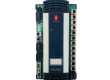
In a typical configuration, Quantum PLC modules are installed in redundant or distributed racks within the plant’s control room and remote MCC (Motor Control Center) locations. Remote I/O modules connect to field sensors and actuators (pumps, level switches, valves, flow meters, chemical dosing systems), minimizing long cable runs and localizing signal conditioning. Quantum CPUs manage real-time control logic, execute PID loops for continuous processes, and communicate with SCADA software via industrial protocols (e.g., Modbus/TCP, Ethernet/IP).
For example, in a sewage treatment control system delivered for the Ajman Sewage Treatment Plant, multiple redundant Quantum PLCs handled hundreds of digital and analog I/O points across critical processing units, ensuring fault tolerance in core process control.
Distributed Process Control
Quantum PLCs excel in distributed control where multiple subsystems must operate both independently and in coordination. Pumps for raw influent, aeration blowers for biological tanks, chemical dosing equipment, and effluent discharge valves each have distinct control programs and interlocks. Distributed I/O racks and communication networks allow the PLC program logic to process thousands of real-time signals, actuating outputs according to process conditions and safety constraints.
In many installations, analog modules gather measurements such as turbidity, pH, conductivity, and flow rate. These analog signals feed into PID control loops in the PLC logic, maintaining setpoints for chemical dosing and biological oxygen demand parameters.
Integration with SCADA and Overall Plant Automation
Quantum PLCs typically integrate with a plant’s SCADA layer. The SCADA system provides process visualization, alarming, historical data logging, and operator interfaces. The PLC network delivers control data to the SCADA host via high-speed industrial Ethernet, enabling operators to monitor process trends, override control modes, and respond to alarm conditions from a central control room.
This architecture—PLC for deterministic control, SCADA for supervisory oversight—supports real-time decision making, process optimization, and improved regulatory reporting.
Operational Benefits
Enhanced Reliability and Maintainability
Quantum PLCs are engineered for industrial use with hardware diagnostics, hot-swap module capability, and robust electrical protection. In continuous-operation environments like water plants, these features reduce unplanned downtime and facilitate scheduled maintenance with minimal impact on treatment performance. The modular design allows spare parts stocking and streamlined replacement.
Scalability and Future-Proofing
Many water treatment facilities evolve over time, expanding capacity or adding advanced process steps. The modular I/O nature of Quantum PLCs and support for standard programming languages (IEC 61131-3) makes it straightforward to scale control logic and hardware without wholesale system replacement.
Regulatory Compliance and Data Management
With integration into SCADA databases, treatment plants can maintain detailed process logs for effluent quality and operational performance. This data supports compliance with environmental discharge permits, internal performance reviews, and proactive maintenance programs.
Challenges and Considerations
Legacy System Integration
Some older plants may still operate legacy Quantum hardware or earlier Modicon platforms. Migrating to newer systems requires careful planning to preserve logic functionality and minimize commissioning risk. Documentation and conversion tools are vital where legacy programs must be understood and ported.
Cybersecurity and Network Protection
PLC systems in critical infrastructure like water treatment require robust network segmentation and security practices. While modern Quantum and EcoStruxure architectures support secure communication protocols, plant operators must implement comprehensive cybersecurity measures to protect control networks and remote access points. Industry experience has shown that unsecured PLC interfaces can be a vector for unauthorized command injection unless proper safeguards are in place.
Conclusion
Schneider Electric’s Modicon Quantum PLC modules remain a cornerstone in automated water and wastewater treatment control systems where reliability, scalability, and distributed control are paramount. By linking field I/O with robust logic execution and seamless integration into SCADA systems, Quantum platforms enable plants to achieve stable process control, efficient operations, and compliance with quality and regulatory standards. The technology’s modular design supports phased upgrades and long service life, making it a prudent choice for mission-critical treatment facilities.