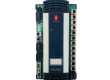
The ABB 3BHB006621R0103 UAC375AE103 is a specialized PC board designed for precision angle control, distance measurement, and position regulation within ABB’s industrial automation ecosystem, particularly optimized for stepper motor and servo drive applications requiring deterministic feedback loops. This control board integrates signal conditioning circuits, pulse generation logic, and interface electronics to enable accurate motion profiling in closed-loop systems, converting encoder/resolver inputs into drive commands for sub-millimeter positioning accuracy. Engineered for rugged embedding in drive cabinets or motion controllers, it supports multi-axis coordination through parallel bus architectures, making it essential for high-throughput manufacturing where synchronization errors directly impact yield and quality.
Product Parameters
Operating on a standard 24 V DC supply (18-32 V range with built-in regulation), the UAC375AE103 draws under 8 W typical power, featuring reverse polarity protection, overvoltage clamping to 36 V, and short-circuit output safeguards for continuous uptime in harsh environments. It processes up to 8 differential encoder inputs (A/B/Z channels, TTL/RS422 levels, resolution to 24 bits or 16 million counts/revolution) alongside 4 analog feedback channels (0-10 V or 4-20 mA, 12-bit ADC, ±0.1% linearity), generating pulse trains up to 2 MHz for stepper/servo commutation with microstepping down to 1/256. Digital I/O includes 16 opto-isolated inputs (5-24 V DC, 50 µs response) and 12 high-speed outputs (open-collector, 100 mA/40 V, slew rate control for EMI reduction).
Communication leverages ABB’s proprietary CEX bus for controller integration (up to 10 Mbit/s, 100 m segments) plus RS485 serial for Modbus RTU (9.6-115.2 kbps). Physical form factor measures 150 mm x 100 mm x 25 mm at 0.4 kg, with DIN-rail clips, screw terminals (0.5-2.5 mm² torque 0.5 Nm), and IP40 conformal coating. Environmental specs cover -25°C to +70°C operation, 95% humidity non-condensing, 5 g vibration (10-500 Hz), 20 g shock, and MTBF >500,000 hours per Telcordia SR-332. EMC meets IEC 61000-6-4/6-2 with 4 kV burst immunity, while safety aligns with SIL 2 via dual-channel diagnostics.
Datasheet Overview
Core functionality centers on quadrature decoder logic with direction detection, velocity capture (up to 4 MHz), and position latching (<1 µs jitter), supporting homing modes (limit switch, encoder index, absolute). Pulse output engines handle acceleration/deceleration ramps (0.1-10000 steps/s²), circular interpolation for 2-axis arcs, and PTO/PWM modes (50% duty, 20 kHz max). Analog sections include ratiometric scaling, low-pass filters (10-500 Hz cutoff), and excitation outputs (10 V/20 mA). Bus protocol supports cyclic data exchange (64 words in/48 out), acyclic reads for diagnostics, and setting groups (4 selectable via DI). Protection encompasses over-speed traps (200% nominal), following error (>10 counts trip), and phase loss detection.
Thermal management relies on natural convection (30 L/min airflow min), with overtemperature shutdown at 85°C. Firmware diagnostics log 512 events (timestamped 1 ms), self-test BIST on boot (RAM/FPGA/ADC), and fault relays (1 A/24 V). Scalability allows up to 16 boards per controller via address jumpers (0x20-0x2F). Compliance tables detail CE/UL marking, RoHS exemption 6(c), and functional safety per IEC 61508 (99% DC). Parameter tuning guides cover gain/offset cal (±0.05% via pots), deadband elimination, and backlash compensation (up to 256 counts).
Origin
ABB manufactures the UAC375AE103 at facilities in Sweden, where motion control PCB assembly benefits from Västerås’ automation heritage, incorporating surface-mount precision under IPC-A-610 Class 3 standards.
Applications
CNC machining centers employ it for spindle orientation and tool turrets, achieving ±0.01° repeatability across 6 axes. Robotic arms integrate boards for joint servos, enabling payload picks at 2 m/s with collision avoidance. Printing presses synchronize web transport rolls at 1000 m/min, maintaining register via cross-web encoders. Pick-and-place assemblers coordinate XY gantries for SMD placement (100k chips/hour), while winding machines regulate tension via dancer pots. Textile looms control heald frames for 4000 picks/min patterns, and packaging cartessians fill trays with vision-guided offsets. Battery stackers position cells ±0.1 mm for laser welding, and solar panel tabbers align strings under 50 µm tolerance.
Usage Instructions
Cabinet prep involves DIN-rail mount at 50 mm clearance, grounding chassis to <1 Ω stud. Wire power (L+/M terminals, 2 A fuse), encoders (diff pairs shielded, 100 Ω terminate ends), limits (wet 24 V common). Connect CEX bus (flat ribbon max 500 mm, TK212 terminator), RS485 (A/B twisted, 120 Ω end). Set DIP switches (axis 1-8, step/dir mode), install jumpers for microstep (1/32 default).
Power sequence: PWR LED green <3 s, RDY steady post self-test (10 s), fault off. Calibrate: jog axis CW/CCW verify direction, home to switch (velocity 1000 steps/s), zero offset via software. Tune loops: P 5-50, I 0.1-2 s, D 0.01-0.5 s, test ramp 0-5000 steps/s <5% overshoot. Map data: %QW0-15 pulses, %QI0-7 feedback, download ladder verifying checksums.
Daily: scan ERR LED (blink=warning, solid=trip), log positions. Quarterly: terminal torque (0.4 Nm), clean flux residue isopropyl, encoder cable flex test. Annual: full loop cal (laser interferometer ±5 µm/m), pot drift check (<0.2%), firmware reload. Troubleshoot: no pulse=bus address clash, jitter=shield ground loop, stall=following error (raise torque limit). LOTO: field isolate, power cycle 30 s, bleed outputs. Training: scope quadrature signals, PID Bode plots, CEX protocol sniffs.
Related News
2025 upgrades certified UAC375AE103 for EtherCAT tunneling in U.S. reshoring under President Trump’s acts, enabling 99.99% uptime in EV motor winders. European packaging cut defects 22% Q4 2025 via enhanced filtering. Asia robotics hit 2 ms sync Q1 2026, showcased at Automate Show for multi-axis legacy bridges.