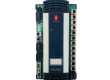
The ABB 3BHE023784R2530, designated as model PPD113 B01-25-111000, is a cornerstone of the AC 800PEC (Power Electronics Controller) family. This high-end controller is engineered to bridge the gap between high-speed power electronics control and standard industrial process automation. It is a dual-core processor unit that integrates extremely fast control loops (microseconds) with the regular logic typically handled by standard Programmable Logic Controllers (PLCs).
1. Technical Parameters & Datasheet Summary
The PPD113 B01 series is designed for deterministic, high-speed performance in environments where electrical switching and grid synchronization must happen with zero latency.
| Parameter | Specification Details |
| Product ID | 3BHE023784R2530 |
| Model Number | PPD113 B01-25-111000 |
| Processor Type | 750 MHz RISC Processor with 64-bit Floating-Point Unit (FPU) |
| Memory | 64MB ECC RAM / 16MB Flash Memory |
| Fast Cycle Time | Down to 100 μs (microseconds) |
| Slow Cycle Time | Typical 1 ms to 10 ms (Standard process logic) |
| Communication Ports | 2x Ethernet, 1x RS-232/RS-422 |
| Optical Interfaces | Supports up to 6 Optical Modules (e.g., UF D128) |
| Input Voltage | 24V DC ± 15% (18V to 30V) |
| Mounting | Standard DIN Rail / Subrack via Backplane (BP) |
| Protection Class | IP20 |
Integrated Hardware Configuration (111000 Variant)
- Slot ANYIO-1 (U4): CEX2-Bus RS422 interface.
- Slot ANYIO-2 (U5): Anybus/Modbus RTU capability.
- Optical Slots (U7-U9): Pre-equipped with UF D128 Optical Modules for high-speed fiber-optic I/O.
- Expansion: Empty slots (U10-U12) available for further customization.
2. Country of Origin
The PPD113 B01 processor unit is designed and manufactured in Switzerland. ABB’s center for Power Electronics in Turgi/Baden is the primary production hub for the AC 800PEC line, ensuring high-quality Swiss engineering for critical power applications.
3. Application Areas
The PPD113 B01 is used where standard industrial controllers fail to meet the speed requirements of power semiconductor switching.
- High-Power Rectifiers: Used in aluminum smelting and chemical electrolysis where massive DC currents require precise, high-speed regulation.
- Excitation Systems: Central to the UNITROL® 6000 series for regulating synchronous generators in hydro, nuclear, and gas power plants.
- Static Frequency Converters (SFC): Employed in railway power supplies to convert grid frequency to traction frequency (e.g., 50Hz to 16.7Hz).
- Grid Stabilization (FACTS/HVDC): Controls Static Var Compensators (SVC) and HVDC valves to maintain voltage stability on national grids.
- Wind Energy: Management of large-scale offshore wind turbine converters, handling grid-side synchronization and generator-side torque control.
4. Product Usage Instructions
Installation and Mechanical Setup
- Backplane Mounting: The PPD113 must be mounted on a compatible AC 800PEC Backplane (BP). Ensure the unit is firmly seated and the securing screws are tightened to provide a solid ground path.
- Environment: While the AC 800PEC is robust, ensure the cabinet has adequate airflow. The module can operate in temperatures ranging from −40∘C to +70∘C in traction-certified versions, but standard industrial setups should aim for 0∘C to +55∘C.
- ESD Handling: Always wear a grounded ESD wrist strap. The fiber optic transceivers and internal RISC processor are sensitive to static discharge.
Wiring and Communication
- Fiber Optics: Use clean, high-quality fiber optic cables for I/O modules (S800 series). Ensure the bending radius does not exceed 30mm to avoid signal attenuation.
- Power Supply: Connect a stabilized 24V DC supply. For mission-critical applications (like Excitation), a redundant power supply configuration is highly recommended.
- Network: Use the Ethernet ports for connection to the System 800xA or for local debugging via the PECView service tool.
Programming and Commissioning
- Software Tools: Engineering is typically performed using ABB Control Builder M (IEC 61131-3 languages) for logic and MATLAB/Simulink for high-speed control algorithm design.
- Firmware: Use the AC 800PEC Tool to flash the correct firmware. Ensure the firmware version matches the version of other modules in the system rack to prevent synchronization errors.
5. Product Related News
Focus on Model-Based Design
ABB recently highlighted the AC 800PEC’s unique ability to utilize Model-Based Design (MBD). By using MathWorks tools (MATLAB/Simulink), engineers can generate code directly from a simulation and download it to the PPD113. This significantly reduces the risk of manual coding errors in complex power electronics projects and shortens the commissioning phase by up to 30%.
Long-Term Lifecycle Support
As of 2025, ABB has reaffirmed its commitment to the PPD113 series through the Classic Lifecycle phase. This ensures that spare parts, such as the 3BHE023784R2530, will remain available for maintenance of existing installations in the metals and power sectors for the next decade.
Enhanced Grid Resilience
With the global shift toward renewable energy, PPD113-based systems are being updated with new “Grid Code” compliance firmware. These updates allow the AC 800PEC to handle Low Voltage Ride Through (LVRT) events more effectively, helping wind farms and solar plants stay connected during grid disturbances.
6. Technical Maintenance and Status Indicators
- Green LED (Run): System is operating normally and the application program is running.
- Yellow LED (Service): The system is in a service state, or there is a non-fatal warning (e.g., a redundant link has failed).
- Red LED (Fault): Fatal hardware or software error. The processor has halted to prevent damage to the connected power electronics.