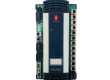
The ABB 70EA02A-ES is a specialized, high-integrity signal processing module designed for use within ABB’s legacy and evolved Distributed Control Systems (DCS). Specifically engineered for dual-conductor transmission environments, this module serves as a critical interface between field instrumentation and the central control architecture. It is primarily tasked with the acquisition and conditioning of signals from various sensors, ensuring that data transmitted over long distances remains accurate, noise-free, and reliable for process control logic.
Product Introduction
In the world of industrial automation, the integrity of signal transmission is paramount. The 70EA02A-ES is a member of the Procontrol or Advant-related hardware families, designed to handle “Dual Conductor” configurations. This means the module is optimized to interface with 2-wire transmitters where both power and signal are carried over the same pair of conductors.
The 70EA02A-ES is recognized for its robust galvanic isolation and its ability to filter out electromagnetic interference (EMI) that often plagues industrial plants. By providing a stable interface for analog inputs, it ensures that the DCS receives a high-fidelity representation of field variables such as pressure, temperature, flow, or level.
Product Parameters (Datasheet)
| Technical Parameter | Specification / Detail |
| Model Number | 70EA02A-ES |
| Module Type | Analog Input / Transmission Interface |
| Transmission Mode | Dual Conductor (2-wire) |
| Input Channels | Multi-channel architecture (typically 4 or 8) |
| Signal Range | 0/4-20 mA, 0-10V DC (Software/Jumper selectable) |
| A/D Conversion | 12-bit to 16-bit resolution (depending on system rev) |
| Galvanic Isolation | 1500V AC (Input to Backplane) |
| Input Impedance | Typically 250 Ohms for current loops |
| Power Supply | 24V DC / 48V DC (System bus powered) |
| Diagnostic Support | Wire-break detection, short-circuit protection |
| Operating Temperature | 0°C to +60°C |
Country of Origin
- Origin: Germany / Switzerland (ABB Power Automation Division)
Application Areas
The 70EA02A-ES is found in heavy-duty industrial environments where signal reliability is a safety and productivity requirement. Key sectors include:
- Thermal Power Plants: Monitoring steam pressure and water levels in boilers where high electromagnetic noise from large turbines and motors is present.
- Oil and Gas Refineries: Interfacing with pressure transmitters in hazardous areas where long cable runs between the field and the control room are common.
- Chemical Processing: Precise monitoring of reactor temperatures where 2-wire RTD or Thermocouple transmitters are utilized.
- Water and Wastewater: Managing level sensors in remote pumping stations integrated into a centralized DCS.
- Nuclear Power: Used in non-safety critical balance-of-plant systems where high-availability signal acquisition is required.
Product Technical Description
The technical excellence of the 70EA02A-ES lies in its signal conditioning stage. In a dual-conductor transmission, the module must provide a stable excitation voltage to the field transmitter while simultaneously sensing the minute changes in current (4-20 mA) that represent the process variable.
The module employs active filtering to remove 50/60 Hz line noise. Additionally, the “ES” designation typically refers to an “Extended Specification” or “Evolutionary Series” version, featuring enhanced diagnostics. The onboard microprocessor performs continuous self-checks, verifying the integrity of the Analog-to-Digital Converter (ADC) and the health of the internal reference voltage. If a discrepancy is detected, the module signals a system-level alarm to prevent the DCS from making control decisions based on faulty data.
Product Usage Instructions
1. Mounting and Installation
The 70EA02A-ES is designed for rack-mounting.
- Backplane Connection: Align the module with the guide rails of the DCS subrack. Push until the DIN 41612 connectors are fully engaged with the backplane.
- Grounding: Ensure the rack’s earthing bar is connected to a clean instrument earth. The module relies on the backplane for primary shielding.
2. Field Wiring
- Dual Conductor Connection: Connect the field transmitter (+) to the module’s excitation terminal and the (-) to the signal return terminal.
- Shielding: Instrument cable shields should be grounded at the module end only (cabinet side) to avoid ground loops that can induce signal errors.
3. Software Configuration
- Point Mapping: Within the DCS engineering tool (e.g., Composer or Control Builder), assign the module’s physical slot and channel to a specific tag name.
- Range Calibration: Define the zero and span values (e.g., 4mA = 0 Bar, 20mA = 100 Bar). The 70EA02A-ES supports linear, square root (for flow), and custom linearization curves.
4. Maintenance
- Calibration Check: Annual verification using a precision current source is recommended to ensure the ADC has not drifted.
- Hot-Swap: Most versions of this module support hot-swapping. However, ensure the control loop is in “Manual” mode before pulling the module to prevent process upsets.
Product Related News
In recent years, ABB has focused on the “Evolution without Obsolescence” program. The 70EA02A-ES has been a highlight of this strategy. While many competitors force customers to replace entire racks, ABB has released updated versions of the 70EA02A-ES that are physically compatible with 20-year-old Procontrol racks but feature modern, high-accuracy components.
Recent industrial reports indicate that these modules are being integrated into “Industrial Internet of Things” (IIoT) frameworks via HART-over-DCS upgrades. By allowing digital data to ride over the analog dual-conductor signal, plants are now extracting additional diagnostic data from old field sensors through the 70EA02A-ES interface.
Product Technical (Special Considerations)
A critical feature of the 70EA02A-ES is its behavior during fault conditions. It is designed with “Fail-Safe” logic; if the dual-conductor loop is severed, the module will drive the signal to a “downscale” value (typically < 3.6 mA) or an “upscale” value (> 21 mA). This allows the DCS logic to immediately distinguish between a low process value and a hardware failure. Furthermore, the module includes transient voltage suppressors (TVS) to protect internal circuitry from lightning-induced surges on field cables.
Product Q&A (Common Questions)
Q: Can the 70EA02A-ES support 3-wire or 4-wire transmitters? A: The module is optimized for dual-conductor (2-wire) loops where the module provides the power. For 4-wire transmitters (externally powered), specific wiring changes or a different module variant (like the 70EA01) may be required to prevent voltage conflicts.
Q: What does the “ES” suffix specifically indicate? A: In ABB’s nomenclature, “ES” often stands for “Electronic Switching” or “Enhanced Series,” indicating improved diagnostic bits that can be read by the CPU to identify internal module faults more precisely than standard versions.
Q: Is there an onboard fuse for each channel? A: Most 70EA series modules use electronic current-limiting circuits rather than physical fuses. This allows the module to recover automatically once a field short-circuit is removed.
Q: Can this module be used with HART-compatible sensors? A: The 70EA02A-ES is primarily an analog module. While it will pass the 4-20mA signal from a HART sensor, it may strip away the high-frequency HART digital signal unless used with a specialized HART bypass or a modern DCS interface that supports digital overlay.
Q: How do I identify a channel failure? A: Check the front panel. Usually, an “F” or “Fault” LED will illuminate. In the DCS software, the quality bit for that specific channel will change from “Good” to “Bad” or “Uncertain.”
Summary Table: Module Variants and Compatibility
| Module Variant | Transmission Type | Primary Use Case |
| 70EA02A-ES | Dual Conductor (2-wire) | Standard 4-20mA field loops |
| 70EA01 | Non-powered Analog | Externally powered 4-wire transmitters |
| 70EA03 | RTD/Thermocouple | Direct temperature sensor interface |