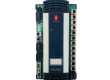
The ABB 89NG08 is a high-availability power supply module specifically engineered for the ABB Distributed Control System (DCS) environment. As a critical infrastructure component, it is designed to provide stabilized, low-noise DC power to the system’s backplane, processing units, and I/O modules, ensuring the continuous operation of industrial automation processes.
Product Introduction
In the realm of industrial automation, the reliability of a control system is only as strong as its power source. The 89NG08 serves as the primary energy conversion unit for ABB DCS racks. It transforms industrial-grade input power into the precise voltages required by sensitive electronic components.
The module is built with industrial-grade redundancy logic, allowing it to function in parallel with other power modules to ensure that a single point of failure does not result in a total system shutdown. Its robust mechanical design and advanced thermal management make it suitable for 24/7 operation in harsh environments, such as chemical plants, refineries, and power generation facilities.
Product Parameters (Datasheet)
The following specifications define the electrical and environmental limits of the 89NG08 module:
| Category | Parameter | Specification |
| Model | 89NG08 | Power Supply / Power Module |
| Input Voltage (AC) | 110V / 230V AC | Auto-ranging or switchable (47–63 Hz) |
| Input Voltage (DC) | 110V / 220V DC | Supported in specific DC-input variants |
| Output Voltage | +24 VDC | Primary system power |
| Output Current | 10A – 20A | Depending on specific load configuration |
| Power Rating | 480W – 500W | Maximum continuous output |
| Efficiency | > 88% | At nominal load and voltage |
| Isolation | 3 kV AC | Input to Output galvanic isolation |
| Protection | OVP, OCP, OTP | Over-voltage, Over-current, Over-temperature |
| Dimensions | Standard Slot Width | Occupies dedicated power slots in the subrack |
| Weight | Approx. 1.5 kg | Ruggedized metallic housing |
Country of Origin
- Primary Origin: Germany / Switzerland
ABB’s power modules are manufactured in high-precision European facilities that adhere to strict ISO 9001 quality standards and CE/UL safety certifications.
Application Areas
The 89NG08 is deployed globally across sectors where downtime is economically catastrophic or safety-critical:
- Oil & Gas: Powering Emergency Shutdown (ESD) systems and process control in offshore platforms and refineries.
- Power Generation: Providing stable logic power for turbine control and boiler management systems.
- Chemical Processing: Ensuring the continuous operation of batch reactors and safety interlocks.
- Pulp & Paper: Managing large-scale automated machinery and conveyor systems.
- Water Treatment: Reliable power for decentralized pumping stations and filtration controls.
Product Technical Description
The 89NG08 utilizes a Switch-Mode Power Supply (SMPS) topology. Unlike linear power supplies, the SMPS design offers high efficiency and reduced heat dissipation.
- Redundancy Logic: The module includes internal decoupling diodes. This allows multiple 89NG08 modules to be connected to the same bus. If one module experiences an internal short or loss of input, the internal diodes prevent the fault from pulling down the entire DC bus, allowing the remaining “healthy” modules to take over the load instantly.
- Filtering and Regulation: Industrial environments are plagued by electromagnetic interference (EMI). The 89NG08 features multi-stage EMI filtering on the input side to prevent grid noise from affecting the DCS logic. On the output side, high-frequency ripples are suppressed to millivolt levels to ensure the accuracy of analog-to-digital conversions in I/O modules.
- Thermal Management: The module is designed for natural convection cooling within a standard cabinet. The internal heat sinks are strategically placed to dissipate heat away from electrolytic capacitors, thereby extending the module’s mean time between failures (MTBF).
Product Instructions for Use
1. Installation and Mounting
The 89NG08 is designed for rack integration.
- Ensure the rack power is disconnected before insertion.
- Align the module with the guide rails in the dedicated power supply section (usually the far left or far right of the rack).
- Push the module firmly until the backplane connectors are fully engaged.
- Secure the module using the front-panel captive screws to ensure a solid ground connection.
2. Wiring
- Input: Connect the AC or DC source to the designated terminals. Use ferruled wires to prevent stray strands from causing short circuits.
- Grounding: The module frame must be connected to the system’s safety earth. Proper grounding is essential for the effectiveness of the internal EMI filters.
3. Commissioning
- Apply input power and observe the “Power OK” LED.
- Measure the output voltage at the test points (if available) to ensure it is within the 23.8V – 24.2V DC range.
- Check the “Fault” LED; if illuminated, immediately check for downstream short circuits.
4. Maintenance
- Periodically check for dust accumulation on the ventilation slots.
- In redundant systems, perform a “load swap” test annually by temporarily disconnecting one supply to ensure the partner module can handle the full load.
Product Related News
- Increased Demand for Grid Stability: With the rise of renewable energy integration, ABB has highlighted the 89NG08’s ability to handle the “dirty power” and frequency fluctuations often found in modern microgrids.
- Lifecycle Status: As part of ABB’s commitment to sustainability, the 89NG08 has entered a phase of long-term support, ensuring that plants running older DCS architectures can still source genuine replacement parts to avoid expensive system migrations.
- Enhanced Reliability Standards: Recent internal testing has shown the 89NG08 exceeding its original MTBF ratings in high-humidity tropical environments, reinforcing its position as a “fit-and-forget” component.
Common Problems Q&A
Q: Can I mix an 89NG08 with a different power module model in the same rack? A: It is highly discouraged. For proper load sharing and redundancy timing, all modules on the same DC bus should be of the same model and revision. Mixing different modules can lead to unequal current distribution and premature failure.
Q: What does a flashing yellow LED signify? A: Typically, a flashing yellow LED indicates an “Overload” or “Current Limit” condition. The module is still providing power but is operating at its maximum thermal or electrical threshold. You should reduce the load or add an additional power module for redundancy.
Q: How often should the module be replaced? A: While the 89NG08 is designed for a service life of over 10 years, it is recommended to replace it after 8–12 years of continuous operation, as electrolytic capacitors naturally degrade over time, which may increase output ripple.
Q: Is the module hot-swappable? A: Yes, in a redundant configuration, you can replace a failed 89NG08 while the system is live. However, you must ensure that the remaining power module(s) have sufficient capacity to handle the total system load during the swap.
Q: Why is my module overheating despite a light load? A: Check the cabinet’s air filters and fan units. If the ambient temperature inside the cabinet exceeds 60°C, the module will struggle to dissipate heat. Ensure there is at least 50mm of clearance above and below the rack for airflow.
Recommended Similar/Associated Models
- ABB 89NG05: A lower-wattage variant for smaller I/O clusters.
- ABB 89NG09: A high-output version for extended racks.
- ABB SD822: A common 24V/10A power supply used in S800 I/O systems.
- ABB SD832: A 24V/20A redundant power supply module.
- ABB PM866: A processor module that often draws power from the 89NG08.