- Model: ABB DSAI130D 3BSE003127R1
- Brand: ABB (Sweden / Switzerland)
- Series: Advant / I/O Analog Input Board
- Core Function: Precision analog signal acquisition for industrial control systems
- Type: Analog Input Board (AI Board)
- Key Specs: 16 differential inputs ±10 V / ±10 mA range 12-bit resolution
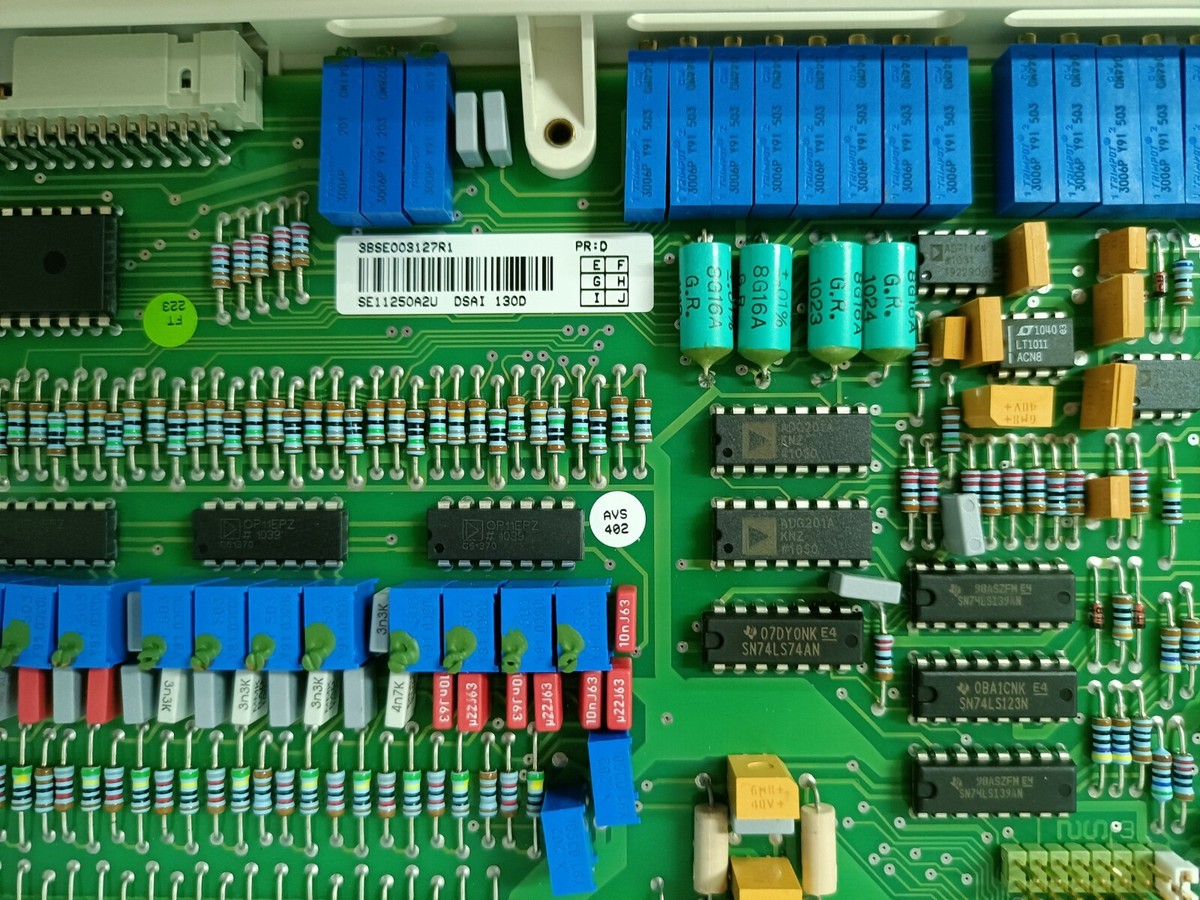
DSAI130D 3BSE003127R1
Key Technical Specifications
- Channels: 16 differential analog input channels
- Input Ranges: ±10 V and ±10 mA selectable inputs
- Resolution: 12-bit A/D conversion accuracy
- Measurement Accuracy: ±0.03 % of range typical
- Conversion Time: ~20 ms per update cycle
- Filter Options: Four selectable cut-off frequencies (10 Hz, 30 Hz, 100 Hz, 300 Hz)
- Input Configuration: Differential inputs for noise rejection
- Dimensions: ~365 mm × 20 mm × 261 mm
- Weight: ~0.475 kg
- Environmental: RoHS compliant (Directive 2011/65/EU)
- Mounting: Rack-mounted analog I/O board for ABB control systems
Part 4: Installation & Configuration Guide
Replacing an analog input board like ABB DSAI130D 3BSE003127R1 requires careful preparation to avoid measurement drift, signal inversion, or unplanned system behavior. This board is typically part of the analog I/O subsystem in legacy ABB DCS or Advant control racks.
Phase 1: Pre-Installation (Estimated 10 minutes)
⚠️ Safety First
- Inform operations and schedule a maintenance window.
- Bring the associated process to a controlled stop if live signals may affect safety.
- Shut down the control rack power and any redundant supplies.
- Wait at least 5 minutes for internal circuitry to discharge.
Tools Required
- Anti-static wrist strap and static-safe mat
- Screwdrivers (PH and flat)
- Digital multimeter (e.g., Fluke for signal validation)
- Labels and a sharp marker
- Smartphone to capture wiring configuration
Documentation Tasks
- Export the current DCS configuration to a file if supported.
- Photograph:
- Terminal wiring positions
- Backplane slot position
- Any filter or jumper settings
Photos avoid miswiring during reinstallation.
Phase 2: Removal of Old Board (5–8 minutes)
- Remove the panel cover or rack door.
- Label each field analog cable at the terminal block.
- Loosen each terminal screw (counter-clockwise).
- Carefully extract the old board from the rack.
- Inspect the backplane edge connector for bent pins or corrosion.
⚠️ Dust and oxidation can affect signal integrity — inspect and clean if necessary.
Phase 3: Installation of New Board (10–12 minutes)
- Ground yourself with ESD protection.
- Confirm the replacement board is ABB DSAI130D 3BSE003127R1.
- Insert the board into the rack until fully seated.
- Reconnect field wiring per labeled positions.
- Tighten screws to firm, consistent torque.
Self-check:
- Correct slot location
- All wires restored
- No loose conductors
- Filter options match original settings
Phase 4: Power-On & Functional Testing (10–15 minutes)
Before energizing:
- Confirm supply power is within specification for the control rack.
- Check for shorts (multimeter reading >10 kΩ between + and – rails).
Power sequence:
- Energize the rack control power.
- Observe any LEDs or status indicators on board.
- Connect to engineering workstation and verify module recognition.
- Check analog input live values against known sources.
Functional test:
- Use a calibrator to inject 4–20 mA or 0-10 V signals on a few channels.
- Confirm scaling and linearity in the control system software.
- Run for at least 15-30 minutes with varying signals to ensure stability.
If readings are noisy or inconsistent, review wiring shielding and filter settings.
Part 5: Customer Cases & Industry Applications
Case 1: Refinery Alarm Precision Fix
Situation:
A major refinery’s process control system exhibited unstable level measurement readings on distillation feeds due to aging analog inputs.
Task:
Operators experienced sporadic alarms at low levels, hindering flow control and throughput.
Action:
We provided a Brand New Surplus ABB DSAI130D 3BSE003127R1 board after verifying wiring and filter options matched original installation.
Result:
Once replaced and tested with signal injectors, data stability improved immediately. Normal control operation returned within the same shift with no reprogramming needed.
Case 2: Power Plant Pre-Season Preparedness
Situation:
A utility plant preparing for peak load season audited spare parts and found their analog I/O boards lacked redundancy.
Task:
Expected lead time for new modules was variable and long.
Action:
We recommended stocking one DSAI130D board as min buffer stock and increasing to three units as max for planned seasonal risk.
Result:
When a channel drift issue surfaced weeks later, replacement was immediate — avoiding a potential 6-hour outage.
Case 3: Petrochemical Plant Integration
Situation:
A petrochemical planner needed to expand analog measurement loops on legacy DCS before a revamp project.
Task:
OEM analog boards were difficult to source with short lead times.
Action:
We supplied original ABB analog input boards, and during technical onboarding, we mapped filter time settings for specific loops (pressure, temperature), ensuring consistent performance.
Result:
System expansion completed on schedule with reliable analog data feed into control logic.
Part 6: Frequently Asked Questions (FAQ)
Q1: Is the ABB DSAI130D 3BSE003127R1 still in production?
A: This analog input board is typically a legacy part for older ABB racks. Confirm production status with your OEM distributor — many sites treat it as end-of-life spare.
Q2: Are these units new or refurbished?
A: Ours are Brand New Surplus, meaning original new boards from factory inventory, fully tested and warranty-backed. Not refurbished or repaired.
Q3: Does this board support hot swapping?
A: Hot swap capability depends on the specific rack and control system. When in doubt, power down the analog I/O bay before replacing to avoid signal glitches.
Q4: What signals can it measure?
A: The board accepts ±10 V and ±10 mA differential inputs. With external resistors or conditioning, 4-20 mA loops are commonly accommodated.
Q5: How should I plan spare inventory?
A: For critical analog measurement loops:
- Min buffer stock: 1 board
- Max stock: 2–3 units depending on failure history and lead time variability
Early procurement reduces emergency freight and downtime risk.
Q6: Why is this board important for DCS performance?
A: Analog input boards impact process signal fidelity — poor boards can introduce noise, drift, or miscalculation in control loops. Strategic stocking improves uptime and measurement confidence.