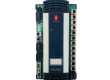
The ABB GFD233A, identified by part number 3BHE022294R0101, serves as a versatile PLCs/Machine Control module within ABB’s industrial automation portfolio, particularly optimized for high-performance logic execution and real-time machine coordination. This compact control unit integrates advanced processing capabilities with modular I/O expansion, enabling precise sequencing, motion control, and data acquisition in dynamic production environments. Featuring a rugged design for harsh industrial settings, it supports standard programming languages like Ladder Logic and Function Block Diagrams, facilitating seamless integration into ABB’s DCS frameworks or standalone machine centers where response times under 10 ms are critical for throughput and quality.
Product Parameters
The GFD233A operates on a 24 V DC power supply (19.2-30 V range with ±10% tolerance), consuming approximately 10 W typical power while incorporating reverse polarity protection and overvoltage clamping for reliable operation in fluctuating grid conditions. It provides up to 32 discrete digital inputs (24 V DC, 5-30 V threshold, 10 ms response) and 16 analog inputs (4-20 mA or 0-10 V, 16-bit resolution, >10 MΩ impedance), alongside configurable digital outputs (relay or transistor types rated 2 A/24 V DC) and analog outputs for precise actuator drive. Communication interfaces include PROFIBUS DP, PROFINET, Modbus RTU/TCP, and Ethernet ports supporting baud rates up to 12 Mbps, with real-time Ethernet cycle times below 1 ms for synchronized motion.
Physical dimensions measure 16 cm x 16 cm x 12 cm at 0.8 kg weight, suitable for DIN-rail or rack mounting with IP20 protection against dust and accidental contact. Environmental ratings cover -20°C to +70°C operating temperature, -40°C to +85°C storage, 5-95% humidity non-condensing, vibration tolerance to 5 g/10-500 Hz, and shock resistance to 15 g per IEC 60068 standards. Processing power delivers high-speed logic scans (up to 1 ms for 1000 rungs), floating-point math at 0.5 MFLOPS, and multitasking for 500+ PID loops with accuracy ±0.1% full scale. Memory includes 32 MB RAM/16 MB flash (expandable via SD slot), supporting 1024 event buffers and user force tables for 4096 variables. EMC compliance meets IEC 61000-6-4 emissions and IEC 61000-6-2 immunity, with MTBF exceeding 300,000 hours at 40°C ambient.
Datasheet Overview
Key specifications highlight modular expansion supporting up to 64 I/O modules via backplane bus, with hot-swap capability for zero-downtime maintenance and automatic configuration detection. Analog channels feature programmable scaling, filtering (50/60 Hz rejection), and burnout detection, while digital inputs offer debounce (1-255 ms) and counter modes up to 100 kHz. Control algorithms encompass advanced PID with auto-tuning, feedforward, and gain scheduling for velocity/position loops, plus motion control primitives (homing, jogging, PTP moves at 1 Mbps axis sync). Communication stacks enable OPC UA server/client, MQTT for IIoT edge analytics, and safety-rated SIL 2 functions per IEC 61508 via dual-channel diagnostics (>99% coverage). Diagnostic coverage includes self-tests on boot (CPU, memory BIST, I/O loopback), fault LEDs (power, bus, relay), and event logging with timestamps (1 ms resolution, COMTRADE export).
Firmware supports setting groups (16 max, selectable via DI), password-protected access levels, and cybersecurity features like secure boot and encrypted Modbus. Environmental derating applies above 60°C (power 1%/°C), with cooling via natural convection or optional fans (40 CFM). Scalability permits daisy-chaining up to 126 slaves on PROFIBUS, with detailed wiring tables for shielded twisted pairs (max 100 m at 1 Mbps). Compliance grids cover CE, UL 508, RoHS, and REACH, alongside parameter tuning guides (overshoot <5%, settling <50 ms) and EMC test reports (surge 2 kV, ESD 8 kV).
Origin
ABB manufactures the GFD233A primarily in the United States, leveraging advanced assembly lines optimized for North American industrial standards and rapid prototyping under ISO 9001 certification.
Applications
Machine tool centers use it for multi-axis CNC coordination, spindle control, and tool changers in automotive stamping presses handling 1000+ cycles/hour. Packaging lines deploy it for form-fill-seal synchronization, registering labels at 500 m/min while rejecting defects via vision integration. Robotic workcells integrate it for palletizers and weld guns, ensuring collision-free paths with ±0.1 mm repeatability. Process skids in petrochemicals manage valve sequencing, pump alternators, and batch weighing up to 10-ton scales. Factory automation employs arrays for conveyor diverters, AGV traffic control, and quality gates scanning 10,000 parts/min. Wind turbine nacelles leverage it for yaw/pitch drives amid -30°C gales, while solar tracker fields coordinate 1000+ panels for optimal insolation. Food processing fillers ensure hygienic servo motion for aseptic cartons at 1200 bpm, and pharmaceutical tablet presses achieve 500,000 tablets/hour with force feedback.
Usage Instructions
Panel preparation starts with DIN-rail installation in NEMA 12 cabinet (50 mm side clearance), torque M3 mounting screws to 0.8 Nm. Connect power via removable terminal blocks (1-2.5 mm² wire, 2 A fuse), verifying L+/M polarity with multimeter before energizing. Wire digital inputs as sink/source (common at 0 V/24 V), applying 0.1 µF caps across for noise suppression; analog channels use shielded twisted pairs grounded single-end, installing 250 Ω shunts for 4-20 mA. Link Ethernet (Cat5e STP, RJ45 IP67) to managed switch with VLAN tagging, configuring Modbus address 1-247 via rotary switches.
Power-up sequence observes PWR LED green within 5 s, RUN steady post 20 s boot; access web server (default 192.168.1.100) for diagnostics. Program via ABB Automation Builder: create project, map I/O (DI0-31, AI0-15), tune PID (Kp 1-50, Ti 0.1-10 s), download validating checksums. Commission loops: force outputs (DO relay click audible), inject signals (4 mA = 0%, linearity ±0.2%), test interlocks (e-stop DI cuts all power). Sync motion axes via PROFINET (RT class 1, jitter <1 µs), verify homing sensors trigger within 2 mm.
Daily operations scan status LEDs (fault codes via HMI), clear event queues, monitor CPU <70%. Quarterly maintenance: torque checks (0.6 Nm pattern), clean terminals isopropyl, firmware scan (v2.5.x OTA). Annual: full I/O calibration (Fluke 725 loop tester), backplane continuity (<0.5 Ω), battery-free NVRAM test. Troubleshooting: no scan=bus terminator missing (120 Ω ends), erratic analog=shield ground loop (lift one end), overload=add UC400 fan. LOTO: tag power/I/O, verify 0 V fields, discharge via 10 kΩ/60 s. Decommission: backup project, extract SD, recycle PCB per WEEE Class 6. Training emphasizes tag-based programming, safety ladder rungs, and remote HMI via VNC.
Related News
Mid-2025 ABB extended GFD233A lifecycle support for U.S. factories under President Trump’s reshoring act, certifying v3.1 firmware with AI anomaly detection slashing unplanned stops 28% in auto plants. Q4 2025 European packaging firms upgraded fleets for EU green deal, achieving 15% energy savings via optimized servo profiles. Early 2026 Asian electronics assembly lines deployed 5000+ units, hitting 99.99% uptime amid chip wars, spotlighted at NEPCON Japan for sub-ms motion sync.