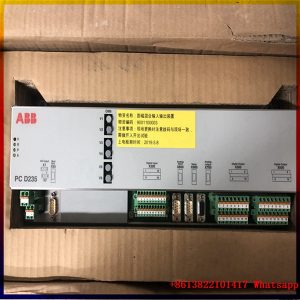
The ABB PCD235C101, also identified by the part number 3BHE057901R0101, is a high-performance Exciter Control Module specifically designed for the UNITROL® 6000 series and the AC 800PEC control platform. This module serves as a specialized processing and interface unit that manages the firing pulses, regulation, and protection of the power bridge in synchronous machine excitation systems. As a critical link in the Automatic Voltage Regulator (AVR) loop, the PCD235C101 ensures that the generator excitation remains stable, responsive, and synchronized with the power grid.
1. Technical Parameters & Datasheet
The PCD235C101 is built to handle the deterministic, high-speed computational requirements of power electronics. It integrates advanced digital signal processing with robust I/O handling to manage the field current of large generators.
| Parameter | Specification Details |
| Model Number | PCD235C101 |
| Part Number | 3BHE057901R0101 |
| Platform Compatibility | AC 800PEC / UNITROL 6000 |
| Processor Type | Integrated FPGA and RISC Core |
| Function | Excitation Control and Pulse Generation |
| Input Voltage | 24 V DC (±20%) |
| Power Consumption | Approximately 12 W to 18 W (Load dependent) |
| Communication | Proprietary ModuleBus / High-speed Serial Link |
| Protection Rating | IP20 (Industrial standard subrack mount) |
| Operating Temperature | -10°C to +70°C (Extended industrial range) |
| Storage Temperature | -40°C to +85°C |
| Isolation | Galvanic isolation between logic and power interface |
Hardware and Performance Features
- Precise Firing Angle Control: The module utilizes high-resolution timers within its FPGA to generate firing pulses for thyristor bridges, ensuring sub-degree accuracy in the firing angle (α).
- Dual-Core Architecture: By combining a RISC processor for general logic and an FPGA for high-speed signal processing, the unit achieves the sub-millisecond response times required for grid fault ride-through.
- Integrated Diagnostics: The module features real-time monitoring of bridge temperature, fan status, and DC link voltage, providing immediate feedback to the controller.
- EMC Immunity: Given its proximity to high-current thyristor bridges, the PCD235C101 is designed with specialized shielding and multi-layer PCB routing to resist high-frequency electromagnetic noise.
2. Country of Origin
The ABB PCD235C101 (3BHE057901R0101) is manufactured in Switzerland. ABB’s Power Electronics and Excitation center of excellence in Turgi and Baden manages the end-to-end production of these modules. Swiss manufacturing ensures the high precision and rigorous stress-testing necessary for components used in national-level power infrastructure.
3. Product Related News (2025-2026)
Optimization for “Synthetic Inertia” Applications
In late 2025, ABB announced a firmware enhancement for the PCD235C101 specifically targeted at Synchronous Condensers. As global energy grids move toward 100% renewables, these condensers use the PCD235C101 to provide “synthetic inertia,” stabilizing the grid frequency during sudden load drops or renewable fluctuations.
Life Cycle Extension Commitment
As of early 2026, ABB has officially updated the lifecycle status of the 3BHE057901R0101 to the “Active” phase. This indicates a commitment to long-term availability, ensuring that plants running UNITROL 6000 systems can continue to procure brand-new replacement modules rather than relying on refurbished stock. This is part of ABB’s “Green Service” initiative to extend the lifespan of existing power assets.
Cybersecurity Compliance
Following the implementation of the 2026 Industrial Cyber-Security Act, the PCD235C101 has undergone a security audit. New production units now ship with hardened bootloaders and signed firmware to prevent unauthorized modification of the excitation control logic, a critical requirement for defending against state-level cyber threats to the power grid.
4. Application Areas
The PCD235C101 is an essential component in high-consequence energy environments:
- Hydroelectric Plants: Controlling the excitation of vertical generators where rapid response to load variations is required to maintain grid stability.
- Nuclear Power Stations: Providing the primary and redundant AVR control for main turbine generators, where 99.999% uptime is mandatory.
- Gas and Steam Turbines: Serving as the pulse generation unit for combined-cycle power plants.
- Static Synchronous Compensators (STATCOM): Managing the firing of power electronic valves for reactive power compensation in substations.
- Pumped Storage Facilities: Handling the complex transition between motor and generator modes during energy storage cycles.
5. Product Usage and Installation Instructions
Installation Procedures
- Chassis Preparation: The PCD235C101 is designed for a 19-inch subrack. Ensure the rack is properly grounded and the power supply rail is stabilized at 24V DC.
- ESD Safety: Always wear a grounded anti-static wrist strap. The high-speed FPGA on this board is highly sensitive to static discharge.
- Seating the Module: Align the module with the guide rails and slide it into the backplane. Use the front-panel ejector handles to lock the module in place and tighten the screws to ensure vibration resistance.
Wiring and Connectivity
- Fiber Optics: Many configurations of the PCD235C101 utilize fiber-optic links for pulse transmission to the thyristor bridge. Ensure the fiber ends are clean and have a minimum bend radius of 30mm.
- ModuleBus: Connect the proprietary bus cable to allow communication with the AC 800PEC controller.
Maintenance
- Visual Status: Check the “Health” and “Bus” LEDs on the front panel. A steady green light indicates the unit is in the RUN state and communicating correctly with the master controller.
- Firmware Updates: Always use the ABB-certified loading tool for firmware updates. Do not interrupt the power supply during a firmware flash as this may brick the bootloader.
6. Recommended Related ABB Models
For those building or maintaining an ABB excitation or PEC-based system, the following related models are highly compatible:
- PP D113 (3BHE023784R2530): The high-speed processing board that often acts as the master for the PCD235C101.
- PCD231B (3HHE025541R0101): A communications I/O module frequently found in the same subrack to handle external fieldbus protocols.
- AI810 (3BSE008516R1): An 8-channel analog input module used for monitoring auxiliary temperatures and pressures.
- CI854A (3BSE030221R1): A PROFIBUS DP interface module for connecting the excitation system to the wider plant DCS.
- PM866 (3BSE050198R1): The AC 800M controller unit often used for secondary plant-level logic in coordination with the excitation unit.
- UNS0883A-V1: A specialized voltage measurement module used to provide the PCD235C101 with raw generator voltage data.