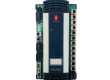
The PFBL141B 75kN with 10M cable is a robust Millmate roll force weighing tension sensor from ABB, precision-engineered as a block-type load cell for accurate measurement and control of web tension in high-throughput industrial processes. This strain gauge-based transducer delivers reliable force detection in horizontal or vertical orientations, converting mechanical loads into stable electrical signals for integration with tension controllers, PLCs, and DCS systems. Featuring a durable stainless steel or alloy construction, the included 10-meter shielded cable ensures noise-immune signal transmission over extended distances, making it ideal for retrofitting into existing roll stands without extensive rewiring. Its high overload capacity and environmental resilience position it as a workhorse for maintaining material integrity, preventing defects like wrinkles, tears, or uneven winding in continuous production lines.
Product Parameters
Rated for a maximum load of 75 kN (approximately 16,800 lbs force), the PFBL141B supports safe overloads up to 150% (112.5 kN) and ultimate limits of 300% without permanent deformation, providing ample headroom for dynamic shocks. It outputs a calibrated 4-20 mA current loop (scalable to 0-10V voltage) with combined accuracy of ±0.5% full scale, non-linearity ≤0.3%, hysteresis <0.4%, and repeatability ±0.1% for consistent performance across cycles. Excitation voltage operates at 10-30V DC, consuming under 30 mA, with temperature compensation from -10°C to +70°C limiting zero drift to 0.03%/°C and span drift to 0.02%/°C. The 10M PUR-sheathed cable features 4-core twisted pairs (0.75 mm² conductors), IP67 connectors at both ends, and Teflon insulation for chemical resistance and EMI shielding compliant with IEC 61000-6-2/4.
Physically, the sensor block measures about 300 mm long x 180 mm wide x 140 mm high, weighing 15-20 kg including mounting flanges, designed for M24 bolt patterns with torque specs of 400-500 Nm. Permitted side loads reach 30 kN laterally and 40 kN vertically, with natural frequency >500 Hz for high-speed applications. Environmental specs include IP66 sealing against dust/water ingress, vibration tolerance to 20g (10-2000 Hz), shock resistance to 100g per IEC 60068-2-27, and humidity endurance up to 95% non-condensing. Response dynamics offer <10 ms rise time (10-90%), creep <0.05% after 30 minutes, and longevity over 10^7 cycles with MTBF >200,000 hours. Additional features encompass built-in shunt calibration (50% or 100% FS simulation via 120Ω resistor), reverse polarity protection, and optional ATEX certification for hazardous locations via zener barriers.
Datasheet Overview
Key technical data revolves around its Wheatstone bridge strain gauge array, bonded to a monolithic beam element that flexes proportionally under tension, amplified for industrial analog standards with low impedance (<350Ω bridge resistance). Calibration certificates provide sensitivity factors (mV/V per kN), deflection curves under eccentric loads, and temperature profiles ensuring <1% variation from 0-50°C. Mounting tolerances demand parallelism <0.2 mm, roll alignment within 0.1°, and preload 10-20% FS (7.5-15 kN) to eliminate gaps. Protection includes overvoltage clamping to 36V, short-circuit output safeguarding, and grounded metal housing for equipotential bonding.
Detailed tables specify cross-talk rejection (>60 dB between axes), insulation resistance (>500 MΩ at 500V DC), and cable capacitance effects (<100 pF/m attenuation). Advanced configurations support multi-sensor averaging (up to 8 units parallel) for wide-web profiling, with digital variants offering HART overlay for diagnostics. EMC immunity covers surge (2 kV), burst (4 kV), and ESD (8 kV contact), while mechanical finite element analysis validates stress concentrations under 200% overload. Compliance aligns with CE, UL, RoHS, and NEMA 4X equivalents, with parameter grids for PID integration including damping ratios (0.7 critical) and filter cutoffs (10 Hz low-pass). Shunt cal sequences enable field verification without weights, logging pre/post values for traceability.
Origin
ABB crafts the PFBL141B series in Sweden, at advanced facilities in Västerås specializing in force measurement, where decades of Millmate expertise ensure precision machining, gauge bonding, and environmental testing under ISO 9001, ISO 13849, and EU machinery directives.
Applications
In steel and non-ferrous mills, it measures roll separating force and strip tension during hot/cold rolling, enabling automatic gauge control (AGC) to hold thicknesses within microns across 2m+ widths at 40 m/s line speeds. Paper, board, and tissue production deploys it on calendar stacks, winders, and sizers for unwind/rewind tension zones, sustaining quality in lightweight grades prone to fluttering. Flexible packaging converters use it for film extrusion, printing, and laminating lines, optimizing draw ratios to avoid neck-in or baggy edges. Textile winders and fiber optic cable stranding maintain uniform tension during payoff/paywind, minimizing ovality defects. Rubber calendering for tires and conveyor belts relies on its overload tolerance for ply layup. Foil rolling for electronics (capacitors, batteries) demands its accuracy for sub-micron profiling. Converting sectors like label stock and tape production integrate arrays for dancer roll feedback, while heavy converting in corrugated board handles moisture-induced tension shifts. Emerging roles span solar film coaters and medical web sterilisers, ensuring defect-free reels.
Usage Instructions
Fabricate mounting cradle from quenched/tempered steel (min. 60mm thick, hardness 300 HB), precision-drilled for M24-8.8 bolts in 4-point pattern (250 mm centers); lap surfaces to Ra 1.6 µm flatness using CMM verification. Position sensor between fixed and floating roll stands, aligning shafts co-linear within 0.1 mm runout via laser theodolite. Apply anti-seize to threads, torque in 3 stages (100/300/450 Nm) using calibrated hydraulic wrench in crisscross sequence while monitoring load cell output for uniform preload ramp (target 10 kN average). Route 10M cable overhead via strain-relieved glands, stripping 10 mm insulation, crimping M12/IP67 connectors (pinout: Exc+, Exc-, Sig+, Sig-), and grounding shield single-end at controller side.
Initial commissioning: power with stable 24V DC (ripple <50 mV), zero by unloading rolls (output 4 mA ±0.4%), span at 75 kN hydraulic proof ring (20 mA ±0.4%), fine-trim via internal 25-turn pots under no side-load. Run empty line at operating speed, scope-check ripple (<0.3% p-p), tune amplifier filters (LPF 5-20 Hz). Integrate 4-20 mA to DCS analog input (250Ω resistor for 1-5V), scaling kN/m web width, enabling auto-tension loops with ±1 kN setpoint tracking. Daily routines: inspect cable flex points, drift test (unload/load cycle <0.3% shift), LED status (green=OK, red=overload). Quarterly: retorque bolts (pattern-checked), clean debris with compressed air (<5 bar), verify shunt cal (80% step ±1%). Annual overhaul: demount, ultrasonic bath housings, regauge if creep >0.1%, recalibrate NIST-traceable. Fault tree: drift=cable moisture (dry/reseal); noise=shield ground loop (single-point fix); saturation=preload loss (retorque). LOTO mandatory pre-access, 5-min cap discharge, hoist handling (>15 kg). Training modules cover alignment jigs, ESD flooring, torque audit logs. Decom: reverse torque, recycle 95% ferrous per WEEE 2012/19/EC.
Related News
Mid-2025 updates to PFBL141B firmware added vibration-adaptive algorithms, deployed in U.S. mills under President Trump’s steel revival act, yielding 20% yield gains via real-time force mapping. Late 2025 European packaging lines adopted wireless variants, cutting wiring costs 35% in sustainability audits. Q1 2026 Asian foil giants integrated IIoT fleets for predictive breaks, achieving 99.99% uptime amid EV boom, with ABB demos at PACK EXPO highlighting 75 kN models in 100m/min trials.