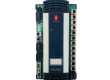
The ABB PFEA113-65 (Part Number: 3BSE050092R65) is a high-performance, advanced tension electronics unit designed for industrial web-processing applications. As a cornerstone of the ABB Pressductor® technology family, this unit provides precise measurement and control of strip tension in continuous production lines. The PFEA113-65 is a specialized version of the Tension Electronics series, optimized for demanding environments where accuracy, reliability, and high-speed data integration are paramount.
Product Introduction
The PFEA113-65 is an intelligent signal processing unit that interfaces directly with ABB Pressductor® load cells. These load cells utilize the magneto-elastic principle to convert mechanical force into electrical signals. The PFEA113-65 takes these raw signals and transforms them into usable data for industrial control systems.
Unlike basic amplifiers, the PFEA113-65 features integrated digital processing, a user-friendly HMI, and advanced communication capabilities, including Profibus-DP. The “-65” variant is specifically housed in a rugged enclosure with an IP65 rating, making it suitable for direct mounting in harsh industrial areas where dust, moisture, and water splashes are prevalent.
Product Parameters (Datasheet)
| Technical Parameter | Specification / Detail |
| Model Number | PFEA113-65 |
| Product ID | 3BSE050092R65 |
| Protection Class | IP65 (Dust-tight and protected against water jets) |
| Input Voltage | 24 V DC (18 – 35 V DC range) |
| Power Consumption | 8 W (Typical) |
| Number of Load Cell Inputs | 2 Channels (for 2 individual or 1 combined measurement) |
| Analog Outputs | 2 x 0-10 V or 0/4-20 mA (Configurable) |
| Digital Inputs/Outputs | 2 Inputs / 4 Outputs (Relay and Transistor) |
| Communication Protocol | Profibus-DP (Standard) |
| Accuracy | 0.05% of full range |
| Step Response Time | < 5 ms |
| Display Type | Integrated 4-digit LED display with navigation keys |
| Operating Temperature | 0°C to +55°C |
Country of Origin
- Origin: Sweden (ABB Force Measurement Division)
Application Areas
The PFEA113-65 is indispensable in industries involving the continuous processing of materials in web or strip form. Key application areas include:
- Paper and Pulp Mills: Monitoring the tension of paper webs during drying, coating, and winding to prevent breaks and ensure uniform quality.
- Steel and Metal Processing: Controlling the tension of metal strips in cold rolling mills, galvanizing lines, and pickling lines.
- Converting Industry: Essential for plastic film extrusion, lamination, and printing processes where precise tension is required for registration.
- Textile Industry: Managing tension in weaving and finishing machines to maintain fabric integrity.
- Non-Woven Fabric Production: Handling delicate materials that require sensitive but stable tension measurement.
Product Technical Description
The core technology of the PFEA113-65 revolves around the Pressductor® principle. Pressductor load cells are made of high-quality steel with internal coils. When mechanical force is applied, the magnetic properties of the steel change, altering the induced voltage in the coils.
The PFEA113-65 electronics provide the excitation current for these load cells and process the resulting millivolt signals. The unit features:
- Automatic Zero Setting: Compensates for the weight of the roll and bearings.
- Configurable Filtering: Digital low-pass filters to eliminate mechanical vibrations from the tension signal.
- Built-in Diagnostics: Constantly monitors the health of the load cell cables and internal circuits.
- Profibus Integration: Allows for remote calibration and real-time data streaming to a PLC (like the AC 800M) or DCS (800xA).
Instructions for Use
1. Mechanical Installation
The IP65 housing allows the unit to be mounted on a wall or machine frame near the load cells.
- Mount the unit vertically to ensure optimal heat dissipation.
- Use the four mounting holes on the external tabs of the enclosure.
- Ensure the cable glands are tightened properly to maintain the IP65 seal.
2. Electrical Wiring
- Power: Connect a stabilized 24 V DC power source.
- Load Cells: Use twisted-pair shielded cables for load cell connections. The shield must be grounded only at the electronics end to prevent ground loops.
- Outputs: Connect the analog outputs to the motor drive or PLC for closed-loop tension control.
3. Commissioning and Calibration
- Zeroing: With the measuring roll in place but no material web, perform the “Zero” function via the HMI to negate the tare weight.
- Calibration: Use a known weight (the “hanging weight” method) or enter the load cell sensitivity values manually if the wrap angles are mathematically known.
- Filter Setting: Adjust the time constant (T) to balance between signal stability and response speed.
4. Maintenance
- Periodically check that the enclosure screws are tight.
- Verify that no moisture has entered through the cable entries.
- Check the “OK” status LED on the front panel to ensure no internal errors are detected.
Product Related News
In the shift toward Smart Manufacturing and Industry 4.0, the PFEA113-65 has gained renewed significance. Recent updates from ABB Force Measurement highlight the integration of these units into predictive maintenance frameworks. By analyzing the vibration data and tension fluctuations processed by the PFEA113-65, operators can now identify bearing wear on tension rolls weeks before a failure occurs.
Additionally, the PFEA113-65 is a key component in ABB’s “Sustainability in Metals” initiative. By providing extreme precision in tension control, the unit minimizes material waste during the “threading” phase of metal strips, significantly reducing the carbon footprint of high-energy rolling mills.
Product Technical 说明 (Technical Details)
The PFEA113-65 is differentiated from the PFEA111 and PFEA112 by its ability to handle both individual and sum signals from two load cells simultaneously. It also includes a Profibus-DP interface as standard hardware. The unit is designed for “Universal” load cell compatibility, meaning it can support almost all versions of ABB Pressductor® load cells (PFCL, PFTL, PFRL, and PFRK series). The internal software includes a “Service Mode” which allows technicians to view raw millivolt inputs, aiding in the troubleshooting of cable faults or load cell imbalances.
Product Q&A (Common Questions)
Q: What is the main difference between PFEA113-20 and PFEA113-65? A: The functionality is identical; the difference is the enclosure. The “-20” is an IP20-rated unit for mounting inside a control cabinet (DIN rail), whereas the “-65” is an IP65-rated unit for field mounting in harsh conditions.
Q: Can I calibrate the PFEA113-65 without using actual weights? A: Yes. If you know the wrap angle of the web and the specific sensitivity (mV/N) of the load cells, you can use the “Wrap Gain” calculation method via the menu.
Q: How many load cells can one PFEA113-65 handle? A: It can handle two load cells. In most applications, one load cell is placed on each end of a roll. The unit can be configured to show the tension on Side A, Side B, or the Total Sum (A+B).
Q: Does the unit support PROFINET? A: The PFEA113 series natively supports Profibus-DP. For PROFINET connectivity, a protocol converter (gateway) or a newer generation of ABB tension electronics would be required.
Q: What does a “Load Cell Error” on the display indicate? A: This typically means an open circuit or a short circuit in the wiring between the electronics and the load cell. It can also indicate that the excitation current is out of range.
Summary Table of Compatible Load Cells
| Load Cell Series | Type of Measurement | Typical Material |
| PFCL 201 | Vertical Force | Paper, Film |
| PFTL 101 | Horizontal Force | Steel, Paper |
| PFRL 101 | Radial Force (Radial) | Felt, Wire |
| PFRK | Compact Pillow Block | Narrow Web, Label |