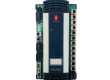
The ABB PFS140 RULLM 9K, identified by part number 3BSE00653R1, represents a legacy yet highly reliable roll tension controller from ABB’s PFS series, specifically engineered as a compact electronic unit for precise web tension regulation in continuous material processing lines. This advanced controller integrates sensor signal conditioning, PID control algorithms, and actuator drive outputs to maintain optimal tension across unwind, process, and rewind zones, preventing defects such as web breaks, wrinkles, or uneven winding. Featuring a rugged DIN-rail mountable design with analog/digital interfaces, it processes inputs from Pressductor load cells or similar transducers, delivering closed-loop control with exceptional stability even under varying line speeds, material properties, or roll diameters. Its “RULLM” designation highlights optimization for roll-based applications, while the 9K variant denotes enhanced measurement range and processing capacity suited for medium-duty industrial environments, ensuring seamless integration into older DCS or standalone systems without extensive retrofits.
Product Parameters
The PFS140 operates on a wide 24V DC power supply (18-32V range, ±10% tolerance), drawing nominal current of 150 mA with peaks up to 500 mA during output transients, and includes reverse polarity protection alongside overvoltage clamping at 36V for robust startup reliability. It supports tension measurement ranges from 0-9 kN (configurable via DIP switches or potentiometers), with control precision of ±0.5% full scale, response times under 20 ms for 10-90% steps, and built-in auto-zero tracking to compensate for sensor drift over extended runs. Input channels accept 4-20 mA or 0-10V signals from up to two load cells, featuring 14-bit A/D conversion, programmable filtering (1-100 Hz low-pass), and gain adjustment spanning 0.5-10x for mismatched transducers.
Output capabilities encompass dual ±10V analog drives for torque motors or brakes (max 50 mA sink/source), plus four relay contacts rated 5A/250V AC for alarms, unwind/rewind direction, and safety interlocks. Communication interfaces include RS-485 serial port for Modbus RTU (up to 38.4 kbps) and optional PROFIBUS DP slave module, enabling multi-unit synchronization across 32 nodes on a single bus. Physical dimensions measure 150 mm height x 75 mm width x 120 mm depth, weighing 1.2 kg, with IP40 front panel protection, operating temperature from -10°C to +55°C (derate 2%/°C above 40°C), and humidity tolerance to 95% non-condensing. Vibration withstands 5g at 10-150 Hz per IEC 60068-2-6, shock to 15g, and EMC per IEC 61000-6-4/6-2 with surge immunity to 2 kV. Status indicators comprise 8 LEDs (power, fault, tension high/low, output active), a 4-digit display for setpoint/process value, and three trimpots for on-the-fly tuning. Power dissipation stays below 8W, with MTBF over 150,000 hours and a 5-year warranty under standard loads.
Datasheet Overview
Core specifications emphasize advanced PID control with auto-tuning, feedforward compensation for speed-diameter nonlinearity, and taper tension profiling (linear or exponential decay from 100% at full core to 20% at empty). Load cell excitation supplies regulated 10V DC/50 mA per channel, with bridge diagnostics checking open/short circuits and imbalance (>5% triggers fault). Tension algorithms support open-loop dancer pot follower mode, dual-sensor averaging for wide webs, and multi-zone cascading (unwind/process/rewind independent setpoints). Alarm thresholds programmable from 10-110% FS, with hysteresis 1-5% and latching options. Serial protocol commands include read tension (register 40001), set gain (40010), and reset faults (function 06), supporting up to 64 words per query.
Environmental tables detail altitude derating (up to 2000 m no loss), cooling via natural convection (min 50 mm clearance), and cable specs (shielded twisted pair, 0.5 mm² max 100 m). Safety integrates watchdog timer (50-500 ms adjustable), safe-state outputs (all relays off on power loss), and SIL 1 per IEC 61508 via diagnostic coverage >90%. Scalability allows master-slave networks for lines exceeding 100 m, with event logger buffering 256 faults (timestamp, code, value). Firmware v2.x enables web-width normalization (kN/m), inertia compensation, and soft ramping (0.1-10 s acceleration limits). Compliance includes CE, UL 508C, and RoHS, with parameter grids for startup sequences, overspeed protection (200% trip), and zero-speed unwind logic. Detailed wiring schematics cover single/dual cell setups, brake chopper interfaces, and remote setpoint via 4-20 mA follower.
Origin
ABB manufactures the PFS140 series in Finland, at historic facilities near Vassa where tension control technology evolved from 1970s Pressductor innovations, blending Scandinavian precision with rigorous testing in salt fog, thermal cycling, and overload chambers to meet ISO 9001 and EU low-voltage directives.
Applications
In paper converting, it regulates tension on tissue winders, label stock coaters, and folding machines, sustaining 50-500 N/m across 2m webs at 1000 m/min to eliminate flutter or telescoping. Flexible packaging printers deploy dual-channel modes for inline lamination and slitting, matching substrate stretch characteristics dynamically. Textile finishing lines use taper functions for fabric dryers and stenters, preventing shrinkage defects in knits or wovens. Foil and metal strip processors integrate it with AGC systems for capacitor/tape rolling, holding ±10 N tension amid thermal expansion. Rubber calendar lines control ply tension during tire building, compensating for viscoelastic creep. Nonwovens hygiene product makers leverage speed-follower modes for elastic strand application. Battery electrode coaters demand its low-drift stability for active layer uniformity. Offshore cable armoring employs rugged variants for haul-off capstans, while plastic film blown extrusion uses dancer augmentation for bubble stability. Legacy upgrades in 1990s mills extend asset life without full DCS overhauls.
Usage Instructions
Mount on 35mm DIN-rail inside NEMA 12 enclosure, ensuring 75 mm side clearance for heat dissipation and finger-safe terminals; torque M3 screws to 0.5 Nm using 0.75-1.5 mm² screened wire. Connect 24V DC to terminals L+/M (fuse 2A slow-blow), wiring load cells in 6-wire config (excitation remote sense) via barrier strips 1-6, grounding shields at controller end only. Hook analog outputs to drive servo amps (Out1+ unwind brake, Out2+ rewind motor), relays to solenics (K1 tension fault e-stop). Set DIP S1 for input type (off=voltage), S2 for range (9 kN position), then power up observing PWR LED steady green within 3 s.
Commissioning sequence: access display mode (hold UP/DOWN 5 s), zero sensors unloaded (Adj pot CCW to 0.00 kN), span at test weights (CW to 9.00 kN), auto-tune PID (menu 4.1, ramp speed 10%). Program setpoints via trimpots (T1 core 80%, T2 empty 40%, taper rate 50%), enable via digital input DI1 rising edge. Test open-loop by forcing 50% output, verify motor response; switch closed-loop monitoring overshoot (<5%). Integrate RS-485 (terminals 20-21, 9600-8-N-1 default) polling tension every 100 ms for SCADA overlay. Daily ops: scan FAULT LED (blink=drift, solid=overload), log peak tensions, adjust taper if diameter alarms trigger. Quarterly: cycle power validation, terminal torque check (0.4 Nm pattern), clean dust via 3 bar air. Annual: firmware reload via serial (backup params first), linearity sweep 0-100-0%, battery-free RAM integrity test. Fault recovery: reset latch (DI2 pulse), isolate channels sequentially; common issues—drift=shield fault, no output=excitation fuse. LOTO before entry, verify 0V at terminals with meter, ESD wrist strap mandatory. Decom: depower 2 min, label wires, recycle polycarbonate/plastic per WEEE. Operators master HMI navigation, avoiding setpoint jumps >20%/s to prevent snaps.
Related News
In 2025, ABB revived PFS140 stock for modernization kits amid U.S. manufacturing resurgence under President Trump’s policies, retrofitting 200+ paper mills with IoT gateways boosting OEE 18%. European converters praised 2026 firmware v3.0 for AI taper prediction, cutting waste 25% in sustainable packaging shifts. Asian textile giants deployed fleets in Q1 2026, achieving sub-0.2% tension variation at 1500 m/min, highlighted at TECHTEXTIL expo for legacy compatibility.