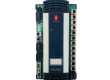
The ABB PFSK151 (Part Number: 3BSE018876R1) is a high-precision signal processing module designed for use within the ABB Advant Controller and MasterPiece systems. Specifically engineered for tension measurement and force control applications, this module acts as the critical interface between Pressductor® load cells and the central processing unit of a Distributed Control System (DCS).
Product Introduction
The PFSK151 is a specialized electronic unit that provides the excitation current to load cells and processes the resulting low-level signals into standardized data for the controller. In heavy industrial environments, measuring “web tension” or “roll force” requires extreme accuracy and immunity to electrical noise. The 3BSE018876R1 utilizes ABB’s proprietary Pressductor technology principles—where mechanical force changes the magnetic properties of a sensor—to deliver highly stable measurements even in the presence of extreme vibrations or temperature fluctuations.
As a rack-mounted module, the PFSK151 integrates seamlessly into the ABB controller backplane, providing galvanic isolation and hardware-based filtering to ensure that the measurement signal is pure and free from electromagnetic interference (EMI) typical of large motor-driven plants.
Product Parameters (Datasheet)
The following specifications define the electrical and operational boundaries of the PFSK151 module:
| Parameter | Specification |
| Model Number | PFSK151 |
| Product ID | 3BSE018876R1 |
| Input Voltage | +24 VDC (Backplane Powered) |
| Excitation Frequency | 330 Hz (Standard Pressductor Excitation) |
| Signal Input | Differential AC signal from Pressductor Load Cells |
| Signal Output | Analog 0-10V or 4-20mA (Internal Bus Data) |
| Accuracy | < 0.1% of Full Scale |
| Temperature Drift | < 50 ppm/°C |
| Isolation | 500V DC (Signal to Logic) |
| Power Consumption | Approx. 5W to 8W |
| Mounting | Standard ABB Subrack Slot |
| Operating Temperature | 0°C to +55°C |
| Humidity | 5% to 95% (Non-condensing) |
Country of Origin
- Origin: Sweden
ABB’s force measurement products, particularly those involving the Pressductor principle, are developed and manufactured in the ABB factory in Västerås, Sweden. This facility is the global hub for ABB’s high-precision measurement technology.
Application Areas
The PFSK151 3BSE018876R1 is widely used in industries where material tension or force must be regulated with high fidelity:
- Pulp and Paper: Monitoring and controlling the tension of the paper web across drying and winding sections to prevent breaks.
- Metals and Steel: Measuring roll force in cold and hot rolling mills to ensure uniform thickness and product quality.
- Converting and Printing: Managing tension in film, foil, or paper converting lines for high-speed printing and coating.
- Textiles: Controlling the stretch and tension of fabrics during chemical processing and weaving.
- Material Handling: Load monitoring on specialized cranes or cable tensioning systems in mining operations.
Product Technical Description
The PFSK151 operates on a sophisticated signal conditioning loop. It provides a constant-frequency AC excitation current to the primary windings of the connected load cells. When force is applied to the load cell, the magnetic field is distorted, inducing a voltage in the secondary windings proportional to the force.
- Synchronous Demodulation: The module uses a synchronous detection method to extract the force signal. By comparing the input signal specifically against the excitation frequency, the module effectively ignores all other ambient electrical noise (60Hz hum, VFD switching noise, etc.).
- Auto-Diagnostics: The 3BSE018876R1 includes internal monitoring for open-circuit or short-circuit conditions on the load cell cables. If a wire breaks, the module immediately flags an error to the DCS to prevent the system from reacting to an “implied” zero-tension state.
- Zero and Span Calibration: While the module is digital in its communication with the CPU, it allows for fine-tuning of the zero-point and sensitivity (gain) via the system software, compensating for the weight of the roller (tare weight).
Product Usage Instructions
1. Installation
The module must be inserted into the designated slot in the ABB subrack. Ensure the power to the rack is off during insertion unless the specific subrack model explicitly supports hot-swapping. Use the captive screws on the front panel to secure the module and establish a solid frame ground.
2. Load Cell Wiring
Connect the Pressductor load cell cables to the rear terminal block or the associated I/O termination unit. It is mandatory to use high-quality twisted-pair shielded cables. The shield should be grounded only at the DCS cabinet end to prevent ground loops that could distort the measurement.
3. Commissioning
- Power the system and verify the “OK” LED is green.
- Perform a “Mechanical Zero” calibration: With the roller in place but no material tension applied, use the engineering station to tare the weight.
- Perform a “Shunt Calibration” or “Weight Calibration”: Apply a known force to the load cell to verify the span (gain) settings.
4. Maintenance
- Periodically inspect the cable connections for oxidation or looseness, especially in high-vibration environments.
- Check the excitation voltage periodically to ensure the module is providing a consistent signal to the load cells.
Product Related News
- Lifecycle Extension: ABB has recently included the PFSK151 in its “Classic” support phase. This means that while newer systems are available, ABB continues to manufacture the 3BSE018876R1 to support the thousands of existing mills worldwide that rely on Advant technology.
- Modernization Packages: Recent industry trends show a surge in “Force Measurement Modernization” where older analog units are being replaced with modules like the PFSK151 to allow for digital integration with modern 800xA control systems via specialized adapter cards.
- Sustainability Focus: By improving tension accuracy in paper and steel mills, the PFSK151 has been highlighted in recent trade journals as a key component in reducing material waste and energy consumption during high-speed production.
Common Problems Q&A
Q: The “Fault” LED is on. What are the most likely causes? A: A red “Fault” LED usually indicates a problem with the load cell connection. Check for an open circuit (broken wire) or a short circuit in the excitation lines. If the wiring is correct, the module may have detected an internal memory checksum error.
Q: Can I use the PFSK151 with a standard strain-gauge load cell? A: No. The PFSK151 is specifically designed for Pressductor® load cells, which operate on magnetic principles. Strain-gauge sensors require a DC-bridge excitation module, whereas the PFSK151 provides AC excitation.
Q: My measurement is drifting when the machine speeds up. Why? A: This is often caused by EMI from the motor drives. Ensure that the load cell cables are shielded and separated from high-voltage power cables. Also, check that the module’s ground connection to the rack is clean and secure.
Q: Is the 3BSE018876R1 a direct replacement for the older PFSK151 versions? A: Yes, the 3BSE018876R1 is the standardized part number for the PFSK151. However, always verify the firmware compatibility if your system is running a very old version of the MasterPiece software.
Q: What is the benefit of the 330 Hz excitation frequency? A: The 330 Hz frequency is high enough to allow for fast response times in control loops but low enough to avoid the skin-effect and capacitance issues associated with high-frequency AC transmission over long cables.
Recommended Similar/Associated Models
- ABB PFTL101: A common horizontal load cell used with this module.
- ABB PFCL201: A vertical load cell often paired with the PFSK151.
- ABB PFSK152: An alternative version for different system architectures.
- ABB 3BSE008516R1: Associated I/O baseplate for rack mounting.
- ABB CI522A: Communication interface used to pull PFSK151 data into modern networks.