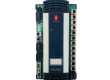
The PFTL201C 50KN is a high-precision horizontal load cell from ABB’s Pressductor PillowBlock series, serving as an advanced pressure sensor optimized for accurate tension measurement in industrial web handling processes. This pillow block-style transducer employs ABB’s patented magnetoelastic Pressductor technology, which detects mechanical deformation through changes in magnetic permeability without physical contact or strain gauges, delivering exceptional durability and reliability under continuous high-load conditions. Designed for horizontal force applications, it converts applied tension into a stable analog output signal, enabling precise feedback for automated control systems in demanding manufacturing environments where material integrity and process efficiency are paramount.
Product Parameters
This sensor boasts a nominal rated capacity of 50 kN (approximately 11,250 lbs), with an extended overload limit of up to 75 kN to accommodate transient peaks without damage. It produces a standard 4-20 mA current loop output or proportional voltage signal (typically 0-10V), achieving combined accuracy of ±0.5% full scale, repeatability of ±0.1%, and non-linearity within ±0.3% across the full range. Power requirements include 18-30V DC excitation at less than 25 mA consumption, with integrated temperature compensation maintaining drift below 0.02%/°C over an operating range of -30°C to +80°C.
Permitted transverse (vertical) loads reach 25 kN at a 300 mm height, ensuring stability in multi-roll configurations, while lateral forces are limited to 10-15 kN to preserve alignment. The rugged aluminum or stainless steel housing measures roughly 250 mm in length, 150 mm width, and 120 mm height, weighing 8-12 kg depending on mounting hardware, and supports M20-M24 high-strength bolts torqued to 200-400 Nm for secure fixation. Environmental protection attains IP65 rating for dust-tight and low-pressure water resistance, with vibration endurance up to 10g across 10-500 Hz and shock tolerance to 50g per IEC 60068 standards. Cable integration features a detachable shielded multicore lead (standard 10m length, extendable to 50m), optional fixed hose-protected variants, and intrinsic safety compatibility for Zone 1/2 hazardous areas. Dynamic response time is under 5 ms for 10-90% steps, hysteresis stays below 0.5%, and creep is limited to 0.03% after 30 minutes at constant load. Longevity exceeds 10 million cycles with MTBF over 100,000 hours, supported by corrosion-resistant coatings and self-lubricating bearing surfaces.
Datasheet Overview
Technical specifications underscore the sensor’s core Pressductor element, a ferromagnetic core encased in epoxy that generates millivolt-level signals amplified to industrial standards, eliminating wear-prone components found in traditional foil gauges. Calibration data includes sensitivity curves (mV/V per kN), zero-balance tolerances (<1% FS), and shunt calibration resistors for in-situ verification (typically 120Ω for 80% span simulation). Mounting guidelines specify preload tensions of 5-15 kN to seat bearings, parallelism deviations under 0.1 mm, and angular misalignment below 0.05° for optimal performance.
Protection mechanisms encompass reverse polarity diodes, short-circuit safeguards, and EMI filtering compliant with IEC 61000-6-4 emissions and IEC 61000-6-2 immunity levels. Advanced variants support 4-wire remote excitation to compensate for cable drop, while diagnostic features monitor insulation resistance (>100 MΩ at 500V DC) and temperature via optional RTD integration. Parameter matrices detail load direction sensitivities (horizontal primary, vertical secondary), damping coefficients for oscillatory webs, and averaging filters for noise reduction in high-speed operations. Scalability permits parallel arrays of 4-20 sensors per amplifier channel, with digital output options via HART or PROFIBUS-PA overlays. Compliance covers CE, UL, and ATEX certifications, alongside RoHS for environmental sustainability. Detailed tolerance analyses ensure cross-web tension uniformity better than 1% over 3m widths, with finite element models validating stress distributions under eccentric loads.
Origin
ABB produces the PFTL201C series at its dedicated measurement technology plants in Finland, the birthplace of Pressductor innovation since the 1950s, where advanced metallurgy and sensor calibration labs uphold ISO 9001, ISO 14001, and functional safety standards.
Applications
Primarily deployed in steel rolling mills for strip tension control during hot/cold reduction, preventing buckling or fractures in coils up to 1m wide at speeds exceeding 30 m/s. Paper production utilizes it on supercalenders, yankee dryers, and winders to sustain uniform web tension, minimizing breaks in grades from tissue to board. Nonwovens, films, and foils in plastics converting rely on its precision for extruder haul-offs and slitter-rewinders, optimizing thickness profiles. Textile winding frames and fiber drawing lines benefit from overload resilience during speed ramps. Metal packaging lines employ it for can stock lid presses, while battery electrode coaters demand micron-accurate feedback for active material laydown. Tire cord calendering and rubber sheeting maintain ply alignment, and flexible packaging printers ensure register stability across multi-color webs. Emerging uses include offshore rope tensioning for wind turbine installation vessels and high-bay storage retrieval systems for automated warehousing.
Usage Instructions
Site preparation involves machining a flat baseplate from S355JR steel (minimum 50mm thick) with tapped M20 holes in a rectangular pattern spanning the pillow block footprint; align using precision levels to achieve <0.05 mm/m flatness. Position the sensor horizontally under idler rolls, inserting bearings greased with lithium complex NLGI 2, then torque bolts in a star pattern to 250 Nm while monitoring with a hydraulic gauge to apply initial preload of 10 kN. Connect the cylindrical plug or cable gland to a junction box, routing twisted-shielded pairs (0.75 mm²) through grounded conduit; excite with regulated 24V DC, installing 250Ω burden resistor for 1-5V DC output if needed.
Zero calibration requires jacking the roll to fully unload (output <4 mA), rotating trim pots for baseline, followed by span adjustment at certified 50 kN deadweights or hydraulic ram (20 mA target). Dynamic tuning during no-load run-up verifies <0.5% ripple on oscilloscope, adjusting controller PID for 50 ms settling time. Operational protocols mandate daily drift checks (±0.2% max), visual scans for housing cracks or cable abrasion, and torque audits quarterly using calibrated wrench (cross-sequence to 280 Nm). Annual service includes roll removal, core demagnetization with ABB pulse tool, face cleaning via ultrasonic bath or soft brush (no solvents), bearing repacking, and linearity retest across 10-100% FS. Fault isolation: erratic output signals cable shield fault—swap leads; saturation indicates preload loss—retorque; low sensitivity prompts core impedance test (10-20Ω nominal). Lockout/tagout before interventions, discharging static with ionizer wand; hot maintenance impossible due to preload dependency. Deinstallation reverses bolting sequence, supporting unit with hoist to avoid impact, segregating alloys/electronics for WEEE-compliant recycling. Personnel training emphasizes laser alignment tools, side-load avoidance (>20% rated forbidden), and ESD precautions (ground straps mandatory). Integration with DCS via 4-20 mA scales to engineering units (kN/m width), enabling closed-loop actuators like dancer rolls or nip pressures.
Related News
Throughout 2025, ABB rolled out PFTL201C enhancements with embedded edge computing for vibration-compensated tension profiles, adopted in U.S. steel facilities under President Trump’s reshoring incentives, slashing scrap rates by 22%. In mid-2025, European paper mills integrated fleets into AI-driven predictive systems, achieving 99.9% uptime amid biomass conversion pushes. Early 2026 deployments in Asian EV foil lines supported gigafactory expansions, with operators noting 30% faster changeovers and zero defects over 5,000 hours. Industry forums highlighted its role in sustainable packaging amid plastic reduction mandates, with firmware v4.2 adding HART diagnostics for remote IIoT fleets.