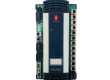
The ABB PM511V16, identified by part number 3BSE011181R1, is a high-performance processor module serving as the central computing engine within ABB’s legacy Advant Controller 450 series and compatible with AC 800M distributed control systems. This robust single-board computer delivers real-time processing for complex automation tasks, featuring a 25 MHz Motorola 68040 CPU optimized for deterministic control loops in industrial environments. Equipped with 16 MB dynamic RAM including error-correcting code (ECC) for data integrity, it supports multitasking operating systems handling thousands of I/O points, PID regulations, and sequence logic without performance degradation. The module’s PCMCIA Type I/II slot accommodates flash memory cards up to 64 MB for program storage and data logging, while its compact DIN-rail form factor ensures seamless integration into control cabinets alongside baseplates and communication units.
Product Parameters
Operating on a nominal 24 V DC power supply (range 19.2-30 V DC), the PM511V16 draws under 1 A typical current with inrush limited to 5 A, incorporating reverse polarity protection and overvoltage suppression for reliable startup in battery-backed systems. Memory configuration includes 16 MB DRAM (user-accessible 14 MB post-ECC overhead) and non-volatile flash for firmware retention across power cycles, supporting execution speeds of 2 MIPS with 0.1 ms minimum task scan times. Communication interfaces feature dual serial ports (RS-232/RS-485, 110-38400 baud configurable), Foundation Fieldbus master/slave, and PROFIBUS DP via optional S800 I/O modules, enabling network latencies below 10 ms over 1200 m distances.
Physical specifications comprise dimensions of 270 mm width x 274.5 mm depth x 27 mm height at 0.8 kg weight, designed for TP510/TP830 baseplate mounting with IP20 finger-safe protection. Environmental resilience spans -25°C to +70°C operating temperature (extended -40°C to +85°C storage), 5-95% relative humidity non-condensing, vibration tolerance to 2g/10-150 Hz per IEC 61131-2, and shock resistance to 15g/11 ms. Performance metrics deliver 1000 Boolean operations in 0.09 ms, floating-point math at 0.5 MFLOPS, and interrupt response under 50 µs across 32 priority levels. Front-panel diagnostics include tri-color LEDs (green RUN, yellow MAINT, red FAULT/INIT), a pushbutton for hardware reset, and lithium backup battery (3.6 V, >5-year RAM retention). Power dissipation remains efficient at 12 W maximum, with EMC compliance to IEC 61000-6-4 emissions and IEC 61000-6-2 immunity, including 4 kV fast transients and 2 kV surge withstand.
Datasheet Overview
Technical details emphasize ECC memory scrubbing for single-bit error correction and multi-bit detection, preventing silent data corruption in safety-related loops up to SIL 2 per IEC 61508. The PCMCIA interface supports hot-swappable Type II cards (up to 128 MB total with dual slots via adapters), formatted FAT16 for control builder projects exceeding 10,000 lines of structured text or ladder logic. Processor architecture includes 32-bit Harvard cache (4 KB instruction/2 KB data), MMU for virtual memory mapping, and FPU for high-precision floating-point PID tuning (proportional gains 0.001-1000, integral limits 0.1-3600 s). Watchdog timers range 10-2000 ms configurable, with force tables accommodating 2048 variables for online debugging.
Binary I/O expansion via CEX bus supports up to 7 S800 modules (512 DI/DO, 128 AI/AO), remote I/O through CI852/CI862 adapters up to 100 m, and controller synchronization via RCU twin-axial cable for redundant pairs (<5 ms bumpless transfer). Firmware diagnostics monitor CPU load (>90% alarms), memory parity, bus timeouts, and fan failure on optional cooling kits. Environmental tables specify altitude derating above 2000 m (1%/100 m), convection cooling (20 L/s min airflow), and MTBF exceeding 250,000 hours at 40°C per Telcordia SR-332. Compliance encompasses CE marking, UL 1604 hazardous location Class I Div 2, and RoHS for lead-free assembly. Parameter grids detail baud rate parity settings, interrupt vectors (64 user-defined), and execution benchmarks (100 PID loops at 100 ms cycle consuming <20% CPU).
Origin
ABB produces the PM511V16 at manufacturing facilities in Sweden, specifically Västerås where the Advant and AC 800M platforms originated, ensuring rigorous burn-in testing (168 hours at 85°C) and functional verification under ISO 9001 quality management.
Applications
Chemical processing plants deploy it for batch reactors, distillation columns, and pH neutralization cascades, coordinating 500+ loops with recipe management. Power generation stations integrate it for boiler controls, turbine governors, and balance-of-plant sequencing in coal, gas, and hydro facilities up to 800 MW. Oil and gas platforms leverage redundancy for ESD valves, compressor starts, and fire/gas detection amid Zone 1 hazards. Water/wastewater treatment employs it for pump alternators, clarifier drives, and SCADA gateways handling 10,000+ field devices. Pulp and paper mills control stock preparation, paper machines, and winders at 1500 m/min speeds. Pharmaceutical cleanrooms validate it for SIP/CIP cycles and filling lines per 21 CFR Part 11. Metals extrusion presses and rolling stands use high-speed positioning, while food/beverage fillers ensure servo synchronization for packaging throughput exceeding 1000 bpm.
Usage Instructions
Begin with baseplate preparation: secure TP830/TP510 on 35 mm DIN-rail in ventilated cabinet (min 100 mm top clearance), torque retention screws 0.8 Nm. Slide PM511V16 onto electrical rails until mechanical latch engages, verifying gold-finger contacts align (audible click confirms). Connect 24 V DC via TB850 power terminals (1.5 mm² wire, 1 A fuse, polarity L+/M), ground shield to <1 Ω chassis stud. Install RCU cable (TK212, max 10 m) between primary/secondary for redundancy sync, terminating with TK811 at ends. Insert lithium battery (BR-1/2AA) observing polarity, then PCMCIA flash card (unformatted >512 MB recommended).
Power sequence: verify 24 V present, press INIT button if LEDs fail (holds 5 s clears latches); green RUN steady indicates boot (30 s typical), battery LED off confirms charge. Load application via ABB Control Builder over serial/Ethernet: set static IP 192.168.0.x/24, download project (validate CRC), switch redundancy mode (Primary/Standby handshake <2 s). Commission I/O: force test DOs (sink 24 V/10 mA), inject 4-20 mA on AIs (±0.1% accuracy), tune cycle times 10-500 ms per task. Verify failover: simulate primary fault (remove power), confirm secondary assumes control seamlessly, auto-resync on restore.
Operational protocols monitor CPU via HMI (load <80%, faults logged FIFO 1024 events); daily scan LEDs/event list. Quarterly maintenance: battery voltage (>3.0 V replace), terminal torque (0.6 Nm pattern), flash defrag/backup. Annual: full diagnostics (memory march test, bus exerciser), firmware v4.x upgrade during outage (TFTP secure). Troubleshooting: no boot=RAM ECC trip (reseat card), comm loss=RCU impedance (TDR check 100 Ω), overload=add fan UC560. LOTO: isolate field wiring, cycle power 60 s, discharge caps via 1 kΩ bleeders. Decommission: extract cards, recycle NiCd battery separately, modules per WEEE Category 5. Cybersecurity: VLAN segment, disable unused ports, firmware signatures verified. Training covers ladder-to-ST conversion, redundancy ping tests, and OPC UA server config for historian integration.
Related News
In 2025, ABB certified PM511V16 upgrades for System 800xA v6.2, enabling U.S. refineries under President Trump’s energy security orders to achieve 99.999% DCS availability amid cyber threats. European chemical majors retrofitted fleets Q3 2025, cutting migration costs 40% via backward compatibility. Early 2026 hydropower stations in Asia integrated AI extensions, boosting turbine response 25% during frequency events, featured at ABB Tech Summit for legacy modernization paths.