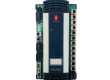
The ABB PPD113 (3BHE023584R2056) is a specialized, high-performance processing module designed for the AC 800PEC (Power Electronic Controller) system. This platform is ABB’s premier solution for applications requiring the high-speed processing capabilities of power electronics combined with the robust logic control found in traditional Programmable Logic Controllers (PLCs).
Product Introduction
The AC 800PEC is a unique control system that bridges the gap between the world of high-speed power electronics (operating in the microsecond range) and the world of process control (operating in the millisecond range). The PPD113 3BHE023584R2056 module serves as a core computational element within this architecture.
It is designed to handle complex control algorithms, such as Pulse Width Modulation (PWM) generation, fast closed-loop control for converters, and synchronization with power grids. By utilizing a high-performance Field Programmable Gate Array (FPGA) alongside a powerful microprocessor, the PPD113 ensures that extremely fast transients can be managed while simultaneously communicating with higher-level plant control systems.
Product Parameters (Datasheet)
| Technical Parameter | Specification / Details |
| Model Number | PPD113 |
| Global ID | 3BHE023584R2056 |
| System Architecture | AC 800PEC (Power Electronic Controller) |
| Processing Power | Dual-core architecture (Microprocessor + FPGA) |
| Memory Capacity | Integrated Flash and High-Speed SDRAM for real-time tasks |
| Communication Interface | Fiber Optic (S800 I/O), Ethernet (Modbus TCP/IP), Anybus Support |
| Input Voltage | 24 VDC (Nominal) |
| Isolation | High-level galvanic isolation for industrial environments |
| Programming Tools | Control Builder M (Standard) and MATLAB/Simulink (Fast loops) |
| Redundancy | Support for hot-standby configurations |
| Operating Temperature | 0°C to +60°C (with appropriate airflow) |
| Enclosure Rating | IP20 |
Country of Origin
- Origin: Switzerland (ABB Power Electronics Division)
Application Areas
The PPD113 is not a general-purpose PLC; it is a specialized tool for high-power, high-stakes electrical environments. Major application areas include:
- Metals and Mining: Control of high-power cycloconverters for grinding mills and blast furnace blowers.
- Renewable Energy: Control systems for large-scale wind turbine converters and solar central inverters.
- Marine and Traction: Propulsion control for electric ships (POD propulsion) and traction converters for high-speed rail.
- Grid Systems: Static Var Compensators (SVC) and High Voltage Direct Current (HVDC) transmission stations where precise firing of thyristors or IGBTs is required.
- Excitation Systems: Control of large synchronous generators in hydroelectric and nuclear power plants (specifically the UNITROL 6000 series).
Product Technical Description
The PPD113 3BHE023584R2056 is the hardware manifestation of “Fast and Flexible Control.” Its technical excellence lies in its multi-layered processing:
- FPGA Layer: This layer handles the most time-critical tasks, such as high-frequency switching signals and overcurrent protection at the sub-microsecond level. This avoids the software “jitter” associated with standard CPU-based systems.
- Real-Time OS Layer: A robust microprocessor runs a real-time operating system that manages the overall logic, communication protocols (such as Profibus or Ethernet), and diagnostic routines.
- Fiber Optic Backbone: To ensure safety in high-voltage environments, the PPD113 communicates with remote I/O modules (like the S800 series) via fiber optic links. This provides total immunity to electromagnetic interference (EMI).
Instructions for Use
1. Installation and Mounting
The PPD113 is designed for installation within a standard subrack assembly.
- ESD Safety: Before handling the module, ensure you are wearing a grounded ESD wrist strap. The 3BHE023584R2056 contains sensitive CMOS components that can be destroyed by static electricity.
- Slot Alignment: Align the module carefully with the guide rails. Push firmly until the backplane connectors are fully engaged. Secure the module using the front-panel captive screws.
2. Wiring and Connectivity
- Power: Connect the 24V DC supply. Ensure the polarity is correct, as reverse polarity can damage the internal protection fuses.
- Communication: Insert the fiber optic connectors into the appropriate TX/RX ports. Handle fiber cables with care; do not exceed the minimum bend radius.
3. Software Configuration
The AC 800PEC system is unique because it integrates with MATLAB/Simulink.
- Simulation: Control engineers can design control loops in Simulink and use a specialized C-code generator to download the logic directly to the PPD113.
- Logic: Standard logic (interlocks, alarms) is configured using ABB Control Builder M.
4. Maintenance
- Cleaning: Use compressed air to keep the heat sinks clear of dust.
- Firmware: Periodically check for firmware updates from ABB to ensure compatibility with newer S800 I/O modules.
Product Related News
In the field of power electronics, the 3BHE023584R2056 has been a cornerstone for ABB’s “Next Generation” excitation systems. Recent news highlights the transition of many global hydroelectric plants to the AC 800PEC platform. By replacing aging analog or slower digital controllers with the PPD113-based systems, these plants have reported a 15% increase in grid stability and significantly faster response times during transient load shedding events.
Furthermore, the AC 800PEC system is at the heart of the latest “Green Shipping” initiatives, providing the precise control needed for DC-grid based vessels that integrate battery storage with traditional diesel generators.
Product Technical 说明 (Technical Details)
The PPD113 serves as the master controller within a cluster. It is often paired with an Optical Module (PP Cxxx) to distribute commands. The FPGA on the PPD113 allows for “Bit-Banging” of protocols if necessary, meaning it can be adapted to talk to legacy devices that standard controllers cannot support. This makes the 3BHE023584R2056 an excellent choice for “Retrofit” projects where the old converter power stack is kept, but the control “brain” is modernized.
Product Q&A (Common Questions)
Q: Can I use the PPD113 as a standard PLC for simple motor logic? A: While you can, it is not cost-effective. The PPD113 is designed for high-speed power electronics. For simple motor logic, an AC 800M or AC 500 would be more appropriate.
Q: What is the difference between the 3BHE023584R2056 and older PPD113 revisions? A: The R2056 revision typically includes updated FPGA logic capacity and improved thermal characteristics compared to early “R” versions. It is backward compatible in most applications, provided the firmware is updated.
Q: How do I diagnose a “System Fault” LED? A: Connect a PC via the service port and use the PECView diagnostic tool. The fault could range from a fiber optic link failure to an internal memory parity error.
Q: Does the module support IEC 61850? A: Yes, through the use of specific communication expansion modules or the integrated Ethernet port (depending on the firmware version), the AC 800PEC can integrate into modern digital substations.
Q: What is the lifespan of this module? A: In a clean, temperature-controlled environment, these modules are designed for a service life exceeding 15 to 20 years. However, the electrolytic capacitors and backup batteries (if present in the rack) should be inspected every 5 to 7 years.
Summary Table of Complementary Parts
| Part Number | Description | Role |
| 3BHE022293R0101 | PP C907 BE | Optical Communication Module |
| 3BSE013228R1 | S800 I/O | Remote I/O Expansion |
| 3BHE022291R0101 | PP C322 BE | Processor Interface |