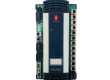
The ABB PPD113 B03-26-100110, bearing the part number 3BHE023584R2634, is a high-performance processing module belonging to the specialized AC 800PEC (Power Electronics Controller) series. This controller is specifically engineered for the high-speed requirements of power electronics, where control cycles are measured in microseconds. It acts as the “brain” for complex conversion systems, combining the flexibility of a general-purpose processor with the deterministic speed of a Digital Signal Processor (DSP).
1. Product Parameters & Technical Datasheet
The PPD113 is a central processing unit designed to handle both fast control loops (current and voltage regulation) and slower sequence logic (supervisory control).
| Parameter | Specification Details |
| Model Designation | PPD113 B03-26-100110 |
| Part Number (ID) | 3BHE023584R2634 |
| Processor Family | AC 800PEC (High-speed Power Electronics) |
| Control Cycle Time | Minimum 25μs (for fast loops) |
| Memory Configuration | Integrated High-Speed SDRAM and Flash |
| Communication Links | Multi-channel Fiber Optic (V-Pin), Ethernet, RS-232 |
| Supply Voltage | 24V DC (±15%) |
| Power Dissipation | Approximately 15W – 22W |
| Operating Temperature | 0∘C to +55∘C (ambient) |
| Storage Temperature | −40∘C to +85∘C |
| Relative Humidity | 5% to 95% (Non-condensing) |
Key Hardware Features
- Dual-Level Execution: The hardware architecture supports “Fast Tasks” for power converter pulse patterns and “Slow Tasks” for system monitoring and communication.
- FPGA Co-Processing: Includes integrated logic for ultra-fast I/O processing and Pulse Width Modulation (PWM) generation.
- Galvanic Isolation: The optical interfaces provide total electrical isolation between the control electronics and the high-voltage power components, eliminating EMI issues.
- Deterministic Performance: Unlike standard industrial PCs, the PPD113 ensures that control algorithms are executed with zero “jitter,” essential for the stability of power converters.
2. Country of Origin
The PPD113 B03 processor is designed and manufactured in Switzerland. ABB’s Turgi facility is the global center for AC 800PEC technology, where these units undergo rigorous vibration, thermal, and electromagnetic compatibility (EMC) testing to meet stringent Swiss engineering standards.
3. Application Areas
The AC 800PEC PPD113 is specialized for applications where a standard PLC (like the AC 800M) is not fast enough.
High Power Drives
- Medium Voltage Converters: Control of ACS 5000 and ACS 6000 drives used in oil and gas pumping, marine propulsion, and blast furnace blowers.
- Metals Industry: Control of cycloconverters and high-power rectifiers for electric arc furnaces (EAF).
Power Generation and Grid Stability
- Excitation Systems: Central control for UNITROL® 6000 systems, managing the magnetic field of large synchronous generators.
- Static Frequency Converters (SFC): Converting grid frequency (e.g., 50Hz to 16.7Hz) for railway power systems.
- HVDC & FACTS: Used in High Voltage Direct Current transmission and Flexible AC Transmission Systems (like STATCOM) to stabilize national power grids.
Renewable Energy
- Wind Power: Controlling the grid-side and generator-side converters in multi-megawatt offshore wind turbines to ensure smooth power injection into the grid.
4. Product Usage Instructions
Installation and Mechanical Setup
- Chassis Integration: The PPD113 must be installed in a compatible AC 800PEC subrack. Use the guide rails to ensure the backplane connector is aligned.
- ESD Precautions: This module is highly sensitive to static electricity. Maintenance personnel must wear a grounded ESD wrist strap before touching the module or the fiber optic ports.
- Cooling: Ensure that the subrack fan unit is functional. The PPD113 relies on vertical airflow for heat dissipation.
Connectivity and Wiring
- Fiber Optics: Connect the optical fibers to the front-panel ports. Ensure the “Transmitter” (Tx) on the PPD113 connects to the “Receiver” (Rx) on the I/O or bridge module.
- Cleaning: Always clean the fiber optic connectors with an alcohol-free optical cleaner before insertion. Contamination is the #1 cause of “Communication Lost” errors.
- Service Port: Use the RS-232 or Ethernet service port only for local diagnostics or initial IP address assignment.
Commissioning and Software
- Tools: Software development is typically done in MATLAB/Simulink (for control laws) and ABB Control Builder M (for logic).
- Firmware: Verify the firmware version on the module label. If a version mismatch occurs between the PPD113 and other rack modules, the system will prevent the “Run” state to protect the power hardware.
5. Product Related News
Ongoing Lifecycle Support
ABB has recently categorized the PPD113 B03-26 series under the “Active” or “Classic” lifecycle phase, depending on the specific system configuration. This ensures that spare parts, such as the 3BHE023584R2634, will be available for another 10+ years to support the long service life of power plants and industrial drives.
Performance Enhancements via Firmware
Recent developments in AC 800PEC firmware have optimized the PPD113’s ability to handle Grid Code Compliance requirements. As more renewable energy enters the grid, the PPD113 processors are being updated to provide faster “Low Voltage Ride Through” (LVRT) capabilities, allowing power plants to stay connected during grid faults.
Digitalization and Connectivity
News from ABB’s Power Electronics division highlights the integration of PPD113-based systems with ABB Ability™. This allows the high-resolution data captured by the PPD113 (which is usually lost in slower systems) to be analyzed for predictive maintenance, identifying early signs of thyristor wear or cooling system degradation.
6. Technical Maintenance Q&A
Q: What do the LED indicators on the PPD113 signify?
- Green (Run): The processor is executing the application code normally.
- Yellow (Warning): A non-critical error has occurred (e.g., redundancy link lost, or temperature is approaching limits).
- Red (Fault): A fatal hardware or software error. The processor has stopped execution to prevent damage to the converter.
Q: Is the PPD113 B03-26-100110 interchangeable with older PPD113 models? A: Compatibility depends on the “B” revision number and the 10-digit suffix. While the hardware footprint is identical, different suffixes indicate different memory or FPGA configurations. Always check the system’s “Bill of Materials” (BOM) before attempting a replacement.
Q: How do I backup the software on the PPD113? A: The application software is stored in non-volatile Flash memory. It can be backed up using the AC 800PEC Toolset via the Ethernet connection. It is highly recommended to perform a backup before any hardware replacement.
Q: Why does the module require fiber optic communication instead of copper? A: In power electronics, the high-voltage switching creates massive electromagnetic interference (EMI). Copper wires would act as antennas and pick up this noise, causing the controller to crash. Fiber optics are immune to EMI and provide the necessary galvanic isolation between the control and power stages.