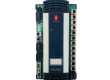
The PPD517A3011, identified by part number 3BHE041576R3011, serves as a core excitation central controller module from ABB’s AC 800PEC series. This advanced unit plays a pivotal role in managing excitation systems for synchronous generators, ensuring stable voltage output and reactive power control across diverse power generation environments. Designed for rugged industrial use, it integrates seamlessly into distributed control systems, providing high-reliability performance through redundant architecture and precise regulation algorithms.
Product Parameters
This controller operates primarily on a 24V DC power supply, featuring a tolerance of less than or equal to plus or minus 5% fluctuation to handle variable input conditions without performance degradation. Its redundant dual-channel switching mechanism enhances fault tolerance, allowing seamless failover in critical operations. Key interfaces encompass a high-speed Ethernet port supporting Modbus TCP/IP and IEC 61850 protocols for real-time data exchange, alongside RS485 and RS232 serial ports configurable from 1200 to 19200 baud rates for legacy system compatibility. Digital output capabilities deliver at least 5A at 24V DC, optimized for PWM control of thyristor or IGBT bridges in excitation power stages. Additional monitoring includes a 10V DC analog output for excitation current feedback, while fiber optic ports enable redundancy switching in under 20 milliseconds.
Physically compact at 13.2 cm height, 5.3 cm width, and 6.5 cm depth, the module weighs just 0.75 kg, facilitating easy integration into standard 19-inch industrial racks. It maintains an operating temperature range of 0 to 60 degrees Celsius, extendable to minus 40 to 70 degrees Celsius with proper ventilation, and carries an IP20 ingress protection rating against dust and solids. PID control loops achieve voltage regulation stability within plus or minus 0.5%, supporting excitation currents up to 1.0 kN. Electromagnetic compatibility adheres to IEC 61000-4 standards, and safety certification reaches SIL 2 per IEC 61508 and IEC 61511, making it suitable for safety-critical applications. Power consumption remains low at under 15W typical, with inrush current limited to prevent startup surges. Environmental resilience includes vibration tolerance up to 2g and shock resistance per IEC 60068-2-27, ensuring longevity in harsh settings like power plants or heavy industry.
Datasheet Overview
The technical specifications highlight advanced control modes including constant voltage, power factor correction, reactive power (VAR) regulation, and field current limiting, all tunable via proportional gain, integral time, and derivative time parameters in the PID regulator. Overvoltage, undervoltage, and overcurrent protections activate within milliseconds, with configurable thresholds to safeguard generators from faults. Event logging follows COMTRADE format, capturing over 1000 disturbances with timestamps for post-event analysis. Communication stacks support OPC UA for modern integration, alongside DNP3 for utility protocols.
Firmware architecture includes self-diagnostics for module health, reporting faults via LED indicators or network alarms. Analog inputs handle 4-20 mA or 0-10V signals from transducers, while binary inputs monitor discrete states like breaker positions. Response times for control loops stay below 10 ms, critical for dynamic load changes. Cooling requirements specify forced air flow of at least 0.5 m/s across the heatsink. Storage conditions allow minus 40 to 85 degrees Celsius with 5-95% non-condensing humidity. Compliance extends to CE marking for European deployment and UL listing for North American markets. Scalability permits daisy-chaining multiple units in excitation cabinets, with synchronization jitter under 1 microsecond via fiber optics. Detailed parameter tables in the datasheet cover gain scheduling for nonlinear loads, anti-windup logic in integrators, and rate-of-change limits for ramping setpoints smoothly.
Origin
ABB produces this module at its primary facilities in Sweden, leveraging the company’s deep-rooted expertise in power and automation technologies originating from the merger of ASEA and BBC in 1988. Swedish manufacturing ensures adherence to stringent European quality standards, with components sourced globally but final assembly and testing conducted in state-of-the-art cleanrooms.
Applications
In power generation, the PPD517A3011 excels in excitation control for coal-fired, gas turbine, hydroelectric, and synchronous generators up to megawatt scales, maintaining grid stability during load fluctuations or black starts. Substations deploy it for static VAR compensation and synchronous condenser support, optimizing reactive power flow. Industrial applications span metallurgy with arc furnaces requiring fast response to melt cycles, petrochemical plants for large compressor motors, and cement or steel mills driving high-inertia loads. Mining operations benefit from its robustness in dust-laden environments, controlling haul truck alternators or underground generators. Integration into DCS or PLC frameworks via Ethernet enables coordinated control with turbine governors, boiler controls, and protection relays, forming cohesive automation islands. Renewable hybrids pair it with wind or solar inverters for synthetic inertia emulation, while marine propulsion systems use it for shipboard generators ensuring uninterrupted power amid wave motion.
Usage Instructions
Begin installation by securing the module into a DIN-rail or rack slot within a ventilated enclosure, ensuring at least 5 cm clearance on all sides for airflow. Connect the 24V DC supply via screw terminals, verifying polarity and fusing at 3A per channel; ground the chassis to less than 1 ohm resistance and confirm insulation at over 50 megohms using a 500V megger. Wire digital outputs to thyristor firing circuits, applying suppression diodes across inductive loads. Link Ethernet to the control network with Cat5e cable, assigning static IP addresses via DIP switches or software, and configure subnet masks matching the DCS backbone. For serial ports, set baud rates and parity through jumpers, terminating RS485 lines with 120-ohm resistors at endpoints.
Power up gradually, observing front-panel LEDs: green RUN indicates normal operation, amber ALARM signals diagnostics, and red FAULT demands immediate inspection. Access configuration via ABB Control Builder software over Ethernet, loading the project file to set PID gains—start with proportional at 2.0, integral at 500 ms, derivative at 50 ms, then fine-tune under no-load conditions. Enable redundancy by pairing with a secondary module, synchronizing clocks via fiber and verifying failover toggles in under 1 ms during tests. Calibrate excitation current feedback by injecting known signals and adjusting zero/span pots until readings match within 1%.
Startup sequence involves ramping the field voltage from 0 to setpoint over 10 seconds, monitoring for overshoot. Test regulation by applying 10% load steps, confirming recovery within 200 ms and steady-state error under 0.5%. Simulate faults like overcurrent by shorting outputs briefly, ensuring trip functions activate and auto-reset after clearance. Integrate with governor controls by mapping setpoints over Modbus, aligning power factor targets. Daily checks include scanning LEDs and event logs for anomalies; quarterly maintenance entails visual inspection of connectors for corrosion, cleaning dust from heatsinks with compressed air, and verifying torque on terminals at 1.2 Nm. Annually, update firmware via USB port using ABB’s secure loader, backing up configurations first. If alarms persist, cycle power after 30 seconds or swap redundant channels. Decommissioning requires discharging capacitors for 5 minutes before handling, recycling per WEEE directives. Operator training should cover HMI screens for runtime adjustments, emphasizing never exceeding 110% rated current continuously. This comprehensive approach maximizes uptime, drawing on the module’s inherent diagnostics for predictive maintenance in mission-critical setups.