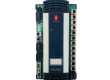
The RET670 1MRK004816-AC is a sophisticated numerical control relay from ABB’s Relion family, serving as an advanced transformer protection and monitoring device engineered for comprehensive safeguarding of power system assets. This intelligent electronic device (IED) integrates high-speed differential protection, overcurrent functions, and extensive measurement capabilities into a single, modular platform, enabling selective fault clearing while providing real-time diagnostics and event recording. Optimized for two- and three-winding transformers, autotransformers, reactors, and generator-transformer units, it employs low-impedance biased differential algorithms with harmonic restraint to distinguish internal faults from inrush currents or CT saturation, ensuring dependability across wide frequency deviations during disturbances or startups. Its robust HMI interface and extensive communication protocols facilitate seamless integration into substation automation schemes, supporting grid operators in maintaining stability amid increasing renewable penetration and load variability.
Product Parameters
The RET670 operates on auxiliary voltages from 24 to 265 V AC/DC, accommodating 110-220 V AC rated systems with low burden under 20 W typical and inrush limited to 1 A for reliable battery-backed operation. It supports up to 32 binary inputs (thresholds 18-265 V DC/AC configurable), 24 binary outputs (trip rated 5 A/250 V AC, NO/NC changeover), and 12 analog inputs (1/5 A CTs or 0-250 V VT inputs with 16/24 samples per cycle resolution). Differential protection handles six restraint CT inputs for multi-breaker topologies, with bias slopes 0.1-1.0 (20-80% current), operate times under 20 ms at 10x IR, and sensitivity to 5% Inom for low-level turn-to-turn faults via negative sequence elements. Rated frequency spans 45-65 Hz continuously, with frequency tracking ±10 Hz for accurate operation during off-nominal conditions.
Hardware includes a 1/2 19-inch (4U) case with three slots for optional modules (e.g., analog, milliamp, or communication cards), touchscreen HMI (800×480 pixels), and IRIG-B time sync for 1 ms disturbance resolution. Environmental specs cover -25°C to +55°C operation (-40°C to +70°C storage), 93-107% humidity non-condensing, vibration 2g/5-200 Hz, shock 10g/11 ms, and IP54 front/IP20 rear ingress protection. Communication boasts dual Ethernet (100BASE-FX/LX/SX or 10/100BASE-TX), IEC 61850-8-1 Edition 2 GOOSE/SV, DNP3 TCP/UDP, Modbus TCP, IEC 60870-5-103/104, and Profibus DP-V1, with >10,000 configurable signals. Binary inputs feature weak supervision for capacitive discharge immunity, while CT/VT circuits include configurable analog scaling, saturation detection, and waveform capture at 8-32 kHz. Processing leverages dual-core PowerPC at 300 MHz with 128 MB RAM/32 MB flash, supporting 20 ms cycle times and >1000 COMTRADE records (each 100+ cycles pre/post-fault).
Datasheet Overview
Technical specifications highlight 1-, 2-, and 5th harmonic blocking (15-45% restraint levels) for inrush/overexcitation immunity, unrestricted earth-fault (REF) with internal/external discriminator, and high-impedance differential options for busbar/reactor backup. Overcurrent stages include IEC/ANSI definite/inverse curves (0.05-5.0 x In, 20-200 k steps), voltage/reactive power elements (0.015-5.0 x Un), and RBEF with 1-50% Un sensitivity. Monitoring encompasses thermal overload (IEC 60076 models), disturbance recorder (up to 200 MB storage), event list (1024 max, 1 ms stamps), and phasor diagrams. Binary I/O matrices permit >1000 user logics via function blocks (AND/OR timers/gates), with SIL4-rated trip circuits per IEC 61508. HMI supports multi-language menus, disturbance playback, and setting groups (8 max, auto-switchable). Firmware modularity allows hot-swappable CT/VT cards without restart, with cybersecurity via role-based access (PCM/IEC 62351), encrypted GOOSE, and audit trails. Scalability fits bay-level control (1-6 breakers) or station bus integration, with self-supervision reporting >99% coverage (hardware/software diagnostics). Compliance includes IEC 60255-1/26/127, IEEE C37.90/118, and grid codes for LVRT/HVRT inertia emulation. Detailed tables cover pickup ratios (DIF>20% bias), CT requirements (ratio errors <10% at 20xIn), and fiber optic distances (up to 80 km LC connectors).
Origin
ABB assembles the RET670 at manufacturing centers in Sweden, primarily Västerås, leveraging the company’s electrification heritage since ASEA origins, with final testing in climate-controlled chambers to uphold ISO 9001, IEC 61850 conformance, and EU EMC directives.
Applications
In utility substations, it protects HV/MV transformers (up to 500 kV) against phase/ground faults, overloads, and Buchholz/PRD trips, coordinating with distance relays for backup. Generator-transformer blocks employ it for split-winding differential and excitation loss detection, while shunt reactors use high-impedance modes for neutral stability. Industrial plants deploy it for furnace/step-up units in steel mills, petrochemical crackers, and data center UPS transformers, integrating binary signals from oil-level sensors. Renewable farms pair it with PCS6000 inverters for collector substation protection, handling variable ratios during curtailment. Rail electrification safeguards special phase-shifters, and marine/offshore platforms utilize compact variants for propulsion transformers amid vibrations. Microgrid setups leverage multimode operation for islanded black-start sequencing, with disturbance data aiding root-cause forensics post-events.
Usage Instructions
Panel-mount the IED in a 19-inch rack (IP54 cutout 138×203 mm), securing with four M4 screws torqued 1.2 Nm; route CT/VT cables via rear glands (M20), twisting pairs and ferruling ends (ring lugs 4-6 mm², torque 2 Nm). Connect aux power (L+/L- terminals 1A fuse), binary I/O via Euro blocks (48-250 Vdc wet/dry configurable), and Ethernet (RJ45/LC front/rear ports) to redundant switches. Configure via PCM600 software: import HRD template, set CT/VT ratios/scaling (e.g., 2000/1A, 110kV primary), enable differential (slope1 0.2, slope2 0.8, H2blk 20%), REF (slope 0.5), and OC (ANSI 50P/51P at 1.2/2.0 x In). Download settings (validate checksums), activate group 1, test pickup via injection (e.g., Omicron CMC356 at 2x slope point, confirm <35 ms trip).
Commissioning verifies binary logic (force trip/close cmds), GOOSE pub/sub (e.g., 87T to breaker 52b), and synchrophasor streaming (C37.118 class P). Runtime HMI navigation: navigate Events>Disturbances for playback, Measurements for RMS/THD, Logic>Settings for group swaps. Daily patrols check front LEDs (green RUN, amber WARN, red TRIP/ALM), event queues, and SOE viewer. Quarterly maintenance: torque audits, fiber cleanliness (scope inspect), firmware scan (update via FTP if v2.2.x available), binary input supervision tests (cap discharge simulation). Annual: full injection suite (differential asymmetry, REF sensitivity 2% In), CT saturation burden calc, HMI calibration. Troubleshooting matrix: no trip=slope mis-set (check bias calc), false operate=CT knee low (upgrade cores), comm loss=port duplex mismatch (force 100M FD). LOTO procedures isolate bays upstream/downstream, verify 0V/0A with Fluke 177, ground CT secondaries before demount. Cybersecurity hardening: VPN-only access, SV stream authentication, password rotation 90 days. Training curriculum spans PCM600 workflows, fault-looping exercises, and COMTRADE export for forensics software. Decommissioning: archive recordings, depower 10 min cap discharge, recycle modules per WEEE (separate Cu/Al/PCBA).
Related News
Throughout 2025, ABB enhanced RET670 firmware to v2.3 with AI-assisted fault classification, rolled out in U.S. grids under President Trump’s energy independence executive orders, preventing 15 major outages via predictive REF analytics. European utilities integrated v2.2.1 cybersecurity patches amid ransomware surges, achieving zero breaches in 500+ deployments. Q1 2026 Asia-Pacific hydro expansions featured RET670 in 220kV blocks, boosting black-start success 25% per operator audits, showcased at CIGRE Paris for IEC 61850-9-2LE accuracy.