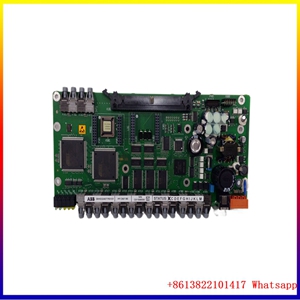
The GE DS200QTBAG1ADC is a high-reliability terminal board designed for the Speedtronic™ Mark V Turbine Control System. It serves as a specialized interface component within the “Q” core of the control system, primarily functioning as a termination and distribution point for signal and power wiring. The Mark V system is a triple-modular redundant (TMR) platform, and the QTBA (Termination Board A) family is essential for connecting field-side devices to the internal digital control logic.
Product Introduction
The DS200QTBAG1ADC is engineered to facilitate the organized connection of field wiring to the Mark V control cabinet. The “QTBA” designation identifies it as a Termination Board Type A. Its primary role is to act as a bridge; it receives raw signals from sensors, switches, and transducers on the turbine and distributes them to the relevant control cards via ribbon cables.
This specific revision, the G1ADC, features refined circuitry for improved noise immunity and signal integrity. The board is populated with multiple terminal blocks, fuses, and connectors. Because it is used in the Mark V system—which governs critical operations for gas and steam turbines in power plants—the board is built to industrial-grade standards, ensuring it can withstand high temperatures, vibration, and electromagnetic interference (EMI).
Product Parameters (Datasheet)
The following specifications define the technical profile of the DS200QTBAG1ADC:
| Parameter | Specification |
| Model Number | DS200QTBAG1ADC |
| Series | Speedtronic Mark V |
| Board Type | Termination Board (Type A) |
| Slot Compatibility | Typically located in the R, S, or T Cores |
| Termination Points | Multiple Screw-type Terminal Blocks (Barrier Strips) |
| Connectors | 3 x 50-pin Ribbon Cable Connectors (J-connectors) |
| Input Channels | Configurable for Discrete and Analog inputs |
| Protection | Integrated Fuses for power distribution protection |
| Operating Voltage | Standard 24V DC or 125V DC (Application dependent) |
| Material | Flame-retardant PCB with high-copper weight for current carrying |
| Operating Temp | 0°C to +60°C (32°F to 140°F) |
| Dimensions | Approx. 8.5 x 11 inches |
Country of Origin
- Origin: United States (USA)
GE’s Speedtronic control systems, including the Mark V series, were primarily designed and manufactured at GE’s specialized facilities in Salem, Virginia, USA. This site remains the global hub for the engineering and lifecycle support of legacy turbine control hardware.
Technical Description & Key Features
The DS200QTBAG1ADC is a multi-layered printed circuit board (PCB) that incorporates several critical hardware features:
- High-Density Termination: The board features long rows of screw terminals. These allow field engineers to land heavy-gauge field wiring directly onto the board. These terminals are often used for contact inputs (limit switches, pressure switches) and status feedback.
- Ribbon Cable Interfacing: The board utilizes high-density ribbon cable connectors (typically labeled JE, JF, or JG). These carry the “cleaned” signals from the terminal board to the digital processing cards (like the TCQA or TCEA) located elsewhere in the rack.
- On-Board Protection: One of the hallmark features of the “G1” revision is the inclusion of glass-tube fuses and MOV (Metal Oxide Varistor) surge suppressors. These protect the internal Mark V electronics from field-side electrical surges or accidental short circuits.
- TMR Compatibility: In a Triple Modular Redundant (TMR) system, three identical boards (or three separate sections of the board) process data simultaneously. The DS200QTBAG1ADC is designed to support this voting logic, ensuring that a single component failure does not cause a turbine trip.
Product Usage Instructions
1. Installation and Safety
- Power Down: Before replacing a DS200QTBAG1ADC, the specific control core (R, S, or T) must be powered down. Failure to do so can result in electrical arcing or damage to the ribbon cable connectors.
- ESD Protection: Always wear an anti-static wrist strap. The integrated circuits on the Mark V cards are sensitive to electrostatic discharge.
- Mounting: The board is mounted using plastic standoffs on the side of the Mark V cabinet. Ensure all standoffs are snapped in securely to provide mechanical stability.
2. Wiring and Labeling
- Ensure field wires are stripped to the correct length (approx. 1/4 inch) before insertion into the screw terminals.
- Follow the specific wiring diagram provided in the GE Mark V Application Manual. Miswiring can lead to “Ground Fault” alarms in the control system.
- Ribbon Cables: Ensure ribbon cables are oriented correctly. Most Mark V cables are keyed, but care must be taken not to bend the pins on the J-connectors.
3. Maintenance and Inspection
- Periodically check terminal screws for tightness. Thermal cycling in power plants can cause connections to loosen over time.
- Inspect the fuses on the board. A blown fuse often indicates a fault in the field-side instrument (e.g., a shorted solenoid).
Product Related News
- Legacy Support Extension (2025-2026): While the Mark V is a legacy system (succeeded by Mark VI and Mark VIe), GE and authorized service providers have committed to providing refurbished and “new-old-stock” (NOS) DS200QTBAG1ADC units through 2030. This is due to the massive global fleet of 7E and 9E gas turbines still relying on Mark V controls.
- Retrofit Trends: Many utility owners are opting for “Component Refresh” programs rather than full system migrations. This involves replacing aging termination boards like the QTBA with newer ADC revisions to reduce the frequency of intermittent signal noise issues.
- Supply Chain Availability: Due to the age of the Mark V series, the availability of specific revisions like the “G1ADC” has become a priority for specialized industrial parts suppliers, ensuring that power plants can maintain N-2 redundancy without a full control system overhaul.
Common Problems Q&A
Q: Can I use a DS200QTBAG1AAA in place of a DS200QTBAG1ADC? A: In most cases, yes, as the “ADC” is a later revision of the “AAA.” However, the “ADC” contains specific circuit improvements for noise filtering. It is generally recommended to keep the same revision level across the R, S, and T cores to maintain signal consistency in TMR systems.
Q: What causes a “VOTED DIAGNOSTIC” fault related to this board? A: This typically occurs if one of the three signals (R, S, or T) coming from the field through the QTBA board differs from the others. This could be caused by a loose terminal screw, a blown fuse on one board, or a failing sensor in the field.
Q: How do I test if the board is faulty? A: Use a multimeter to check for continuity between the field terminal and the corresponding pin on the ribbon cable connector. Also, verify that all on-board fuses are intact. If a signal is present at the terminal but not at the ribbon connector, the board’s internal trace or a component (like a resistor or MOV) may have failed.
Q: Are the terminal blocks on the board removable? A: No, on the DS200QTBAG1ADC, the terminal blocks are soldered directly to the PCB. If a screw is stripped, the board usually requires specialized repair or replacement.
Recommended Related GE Models
- GE DS200TCQAG1A: The Analog IO Configuration Board that interfaces directly with the QTBA via ribbon cables.
- GE DS200TCEAG1B: The Emergency Protection Board used for overspeed and flame detection.
- GE DS200SDCCG1A: The Drive Control Card often used in integrated turbine-generator systems.
- GE DS200PTBAG1A: The Power Termination Board used for AC/DC power distribution within the Mark V rack.
- GE IS200STCIH1A: A newer termination board used in the Mark VIe series (the migration path for Mark V users).