- Model: H1111.0104
- Brand: Rolls-Royce Marine (now Kongsberg Maritime)
- Series: Marine Automation / Thruster Control System
- Core Function: High-reliability controller for marine propulsion and positioning (New Surplus)
- Product Type: Central Processing Unit / Marine Controller
- Key Specs: Marine Grade Housing | Redundant Communication | 24 V DC
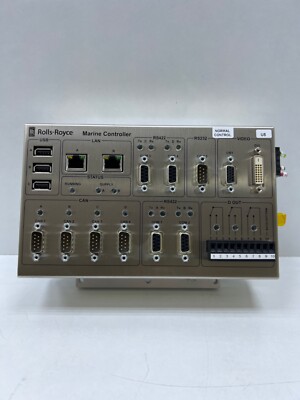
H1111.0104
Key Technical Specifications
- Operating Voltage: 24 V DC (Isolated for marine environments)
- Chassis Material: Anodized aluminum with vibration-resistant mounting
- Communication Interface: Dual Ethernet / CANbus / Serial (RS-485) for redundancy
- Operating Temperature: -15°C to +55°C (Standard bridge/engine room rating)
- Protection Class: IP 20 (Requires cabinet mounting)
- Vibration Resistance: Certified to IACS E10 standards
- Diagnostics: Front-panel status LEDs for System, Link, and Activity
- Compatibility: Integration with Rolls-Royce Icon or Helicon X3 control systems
- Cooling: Passive heat sink (No moving fans for higher MTBF)
Installation & Configuration Guide
Phase 1: Pre-Installation
Estimated time: 20 minutes
⚠️ Marine Safety Protocol:
- Notify the Chief Engineer and the Bridge officer before touching the Dynamic Positioning (DP) or Propulsion control racks.
- Ensure the system is in “Manual” or “Local” control mode.
- Verify that the UPS (Uninterruptible Power Supply) for the automation rack is switched off.
- Static Awareness: Ships are high-static environments. Wear a grounded ESD wrist strap before handling the H1111.0104.
Preparation:
- Metric socket set or Torx drivers (depending on the rack mount).
- Laptop with Rolls-Royce proprietary service tool (if software loading is required).
- Clean, dry workspace on a rubberized mat.
Phase 2: Removal
Estimated time: 10 minutes
- Cable Labeling: Marine wiring looms can be dense. Use cable ties and tags to label every Ethernet and Serial connector.
- Disconnecting Power: Unplug the 24 V DC Phoenix-style terminal block. Use a multimeter to confirm 0 V at the terminal.
- Unmounting: Remove the four mounting bolts securing the H1111.0104 to the 19-inch rack or sub-panel.
- Visual Check: Inspect the removed unit for signs of salt-air corrosion on the rear connectors.
Phase 3: Installation
Estimated time: 15 minutes
- Mounting: Align the new H1111.0104 with the mounting holes. Ensure the heat sink fins have at least 50 mm of clearance for airflow.
- Cabling:
- Re-attach the redundant communication cables.
- Plug in the 24 V DC power block.
- Pro-tip: Apply a small amount of non-conductive contact cleaner to the pins if the vessel has been operating in high-humidity tropical environments.
- Earthing: Ensure the chassis ground strap is securely fastened to the common earth bar.
Phase 4: Power-On & Testing
Estimated time: 45 minutes
- Initial Boot: Switch on power. The “System” LED should blink green during initialization.
- Network Sync: Confirm the module is communicating with the Bridge HMI. The “Link” LEDs on the network ports should show active traffic.
- Firmware Matching: Check the firmware version. In Rolls-Royce systems, all controllers in a redundant pair must have identical software versions.
- Commissioning:
- Perform a “Lamp Test” from the bridge.
- Engage the thruster in “Test” mode (if possible) to verify the command/feedback loop.
- Check the alarm history to ensure no “Module Missing” or “Node Fault” messages remain.
Customer Cases & Industry Applications
Case 1: Offshore Supply Vessel (OSV) DP System Repair
Situation: A PSV (Platform Supply Vessel) operating in the North Sea experienced a “Controller Halt” on its starboard thruster control system. The diagnostic pointed to the H1111.0104 failing due to an internal memory error.
Task: The vessel could not maintain DP2 (Dynamic Positioning Class 2) status, meaning it was prohibited from working near the oil platform. Every day of “Off-hire” cost the owner $25,000.
Action: We shipped a New Surplus H1111.0104 from our Singapore hub via helicopter to the vessel’s nearest port. Because the unit was in-stock, the total turnaround from failure to delivery was under 48 hours.
Result: The onboard ETO (Electro-Technical Officer) swapped the unit and restored the configuration from the system backup. The vessel regained its DP2 certification and resumed operations immediately, avoiding a costly dry-docking for repairs.
Frequently Asked Questions (FAQ)
Q1: Does the H1111.0104 come pre-loaded with software? A: Typically, New Surplus marine controllers come with Base Bios/Firmware but not the specific “Project Application.” You will need the vessel-specific configuration file, which is usually stored on a CF card or the master workstation.
Q2: Is this part compatible with Kongsberg systems? A: Since Kongsberg acquired Rolls-Royce Marine, many H-series parts are now supported by Kongsberg. The H1111.0104 is a direct fit for existing Rolls-Royce installations and is recognized by Kongsberg’s updated service tools.
Q3: Why is the price for this unit so high compared to industrial PLCs? A: Marine controllers are built to survive constant vibration, salt-laden air, and extreme temperature fluctuations. They also carry specific Marine Class Certifications (DNV, ABS, Lloyd’s) which are mandatory for insurance and safety compliance on commercial vessels.
Q4: Can I buy a refurbished unit instead? A: I strongly advise against it for propulsion or DP systems. Refurbished marine boards often have micro-fractures in the solder joints caused by years of engine vibration. New Surplus is the only way to ensure the safety of the vessel and its crew.
Q5: What is the lead time for shipping to a port? A: We understand that ships don’t wait. We provide Priority Handling for marine orders, typically reaching major hubs like Rotterdam, Singapore, or Houston within 3-4 business days.