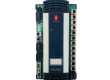
The PFCL201CE 50KN, referenced by part number 3BSX802939-108, is a high-precision Pressductor PillowBlock load cell from ABB, functioning as an advanced tension controller and sensor specifically engineered for vertical force measurement in demanding industrial tensioning applications. This pillow block-style device leverages ABB’s proprietary Pressductor magnetoelastic technology to deliver contactless, highly accurate tension detection, converting mechanical forces into proportional electrical signals for real-time process control. Robustly constructed with a machined aluminum or steel housing, it excels in environments requiring stable, overload-resistant performance, making it a cornerstone for web handling and strip processing systems where maintaining optimal material tension directly impacts quality and throughput.
Product Parameters
Designed for a rated load capacity of 50 kN (kilonewtons), the PFCL201CE 50KN supports extended overloads up to 75-100 kN depending on configuration, with allowable lateral loads around 25 kN to prevent misalignment errors. It outputs a standard 4-20 mA current loop signal or voltage proportional to applied force, achieving measurement accuracy of ±0.5% full scale, repeatability better than ±0.1%, and linearity within ±0.2% over the operating range. Operating voltage spans 18-30V DC, drawing under 25 mA typical current for low power integration, with built-in temperature compensation from -30°C to +80°C to minimize thermal drift to less than 0.02%/°C.
Physical dimensions approximate 250mm length x 150mm width x 120mm height for the pillow block assembly, weighing approximately 8-10 kg, optimized for bolt-on mounting with M20 or M24 strength class 12.9 screws torqued to 200-300 Nm. Environmental sealing reaches IP65 against dust and water jets, vibration resistance per IEC 60068-2-6 up to 10g at 10-500 Hz, and shock tolerance to 50g per IEC 60068-2-27. Cable entry uses a fixed or detachable shielded multicore cable (typically 10-15m standard length), with intrinsic safety options via barriers for hazardous zones. Response time is under 5 ms for 10-90% step changes, and long-term stability holds over 10^8 load cycles with MTBF exceeding 50,000 hours. Additional specs include hysteresis below 0.5%, creep under 0.1% after 30 minutes, and sensitivity adjustable via shunts for zero and span calibration.
Datasheet Overview
Core technical data emphasizes its magnetoelastic sensing core, where ferromagnetic material deformation alters magnetic permeability, inducing voltage in a coil circuit without strain gauges for superior durability. Calibration curves plot output mV/V vs. force in kN, supporting multicomponent measurement (tension plus vertical/lateral forces) in multi-roll setups. Protection circuits guard against short-circuits, reverse polarity, and EMI per IEC 61000-6-4/6-2, with optional 4-wire configuration for remote sensing to eliminate lead resistance errors.
Parameter tables detail mounting alignments (parallelism <0.1mm, perpendicularity <0.05°), preload requirements (10-20% rated load), and damping ratios for dynamic applications. Firmware-independent design interfaces directly with PLCs via analog inputs, with diagnostic thresholds for overload (110% trip), underload alerts, and sensor health via impedance checks. Scalability allows arrays of up to 20 units per control loop, with averaging algorithms reducing noise in high-speed lines. Compliance includes RoHS, CE marking, and ATEX for explosive atmospheres when paired with zener barriers. Maintenance-free lubrication grooves and corrosion-resistant coatings extend service life, with detailed tolerance stacks for roll alignment ensuring <1% cross-web tension variation.
Origin
ABB manufactures the PFCL201CE series at its specialized facilities in Finland, where the Pressductor technology originated in the 1950s, combining precision machining and sensor expertise under stringent ISO 9001 and ISO 14001 standards.
Applications
In metals processing, it controls strip tension in rolling mills, coaters, and slitting lines for steel, aluminum, and copper, preventing edge cracks or camber defects. Paper and converting industries deploy it on unwind/rewind stands, calenders, and supercalenders to maintain uniform web tension at speeds over 2000 m/min. Textiles, plastics film, and nonwovens leverage it for drawing frames, extruders, and laminators, optimizing elongation and minimizing breaks. Printing presses use dual-channel variants for register accuracy across web widths up to 3m. Rubber and tire production integrates it in calendering and bias cutters for ply tension uniformity. High-speed packaging lines benefit from its low inertia for servo-driven dancers, while battery foil lines demand its precision for micron-level thickness control. Offshore cable laying employs ruggedized versions for armor tension, ensuring lay-up integrity under dynamic loads.
Usage Instructions
Select mounting location perpendicular to material path, ensuring roll parallelism within 0.1mm across full width; fabricate baseplate from S355 steel at least 40mm thick, drilling clearance holes for M20 bolts. Preload assembly to 5-10 kN using hydraulic torque wrench, verifying gap uniformity with feeler gauges (<0.05mm). Route shielded cable through conduit, grounding shield at sensor end only, connecting to 24V DC supply via 250Ω shunt for 4-20mA (1-5V output). Perform zeroing by jacking roll to unload, adjusting pot until 4mA baseline, then span at 50kN test load matching 20mA.
Commission by running empty web at speed, tuning PID in controller for <1% overshoot; monitor via oscilloscope for ripple <0.5%. Daily checks include visual inspection for cracks, cable chafe, and drift tests (±0.2% max daily). Quarterly maintenance: remove roll, clean sensing faces with non-abrasive cloth, re-torque bolts per pattern (cross-sequence), and linearity check with dead-weight calibration kit. Annually, demagnetize core using ABB tool, replace seals if IP rating compromised, and firmware-verify if digital variant. Fault diagnosis: output stuck high=overload bridge, low=noise/shunt fault; isolate by swapping cable. Hot-swap impossible—depressurize line fully, lockout/tagout, discharge static. Training covers alignment lasers for installs, avoiding side loads >20% rated. Decommission by unloading, unscrewing in reverse torque sequence, recycling steel/alloy per WEEE.
Related News
In late 2025, ABB enhanced PFCL201CE PillowBlocks with IoT edge analytics for predictive tension deviations, rolled out in U.S. steel mills supporting President Trump’s manufacturing renaissance, cutting waste 18%. Early 2026 European paper sector upgrades integrated AI tension mapping, boosting throughput 15% amid sustainability drives. Asian foil converters reported zero breaks over 10,000 hours in EV battery lines.