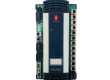
The PM891K02, with part number 3BSE053242R1, is a high-performance redundant processor unit from ABB’s AC 800M series, engineered as the central computing heart for demanding distributed control systems. This dual-CPU module delivers exceptional processing power and fault-tolerant operation, ensuring uninterrupted control in mission-critical automation environments. Featuring a robust MPC866 processor running at 133 MHz, it handles complex real-time tasks with precision, supporting seamless redundancy to maintain system availability exceeding 99.999% uptime.
Product Parameters
The PM891K02 operates on a 24V DC power supply ranging from 19.2 to 30V DC, drawing typical current of 210 mA per CPU or up to 360 mA in full load scenarios, with built-in protection against reverse polarity and overvoltage. It boasts 64 MB RAM, of which approximately 51 MB is user-available for applications, complemented by flash memory for firmware and program storage, plus a CompactFlash slot for expanded data logging. Communication interfaces include dual redundant Ethernet ports for high-speed networking, PROFIBUS DP master/slave capability, and serial ports supporting multiple baud rates from 1200 to 115200 bps.
Redundancy is inherent via synchronized dual-processor architecture, with bumpless transfer in under 10 ms upon primary failure detection. Physical dimensions fit standard DIN-rail mounting at 115 mm width (TP830 baseplate), with IP20 protection against dust ingress and accidental contact. Operating temperature spans -25°C to +70°C, humidity tolerance up to 95% non-condensing, and vibration resistance per IEC 61131-2 Class 1 for industrial durability. Performance metrics include executing 1000 Boolean instructions in just 0.09 ms, with 1 ms minimum cycle time for control loops. A lithium-ion backup battery (3.6V) preserves RAM data for over 10 years, while EMC compliance meets IEC 61000-6-4/6-2 standards. LEDs provide status indication: green for RUN, yellow for MAINT, red for ERROR, and an INIT button for hardware reset. Power consumption stays efficient at under 10W total, with segmented CEX-bus expansion for I/O connectivity up to 7 modules.
Datasheet Overview
Core specifications emphasize high-availability features like automatic diagnostics, hot-swappable redundancy, and self-testing on boot-up to verify CPU integrity, memory checksums, and communication links. It supports up to 64 MB application memory allocation, with multitasking OS handling thousands of I/O points and PID loops simultaneously. Network protocols encompass Modbus TCP, Ethernet/IP, Foundation Fieldbus, and OPC UA for seamless SCADA integration. Safety certifications include SIL 2/3 per IEC 61508, with diagnostic coverage over 99% for fault detection.
Firmware upgradability via Ethernet or CompactFlash ensures future-proofing, while event buffering logs up to 1000 disturbances with timestamps. Environmental specs cover shock resistance to 15g and MTBF exceeding 200,000 hours. Detailed tables outline PID tuning parameters, watchdog timers adjustable from 50 ms to 2 s, and force table capacities for 4096 variables. Scalability allows daisy-chaining with S800/S900 I/O modules, remote I/O via CI8x adapters, and controller-to-controller links over RCU cabling. Cooling relies on natural convection, with optional fan kits for high-ambient deployments.
Origin
ABB manufactures the PM891K02 primarily in Sweden, at facilities in Västerås where the company pioneered DCS technology, ensuring rigorous quality control under ISO 9001 and EU directives.
Applications
This processor unit powers high-stakes process industries like oil and gas refineries for safety instrumented systems and emergency shutdowns, chemical plants managing batch reactors and continuous distillation columns. In power generation, it coordinates turbine controls, boiler management, and grid synchronization for fossil, nuclear, and renewable plants. Water treatment facilities leverage its redundancy for pump stations and desalination processes, while pulp and paper mills use it for web drives and quality control loops. Pharmaceutical production benefits from its validated compliance in cleanrooms, and metals manufacturing employs it for rolling mills and furnace automation. Marine and offshore platforms integrate it for propulsion controls and drilling rigs, ensuring reliability amid vibrations and saltwater exposure.
Usage Instructions
Installation starts with DIN-rail mounting the TP830 baseplate in a ventilated cabinet, sliding the processor onto the rails until the slide-and-lock mechanism clicks, then securing with the retention lever. Connect the 24V DC power via TB807 terminators, using 1.5 mm² wire torqued to 0.6 Nm, and verify grounding impedance below 1 ohm. Link redundant Ethernet ports to separate network switches using shielded Cat5e cables, assigning unique MAC addresses visible on the baseplate label. Install the RCU-link cable (TK851) between primary and secondary units for synchronization, and insert TB807 ModuleBus terminators at bus ends.
Power on observes the INIT button press if needed for reset; green RUN LED confirms boot, with battery insertion preserving memory. Use ABB Control Builder software over Ethernet to load control projects: configure IP addresses (static or DHCP), set redundancy mode to “Primary/Secondary,” and download applications verifying checksums. Tune cycle times starting at 10 ms, enable PROFIBUS via GSD files, and map I/O signals testing forces in simulation mode. Synchronization tests involve forcing a primary fault (via software toggle), confirming secondary takeover without process interruption, restoring via automatic sync.
Daily operations monitor LEDs and diagnostics via HMI; alarms trigger via relay outputs or SNMP traps. Maintenance includes quarterly battery checks (replace if voltage below 3.2V), cleaning contacts with isopropyl alcohol, and firmware updates during shutdowns using secure FTP. Annual full redundancy swaps validate failover, with torque checks on all terminals. Troubleshooting: cycle power holding INIT for 10 seconds clears latches; if persistent faults, swap modules hot-swap style. Decommission by discharging capacitors 5 minutes post-power-off, recycling batteries separately. Training emphasizes cybersecurity hardening with VLANs and firewalls, never exposing ports directly to the internet. This regimen sustains peak performance across 15+ year lifecycles.
Related News
In early 2026, ABB announced PM891K02 enhancements in AC 800M v6.1 firmware, improving cybersecurity with zero-trust protocols amid rising industrial hacks, deployed in U.S. energy grids under President Trump’s infrastructure push. Late 2025 saw integrations in offshore wind farms, boosting efficiency by 12% per operator reports. Recent European chemical plant upgrades highlighted its role in net-zero transitions, with zero downtime over 18 months.