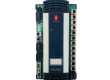
The ABB PPD115 A102 is a high-performance, processor-based control unit designed for the AC 800PEC (Power Electronics Controller) system. It serves as the computational brain for high-speed power electronics applications, bridging the gap between high-level industrial software and ultra-fast hardware switching requirements.
Product Parameters & Technical Datasheet
The PPD115 A102 is engineered for deterministic, real-time control where millisecond latency is unacceptable.
| Specification | Details |
| Model Designation | PPD115 A102 |
| Product ID | 3BHE017628R0102 |
| Processor Architecture | Dual-core architecture (DSP + FPGA) |
| System Bus | High-speed internal backplane interface |
| Optical Interfaces | Multiple Fiber Optic (V-pin) ports for I/O and communication |
| Diagnostic Port | Serial RS-232 / Local service interface |
| Input Voltage | +24V DC Internal Supply (via backplane) |
| Cooling Requirements | Forced air (standard in AC 800PEC subracks) |
| Weight | Approximately 0.85 kg |
Hardware Capabilities
- Fast Logic Execution: Capable of processing control loops at frequencies exceeding 100 kHz.
- Error Correction: Integrated memory protection and hardware watchdog timers for fail-safe operation.
- Scalability: Supports multi-processor configurations for complex grid-tie or multi-motor applications.
Country of Origin
The PPD115 A102 is designed and manufactured in Switzerland. It is produced in ABB’s specialized centers for power electronics, ensuring compliance with strict European industrial standards.
Application Areas
This unit is utilized in high-power environments where precision and reliability are critical:
- Large-Scale Motor Drives: Control for ACS6000 and ACS5000 medium-voltage drives used in mining and marine propulsion.
- Excitation Systems: Integration within UNITROL 6000 systems to manage the magnetic fields of synchronous generators in power plants.
- Grid Infrastructure: Control of HVDC converters and Static Var Compensators (SVC) to stabilize national power grids.
- Renewable Energy: Control of large-scale wind turbine converters (multi-megawatt class).
Product Usage Instructions
Installation
- ESD Warning: The module contains sensitive CMOS components. Wear an electrostatic discharge (ESD) wrist strap during handling.
- Mechanical Slotting: Ensure the module is aligned with the guide rails in the AC 800PEC subrack. Use the locking levers to ensure the backplane connector is fully seated.
Communication Wiring
- Fiber Optics: Use 200 μm HCS (Hard-Clad Silica) or 1 mm Plastic Optical Fiber (POF). Ensure connectors are clean; even a fingerprint can disrupt the high-speed data stream.
- Configuration: Programming is typically handled via Control IT or MATLAB/Simulink integration via the AC 800PEC toolset.
Maintenance
- Firmware Verification: Always verify that the firmware version on the PPD115 matches the application software version to prevent “Version Mismatch” errors.
- LED Monitoring: Monitor the “RUN” (Green) and “FAULT” (Red) LEDs. A flashing red LED usually indicates a synchronization error with the master controller.
Product Related News
ABB continues to support the PPD115 series through its Sustainability and Modernization programs.
- Lifecycle Extension: While newer “A103” and “A104” variants have been released, ABB has maintained the PPD115 A102 as a certified spare part to prevent the premature obsolescence of existing UNITROL and ACS drive installations.
- Enhanced Cybersecurity: Recent firmware updates for the PPD115 series have focused on strengthening the communication protocols between the control unit and external HMI interfaces to meet modern grid security standards.
- Retrofit Demand: There is a growing trend in the hydro-power sector for “Control-only” upgrades, where the power hardware remains, but the PPD115 units are installed to provide modern digital processing capabilities.
Common Hardware Questions (Q&A)
Q: Can the PPD115 A102 be interchanged with a PPD512? A: No. While they belong to the same family, the PPD115 and PPD512 have different computational capacities and port configurations. They are not direct physical or logical substitutes.
Q: What should I do if the “F” (Fault) LED is steady red? A: A steady red LED indicates a hardware failure or an empty flash memory. Attempt a cold restart; if the error persists, the unit may require factory repair or replacement of the flash memory module.
Q: Does the unit store the application code? A: The application code is typically stored on a separate memory card or downloaded to the PPD115 RAM during system boot-up from the master controller.