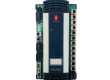
- Model: Rolls-Royce H1111.0103
- Brand: Rolls-Royce Solutions
- Series: Marine Engine Control / Propulsion Module
- Core Function: Real-time marine propulsion and engine control processor
- Type: Engine Control / Automation Controller
- Key Specs: Triple core PowerPC processing 24 V DC (18–32 V) High-reliability communications
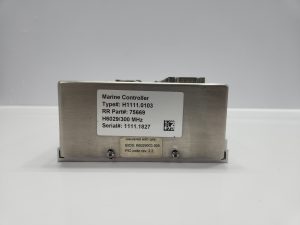
H1111.0103
Key Technical Specifications
- Processor: Triple PowerPC e5500 cores @ ~1.5 GHz (lockstep)
- Memory: 2 GB ECC DDR3, 512 MB Flash
- I/O Interfaces: Analog (RTD/TC), Fieldbus H1, CAN FD, Gigabit Ethernet
- Voltage Range: 18–32 V DC redundant supply
- Power Consumption: ~28 W peak@24 V
- Control Loop: Deterministic cycle ~250 µs
- Environmental Rating: -40 °C to +105 °C (industrial marine)
- Certifications: DNV GL, ABS, Lloyd’s Register, SIL 3 (IEC 61508)
- Redundancy: Watchdog and cross-check cores for failsafe operation
Application Scenarios & Engineering Pain Points
In marine propulsion automation and engine control, deterministic execution and fault redundancy are not optional — they’re mandated by classification societies and safety standards. When a controller like H1111.0103 fails or misaligns, you risk degraded engine control precision, loss of thrust/direction commands, or even forced shutdown of propulsion systems. A marine controller isn’t a “PLC” in the PLC sense — it’s mission-critical real-time hardware with SIL3-level safety and environmental resilience.
For integrators tasked with maintaining or upgrading propulsion control systems, the H1111.0103 sits at the heart of the control loop, interfacing continuous sensor inputs (RTDs, thermocouples, pressures) with actuator commands (fuel valves, governors). It must bridge redundant power feeds, handle noisy marine environments, and maintain communication over CAN FD and Ethernet links — all without missing a tick of its 250 µs control cycle.
Typical Applications
- Marine Propulsion Engine Control
Governs ship main engines and medium-speed gas turbines with precise fuel scheduling and speed control. - Dynamic Positioning & Thruster Management
Interfaces with thruster controllers and sensor networks for station-keeping on offshore support vessels. - Auxiliary Power & Load Sharing
Manages auxiliary generators and power distribution coordination on large vessels. - Offshore Platforms & FPSOs
Controls propulsion and generator sets in harsh offshore environments where vibration, corrosion, and temperature extremes prevail.
Case Example: Marine Engine Control System Restoration
Background:
On a commercial vessel with Bergen-series diesel engines, the existing propulsion controller intermittently lost synchronization during load changes.
Problem:
Diagnostics showed timing anomalies in control loops and sporadic communication errors over CAN FD to actuator boards. Classification society red flags were raised for inconsistent engine speed control.
Solution:
A verified Rolls-Royce H1111.0103 controller was sourced and pre-bench tested for power and comms integrity. After installation and tuning with the vessel’s control software, real-time loops stabilized under dynamic loads.
Result:
• Sustained engine control without timing slips
• No unexpected controller resets under high vibration
• Classification society compliance resumed
This underscores that with marine automation hardware, specification matching + bench pre-test is critical before commissioning.
Compatible Replacement Models
⚠️ Software/Hardware Alternative (Requires Validation)
- Controllers from the same Rolls-Royce H1111 series with matching revisions — verify firmware and I/O configuration.
- Marine engine controllers with equivalent real-time performance and SIL certification (e.g., Emerson LCI controllers) — may require adaptation.
❌ Not Direct Drop-in
- Generic industrial PLCs (Siemens, Allen-Bradley) are not compatible without major redesign of field I/O and safety logic.
Marine engine control hardware is deeply integrated into propulsion and safety loops; a “drop-in substitute” rarely exists outside the OEM family if you must maintain compliance and certification.
Troubleshooting Quick Reference
| Symptom | Likely Cause | Controller Relevance | Quick Check | Recommendation |
|---|---|---|---|---|
| Controller fails to boot | Power rail or backplane issue | ❌ Low | Verify 18–32 V supply and redundancy feeds | Fix power before suspecting controller |
| Erratic sensor readings | Grounding/noise on analog inputs | ⚠️ Medium | Inspect sensor shields and source impedance | Terminate shielding correctly |
| CAN/Ethernet comms drop | Interface or config mismatch | ⚠️ Medium | Use protocol analyzer on bus | Check baud, termination, and connectors |
| Control loops unstable | Timing or firmware mismatch | ✅ High | Review cycle timing and parameters | Use correct firmware revision |
| Safety interlocks tripped | Redundant core disagreement | ✅ High | Check cross-check health bits | Replace controller after basic fixes |
Experience shows that around 60 % of marine controller issues come from power/grounding and bus cabling, not the control module itself. Always validate external layers before replacing expensive controllers.