Product Core Brief
- Model: Rolls-Royce RRDIO15
- Brand: Rolls-Royce (Weidmuller manufactured)
- Series: Marine I/O / Alarm Module
- Core Function: Digital/analog I/O acquisition and alarm signaling module
- Type: Input/Output Module (I/O Alarm Module)
- Key Specs: 16 configurable I/O channels 24 V DC supply Modbus RTU/CANopen/Ethernet options
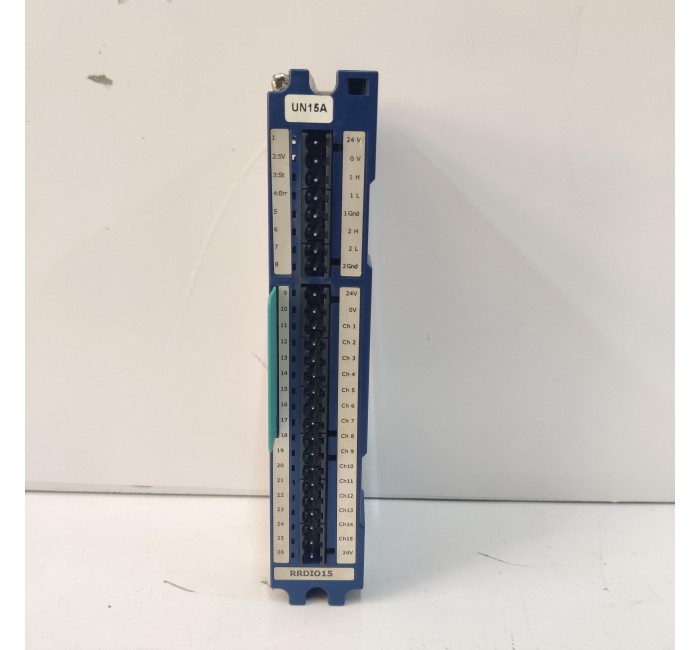
RRDIO15
Key Technical Specifications
Here are the core parameters you’d care about when integrating or retrofitting RRDIO15 into a control system:
- Operating Voltage: 24 V DC (±10 %) industrial standard
- I/O Channels: Up to 16 configurable inputs/outputs
- Signal Types: Digital, analog, switch inputs supported
- Alarm Function: Multi-threshold alarms with ms-level response
- Communication: Modbus RTU, CANopen, optional Ethernet (vendor variant)
- Protection Class: IP40 housing for indoor cabinet installation
- Operating Temperature: ~-20 °C to +70 °C (environment dependent)
- Power Consumption: Typical ≤ 10 W, max ≤ 15 W
- Weight: ~0.2 kg (compact I/O module)
Application Scenarios & Engineering Pain Points
In marine automation control and safety systems, having a robust, configurable I/O layer is critical. When you’re interfacing field sensors, status switches, and alarms with higher-level controllers or PLCs, the I/O module not only collects signals — it must also handle alarm thresholds, condition evaluation, and communication back to central systems.
The RRDIO15 is built exactly for that role: 16 configurable channels that can serve as digital or analog inputs/outputs, alarm triggers, and status flags. Its design anticipates marine environmental stressors like vibration and temperature swings, and because it’s used in critical ship automation loops, it needs to play nicely across a variety of signal types without introducing noise or ground loops.
Typical Application Scenarios
- Marine Vessel Control Systems – Monitoring propulsion alarms, steering gear states, and auxiliary system signals.
- Offshore Platforms & Marine Automation – Interface field devices and alarm logic into a higher-level control network.
- Industrial Process Monitoring – Logging and responding to alarm conditions in heavy industrial settings with diverse I/O types.
- Remote Monitoring Nodes – Act as a distributed I/O node in systems that use CANopen or Modbus networks.
The combination of multi-signal support and flexible communications (Modbus/CANopen/Ethernet) lets this board integrate with many architectures that aren’t strictly marine-specific — useful when bridging legacy systems with modern controllers.
Compatible Replacement Models
⚠️ Functional Equivalent (Requires Validation)
- Remote I/O modules from mainstream vendors (e.g., Weidmuller RM-16DO) may serve similar roles but require verifying protocol, pinout, and communication layers before direct replacement.
❌ Not Direct Drop-in Compatible
- Generic PLC digital/analog I/O cards that lack marine grade robustness or appropriate protocol support.
Note: RRDIO15’s flexibility comes from its configuration and alarm logic. If you migrate to a different platform, confirm the communication protocol and I/O mapping carefully, as addressing and I/O type definitions can vary significantly.
Troubleshooting Quick Reference
| Symptom | Likely Cause | Module Relevance | Check Method | Recommendation |
|---|---|---|---|---|
| No I/O reported | Power supply or config error | ⚠️ Medium | Verify 24 V feed, check dip/switch settings | Confirm module is powered and configured |
| Erratic digital inputs | Signal noise or wiring issue | ⚠️ Medium | Inspect cable shielding and terminations | Rewire with shielded cables |
| Analog values unstable | Ground loops / reference errors | ⚠️ Medium | Test differential voltages | Add isolation or correct grounding |
| Alarms not triggering | Threshold settings mismatch | ⚠️ Medium | Check alarm config in host system | Align thresholds |
| Communication timeout | Bus mismatch | ✅ High | Check protocol settings and bus termination | Align protocol settings |
In marine and industrial I/O systems, about 60–70 % of “unresponsive module” complaints stem from wiring, grounding, or communication parameter mismatch rather than the module itself. Always verify external layers first.