
| Feature | Specification |
| Model | MVI56E-MNET |
| Series | ControlLogix (Enhanced Platform) |
| Module Type | Modbus TCP/IP Enhanced Communication Module |
| Protocol | Modbus TCP/IP (Client/Server) |
| Ethernet Port | 10/100 Mbps RJ45 (Auto-Sensing) |
| Backplane Current | 800 mA @ 5V DC |
| Max Clients | 30 (Client Mode) |
| Max Servers | 20 (Server Mode) |
| Operating Temp | 0°C to +60°C |
The Allen-Bradley ProSoft MVI56E-MNET serves as a high-performance Modbus TCP/IP communication interface designed specifically for the ControlLogix platform. It excels in bridging the gap between Rockwell Automation processors and third-party Modbus TCP/IP devices—such as power monitors, drives, and flow computers—providing seamless data exchange via the backplane without the need for complex ladder logic or heavy processing overhead.
Model Comparisons
The MVI56E-MNET is the “Enhanced” successor to the original MVI56-MNET. While the legacy version required complex configuration via serial cables and lacked internal storage for AOIs (Add-On Instructions), the “E” version features an onboard web server, scrolling LED display for diagnostics, and support for CIPconnect, which allows remote configuration over Ethernet. Compared to the MVI56E-MCMR (Modbus Serial), this module is dedicated to high-speed Ethernet-based Modbus networks, offering significantly higher data throughput and the ability to handle up to 5,000 words of internal database registers.
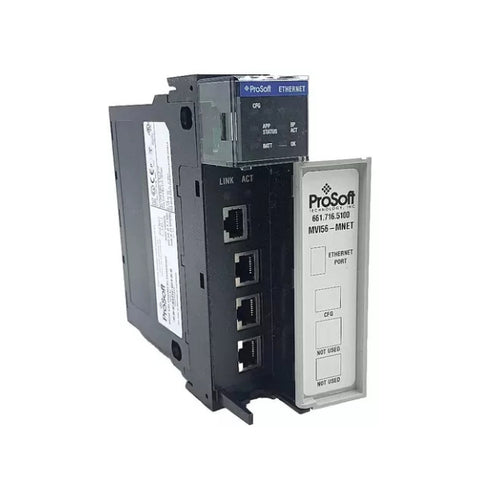
MVI56E-MNET
Operating Tips
- Add-On Instruction (AOI): Always download the latest AOI from the ProSoft website; utilizing the predefined data structures in RSLogix 5000/Studio 5000 significantly reduces manual mapping errors and setup time.
- Warm Booting: If you change the IP address or configuration file, use the “Warm Boot” command within the controller tags rather than cycling the entire chassis power to re-initialize the Modbus stack.
- Network Segmentation: For critical control applications, place the MVI56E-MNET on a dedicated I/O network or VLAN to prevent “broadcast storms” from enterprise-level traffic affecting Modbus polling cycles.


