
The BENDER EDS460-D-2 is a sophisticated insulation fault evaluator designed for use in unearthed AC, DC, and AC/DC (IT) systems. Working in conjunction with a PGH test signal generator or an ISO-685 series insulation monitoring device, this 12-channel locator identifies the specific circuit or outgoing line containing an insulation leak. It utilizes highly sensitive current transformers to detect the specific pulse signal injected into the system, allowing for rapid troubleshooting without the need to disconnect loads or power down critical industrial processes.
Product Specifications
| Parameter | Specification |
| Model Number | EDS460-D-2 |
| Monitoring Channels | 12 Independent Measuring Channels |
| System Voltage Range | AC 0–793 V / DC 0–1100 V (with appropriate sensors) |
| Response Sensitivity | 2 mA to 10 mA (Adjustable) |
| Communication Interface | RS-485 with BMS Protocol (Bender Measuring Bus) |
| Display | LC Display with Backlighting |
| Rated Voltage | AC 100–240 V / DC 100–350 V |
| Operating Temperature | -25°C to +55°C |
| Mounting | DIN Rail (Standard 35mm) |
| Alarm Contacts | 2 Voltage-free Changeover Contacts |
The Bender EDS460-D-2 serves as the central intelligence for automated fault location, significantly reducing mean time to repair (MTTR) in large-scale power distribution networks. By monitoring 12 circuits simultaneously, the device can distinguish between a real insulation fault and system-related leakage capacitance. Its digital processing capabilities allow it to store history and communicate fault locations to a central SCADA or building management system via the BMS bus, ensuring that maintenance teams are alerted to the exact location of a ground fault the moment it occurs.
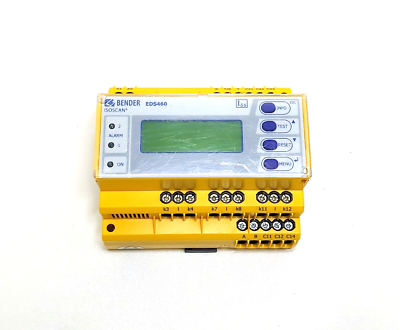
BENDER EDS460-D-2
Model Comparison: EDS460-D-2 vs. EDS460-L
The primary difference between the EDS460-D-2 and the EDS460-L version lies in the display and interface capabilities. The “D” series (Digital) is equipped with a full integrated LC display and navigation buttons, allowing for local configuration and real-time viewing of leakage current values for all 12 channels. In contrast, the “L” version is often a “blind” module intended for slave operation where all data is viewed via a remote display or a master gateway. Furthermore, the D-2 revision features enhanced RS-485 driver stability, making it better suited for long-distance communication in large industrial plants compared to legacy EDS460 iterations.
Operation Tips
- Transformer Orientation: When installing the measuring current transformers (CTs) for the 12 channels, ensure all active conductors (L1, L2, L3, and N) of the circuit pass through the CT in the same direction; the protective earth (PE) must never pass through the CT.
- Address Assignment: If using multiple EDS460-D-2 units on a single BMS bus, ensure each unit has a unique bus address (1–150) set via the local menu to avoid data collisions.
- Threshold Setting: Set the response value slightly above the natural leakage current of the circuit to avoid nuisance alarms; for most industrial IT systems, a starting threshold of 5 mA is recommended.
- PGH Synchronization: Verify that the “Location Mode” is active on your insulation monitor (e.g., ISO685); the EDS460-D-2 cannot locate a fault unless a test signal is being actively injected into the system.


