
The DEIF SIM-Q LF is a high-precision insulation monitoring relay designed specifically for AC networks with high capacitive leakage currents, common in marine and industrial frequency converter applications. This “LF” (Low Frequency) variant utilizes a sophisticated measuring principle to monitor the insulation resistance between an unearthed (IT) mains system and the ship’s hull or protective earth. By providing continuous surveillance of the network’s integrity, it ensures early detection of insulation degradation before a catastrophic short circuit or equipment failure occurs.
Product Specifications
| Parameter | Specification |
| Model Number | SIM-Q LF |
| Measuring Range | 1 MΩ to 0 MΩ |
| Mains Voltage | 400–480V AC |
| Network Type | 3-phase AC (Unearthed / IT System) |
| Low Frequency (LF) | Optimized for systems with high capacitance |
| Output Contacts | 2 Relay Outputs (Warning and Alarm) |
| Response Time | < 2 seconds (Typical) |
| Mounting | DIN Rail or Base Mount |
| Protection Degree | IP40 (Front), IP20 (Terminals) |
| Standard Compliance | IEC/EN 60255, CE, Marine Classification Society standards |
The DEIF SIM-Q LF serves as a critical safety barrier for non-grounded power systems, providing real-time feedback on the health of the electrical distribution network. Its ability to filter out electrical noise and harmonic distortion—frequent side effects of variable frequency drives (VFDs)—makes it superior to standard insulation monitors that might trigger false alarms. With adjustable trip levels for both warning and alarm states, it allows maintenance crews to schedule repairs during planned downtime rather than reacting to emergency outages.
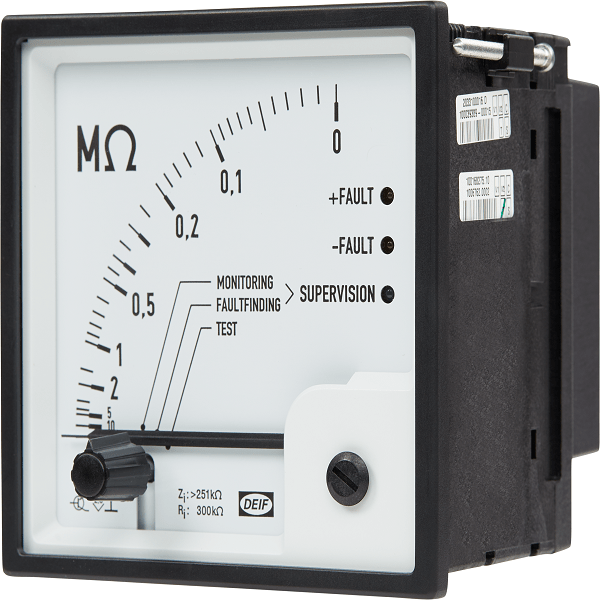
DEIF SIM-Q LF 1…0MOhm 400-480V AC
Model Comparison: SIM-Q LF vs. Standard SIM-Q
The primary distinction between the SIM-Q LF and the standard SIM-Q model is the Low Frequency (LF) measuring circuit. While the standard SIM-Q is suitable for general AC networks, the LF version is engineered for systems with large cable lengths or frequency converters that exhibit high system leakage capacitance (up to 50 µF or more). Unlike basic models that can be “fooled” by capacitive charging currents, the SIM-Q LF maintains accuracy by using a specialized measuring voltage, ensuring that the resistance value displayed represents the actual ohmic insulation state of the 400-480V network.
Operation Tips
- De-energized Testing: When performing a high-voltage “Megger” test on the distribution bus, always disconnect the SIM-Q LF to prevent the test voltage from damaging the sensitive electronic monitoring circuitry.
- Capacitance Calibration: Ensure the unit is correctly matched to the system’s total leakage capacitance; if the “System Fault” LED illuminates, it may indicate that the network capacitance exceeds the LF module’s compensation range.
- Relay Logic Configuration: The warning and alarm relays can be configured for “Normally Energized” (fail-safe) or “Normally De-energized” logic; check your ship’s electrical schematics to ensure the relay behavior matches the alarm system input.
- Terminal Tightness: In marine environments, vibration can loosen screw terminals over time; periodic inspection of the 400-480V AC sensing lines is essential to prevent arcing or intermittent loss of monitoring signal.


