
- Manufacturer: Kongsberg Maritime
- Model Identification: RCU501
- Part Category: Remote Controller Unit (Main Processor)
- Processor System: High-performance processing core for K-Chief 600 systems
- Supply Voltage: Dual redundant 24V DC power inputs
- Networking Capability: Integrated dual-port RLAN (Redundant Local Area Network)
- Storage: Solid-state flash memory for application software and configuration storage
- Environmental Rating: Engineered for marine bridge and engine room environments
- Operating Temperature: -15°C to +70°C
- Vibration Resistance: High-tolerance design for engine room installation
- Connectivity: Support for various I/O module extensions via internal and external bus systems
- Certification: Marine Type Approved by DNV, ABS, and Lloyd’s Register
The KONGSBERG RCU501 represents the next generation of maritime control intelligence, serving as the primary processing node for the K-Chief 600 and AutoChief 600 automation architectures. This unit is specifically designed to handle massive data throughput from distributed I/O systems while maintaining the sub-millisecond response times required for critical vessel safety and propulsion control. With its enhanced thermal management and ruggedized internal components, the RCU501 ensures continuous operation in the extreme conditions of maritime engineering spaces, providing the computational backbone for energy management, machinery monitoring, and ship-wide automation.
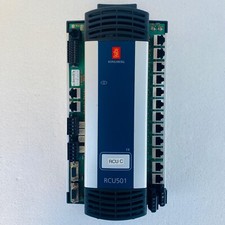
Kongsberg RCU501
Differences from Similar Models
The RCU501 is the direct successor to the RCU500 series, offering significantly increased RAM and faster CPU clock speeds to support the more graphic-intensive and data-heavy requirements of the K-Chief 600 series. While the RCU500 was limited in its processing overhead for very large I/O counts, the RCU501 can manage a larger number of simultaneous control loops and serial data streams without latency. Additionally, the RCU501 features improved cyber-security hardware at the silicon level and enhanced RLAN synchronization, making it more resilient against network jitter compared to legacy RCU400 or RCU500 units.
Operating Tips
Before commissioning an RCU501, always ensure that the IP addresses for the redundant A and B networks are correctly configured via the maintenance port to avoid network collisions on the vessel’s backbone. It is important to monitor the status LEDs during the boot sequence; a steady “Ready” light indicates successful self-diagnostics, while a flashing “Error” light often points to a mismatch between the installed hardware and the software project version. Regularly check the integrity of the heat sink fins and ensure that the cabinet airflow is unobstructed, as maintaining a stable internal temperature is key to maximizing the lifespan of the processor.


