Description
⚡ Product Introduction
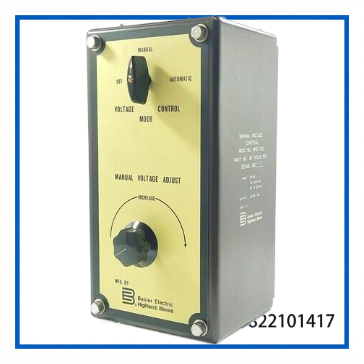
The BASLER ELECTRIC MVC 232, part number 9037000103, is a Manual Voltage Control unit designed for generator excitation systems. It provides a manual means of controlling generator excitation when the automatic voltage regulator is unavailable or when manual backup operation is required.
The MVC 232 is designed for use with compatible Basler Electric automatic voltage regulators in brushless excitation applications. It can isolate the associated automatic regulator and provide manual control of generator output voltage, making it useful as a backup control device for critical generating equipment.
🔧 Key Features
- ⚡ Manual generator excitation control
- 🔄 Manual / automatic voltage-control operation
- 🛡️ Backup operation during AVR or sensing-transformer failure
- 🔌 Designed for compatible Basler excitation systems
- 🎛️ Variable manual voltage adjustment
- 🏭 Suitable for generator and industrial power-generation systems
- 🔧 Rugged metal construction
- 🧰 Suitable for maintenance, replacement, and retrofit applications
📋 Product Datasheet
| Parameter | Specification |
|---|---|
| Brand | BASLER ELECTRIC |
| Model | MVC 232 |
| Part Number | 9037000103 |
| Series | Manual Voltage Control |
| Product Name | Manual Voltage Control |
| Application | Generator Excitation / Voltage Control |
| Input Voltage | 60 VAC nominal |
| Input Frequency | 50–400 Hz |
| Maximum Continuous Output | 55 VDC / 20 ADC |
| Weight | Approx. 36 lb (16.3 kg) |
The published MVC 232 specifications identify a 60 VAC nominal single-phase input, 50–400 Hz input frequency, and maximum continuous output of 55 VDC at 20 ADC. The listed physical weight is approximately 36 lb (16.3 kg).
🏭 Application
The MVC 232 is used within generator excitation systems as a manual backup to automatic voltage regulation. In normal operation, the automatic voltage regulator can control generator excitation. If the regulator or sensing circuit becomes unavailable, the MVC system can provide manual excitation control so the generator can continue supplying important loads while maintenance is performed.
The MVC 232 is particularly associated with compatible Basler SR32A voltage-regulator applications and is rated for up to 55 VDC and 20 ADC continuous output.
🔌 System Integration
Before installing an MVC 232 replacement, verify the existing generator excitation architecture, regulator model, input voltage, field output requirements, terminal wiring, fuses, and mounting arrangement.
The MVC 232 includes manual-control circuitry and a three-position operating arrangement. The manual control should be set appropriately before transferring the system from automatic to manual operation. The associated generator and excitation equipment should be de-energized and isolated according to the applicable electrical safety procedures before servicing.
The MVC 104/108/232 family is housed in a metal enclosure suitable for panel or door mounting.
🧰 Maintenance & Troubleshooting
🔹 MVC does not power up: Check the input supply, fuses, terminal connections, and associated excitation-system wiring.
🔹 Generator voltage cannot be adjusted manually: Check the manual voltage adjustment mechanism, excitation wiring, and output circuit.
🔹 Generator voltage is unstable: Inspect the excitation circuit, regulator isolation, field connections, and generator operating conditions.
🔹 Automatic mode does not operate correctly: Verify the associated automatic voltage regulator, control wiring, switch position, and sensing circuit.
🔹 Excessive output current: Check generator field requirements and excitation-system wiring. Do not exceed the rated continuous output of the MVC 232.
🔹 Replacement does not match existing installation: Verify the exact MVC model, part number, input rating, output rating, regulator compatibility, and terminal arrangement.
⚠️ Generator excitation circuits can involve hazardous electrical energy. Installation, testing, and servicing should be performed only by qualified personnel using the appropriate electrical isolation and safety procedures.
❓ Frequently Asked Questions
Q1: What is the Basler Electric MVC 232?
A: It is a manual voltage-control unit used in generator excitation systems to provide manual control of generator excitation and output voltage.
Q2: What is part number 9037000103?
A: 9037000103 is the part number associated with the MVC 232 Manual Voltage Control unit supplied in this configuration.
Q3: What is the MVC 232 input voltage?
A: The published specification lists a 60 VAC nominal single-phase input with a 50–400 Hz frequency range.
Q4: What is the MVC 232 output rating?
A: Its maximum continuous output is 55 VDC at 20 ADC.
Q5: What is the main purpose of manual voltage control?
A: It provides backup excitation control when an automatic voltage regulator or sensing circuit becomes unavailable, helping maintain generator operation during maintenance or repair.
Q6: Which Basler regulator is associated with MVC 232?
A: The historical Basler documentation identifies the MVC 232 with the SR32A voltage regulator.
Q7: Can MVC 232 be replaced by MVC 104 or MVC 108?
A: Not automatically. These models have different input and output ratings. The replacement must match the generator excitation system and required electrical ratings.
Q8: Is MVC 232 suitable for retrofit applications?
A: It can be suitable when the existing excitation system is designed for MVC 232 and the electrical, mechanical, and control interfaces are compatible.
🔩 Recommended Basler Electric Models
- Basler MVC 104 – Manual Voltage Control
- Basler MVC 108 – Manual Voltage Control
- Basler MVC 112 – Manual Voltage Controller
- Basler MVC 112X – Manual Voltage Controller
- Basler MVC 236 – Manual Voltage Controller
- Basler MVC 300 – Manual Voltage Controller
- Basler MVC 301 – Manual Voltage Controller
- Basler AVC63-12 – Analog Voltage Regulator
- Basler AVC63-4 – Analog Voltage Regulator
- Basler DECS-150 – Digital Excitation Control System
The MVC 232 / 9037000103 should be matched against the existing generator excitation system and regulator configuration before installation, particularly the 60 VAC input and 55 VDC / 20 ADC field-output requirements.