Description
🔹 Product Overview
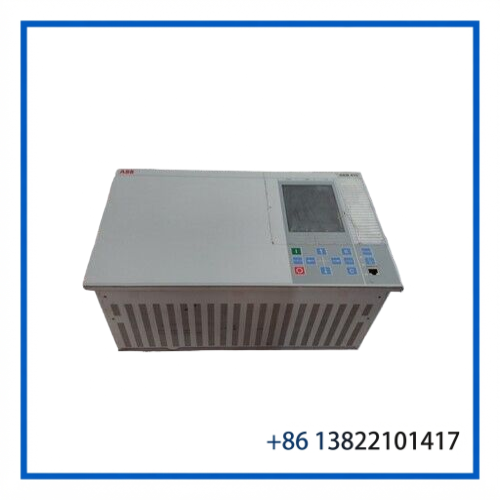
The ABB REB670 is a high-speed busbar protection relay designed for selective differential protection of busbars, T-connections, and meshed corner configurations. It can be applied in medium-voltage, high-voltage, and extra-high-voltage substations operating at 50 Hz or 60 Hz.
The listed unit is identified as SR91C790 / REB670, with a 90–250 VDC auxiliary supply range and 1 A current-input configuration. REB670 protection systems are intended to detect internal phase-to-phase, phase-to-earth, and multiphase busbar faults and provide fast trip signaling.
The REB670 platform can be integrated into substation protection and control architectures where CT inputs, binary I/O, trip circuits, station communication, and protection logic must work together.
📋 Product Datasheet
| Parameter | Specification |
|---|---|
| Brand | ABB |
| Model | REB670 SR91C790 |
| Series | Relion 670 Series |
| Product Name | Busbar Protection Relay |
| Product Type | Busbar Differential Protection IED |
| Rated Frequency | 50/60 Hz |
| Current Rating | 1 A |
| Auxiliary Supply | 90–250 VDC |
| Protection Application | Busbar, T-Connection and Meshed-Corner Protection |
| Condition / Status | Used; verify actual unit condition before installation |
⚙️ Key Features
- High-speed differential protection for busbar systems
- Suitable for MV, HV and EHV substation applications
- 50/60 Hz power-system frequency support
- Designed for 1 A CT secondary applications
- 90–250 VDC auxiliary supply range
- Protection of single and double busbar arrangements
- Applicable to transfer-bus, double-circuit-breaker and one-and-a-half-breaker configurations
- Supports protection, control, monitoring and station communication functions
- Suitable for integration with substation automation and protection systems
- Configurable according to the installed REB670 hardware and application configuration
🔌 System Integration
REB670 is normally installed as part of a complete substation protection scheme. CT circuits provide current measurements to the protection IED, while binary inputs and outputs can interface with circuit breakers, isolators, alarms, interlocking circuits and other protection equipment.
For replacement projects, the complete ordering code should be checked rather than relying only on the basic REB670 designation. Hardware modules, binary I/O configuration, communication interfaces, firmware and protection functions may vary between individual units.
Before commissioning, verify:
- CT ratio and secondary current rating
- CT polarity and phase identification
- Busbar topology and zone configuration
- Trip output wiring
- Breaker auxiliary contacts
- DC auxiliary supply
- Binary input assignments
- Communication configuration
- Protection settings and logic
- Firmware and configuration compatibility
🛠️ Installation & Maintenance
Install the relay in accordance with the applicable ABB documentation and the existing protection-panel design.
Before energization, inspect the terminal connections and confirm that the auxiliary DC voltage is within the configured equipment range. CT circuits should be checked carefully because incorrect polarity, phase identification or wiring can affect differential protection performance.
Recommended maintenance activities include:
- Inspect the relay housing, terminals and connectors.
- Verify the auxiliary DC supply.
- Check CT secondary wiring and polarity.
- Review active alarms and self-supervision indications.
- Confirm binary input/output operation.
- Test trip circuits according to the approved protection-maintenance procedure.
- Review event records and disturbance information when applicable.
- Back up the current configuration before making changes.
- Compare replacement-unit configuration against the original relay.
- Record test results for future maintenance and lifecycle tracking.
🔧 Troubleshooting
Relay does not power up:
Check the station DC supply, polarity, fuses, terminal connections and the configured auxiliary-voltage range.
Unexpected protection alarm:
Review self-supervision indications, binary input status, configuration and recent event records.
Incorrect differential measurement:
Check CT ratios, CT polarity, phase wiring, terminal assignments and the protection-zone configuration.
Trip output does not operate:
Inspect the configured trip logic, binary output, breaker interface, DC trip circuit and external interlocking.
Communication failure:
Check the installed communication interface, physical connections, station-network configuration and parameter compatibility.
✅ First-Operation Checklist
Before placing the REB670 into service:
☑ Confirm complete model and ordering code
☑ Verify 90–250 VDC auxiliary supply compatibility
☑ Confirm 1 A CT secondary configuration
☑ Verify CT polarity and phase sequence
☑ Check busbar zone configuration
☑ Verify trip and alarm wiring
☑ Confirm binary I/O assignments
☑ Check communication parameters
☑ Load or verify the approved protection configuration
☑ Perform functional and trip-circuit testing before energization
❓ FAQ
What is the ABB REB670 used for?
REB670 is primarily used for differential protection of busbars and related substation configurations such as T-connections and meshed corners.
Can REB670 be used on 50 Hz and 60 Hz systems?
Yes. The REB670 platform supports both 50 Hz and 60 Hz power-system applications.
What auxiliary supply does this listed unit use?
The supplied listing identifies a 90–250 VDC auxiliary supply range. The actual relay nameplate and complete ordering code should be checked before installation.
Is this relay suitable as a direct replacement?
Not automatically. The complete ordering code, hardware configuration, firmware, I/O modules, communication interfaces and protection settings should be compared with the existing relay.
What should be checked when replacing an existing REB670?
At minimum, compare the complete ordering code, current-input rating, auxiliary supply, I/O configuration, communication hardware, firmware and protection configuration.
Is the listed unit new?
The referenced listing identifies the unit as used. Actual physical condition, test status and included accessories should be verified before purchase or installation.
📦 Recommended ABB Related Models
- ABB REB670 Busbar Protection Relay
- ABB REL670 Line Distance Protection Relay
- ABB RET670 Transformer Protection Relay
- ABB REG670 Generator Protection Relay
- ABB RED670 Differential Protection Relay
- ABB REC670 Bay Control Unit
- ABB REF615 Feeder Protection Relay
- ABB REF630 Feeder Protection IED
- ABB RET615 Transformer Protection Relay
- ABB REG615 Generator Protection Relay
📊 Spare-Parts & Lifecycle Planning
For critical substation protection equipment, maintaining a tested spare can reduce restoration time after an unexpected relay failure.
For inventory management, the REB670 should be treated as a critical protection component rather than a general automation spare. Recommended planning includes maintaining the complete ordering code in the asset database, recording firmware and configuration information, and keeping one compatible spare where system availability requirements justify it.
For older installations, an ABC classification + EOQ/buffer-stock review + last-time-buy assessment can help determine the appropriate replacement quantity. A replacement relay should always be configuration-matched and functionally tested before being introduced into the protection system.