Description
- Model: ABB RF533 (Global Part Number: 3BSE014227R1)
- Brand: ABB (Sweden / Switzerland)
- Series: Symphony Harmony / Contronic / MelTrac Distributed Control Systems (DCS)
- Core Function: Heavy-duty industrial subrack cage assembly that provides physical housing, structural guidance, power distribution pathways, and high-speed backplane bus interconnects for modular process controllers and I/O cards, New Surplus / Clean Used condition
- Type: Modular System Subrack / Card Chassis Cage
- Key Specs: Standard 19-inch rack-mount profile, integrated multi-slot backplane motherboard, rugged guide rails for slide-in modules, heavy industrial shielding against electromagnetic interference (EMI)
- Mechanical Standard: Standard 19-inch industrial rack-mount chassis configuration
- Backplane Bus Interface: Integrated multi-layer copper backplane PCB supporting high-fidelity data transfer between controllers and interface modules
- Module Slot Allocation: High-density multi-slot layout configured with precision nylon guide rails for aligned slide-in hardware connection
- Power Distribution Network: Heavy copper bus bars built directly into the backplane to deliver stable, low-noise redundant DC power rails to all active card locations
- Grounding Array: Integrated chassis grounding strip to ensure rapid dissipation of static build-ups and external electrical transients
- Cooling Support Profile: Open-frame convection ventilation architecture with standardized mounting patterns for supplementary external cooling fan trays
- Shielding Efficiency: Electrogalvanized steel construction providing continuous EMI/RFI isolation protecting sensitive processor cards
- Connector Integrity: Heavy-duty multi-pin DIN backplane sockets designed to withstand high-vibration environments without signal degradation
- Storage Environment Parameters: -40 °C to +85 °C passive storage window
- Operational Thermal Limits: 0 °C to +55 °C continuous duty within an enclosed cabinet
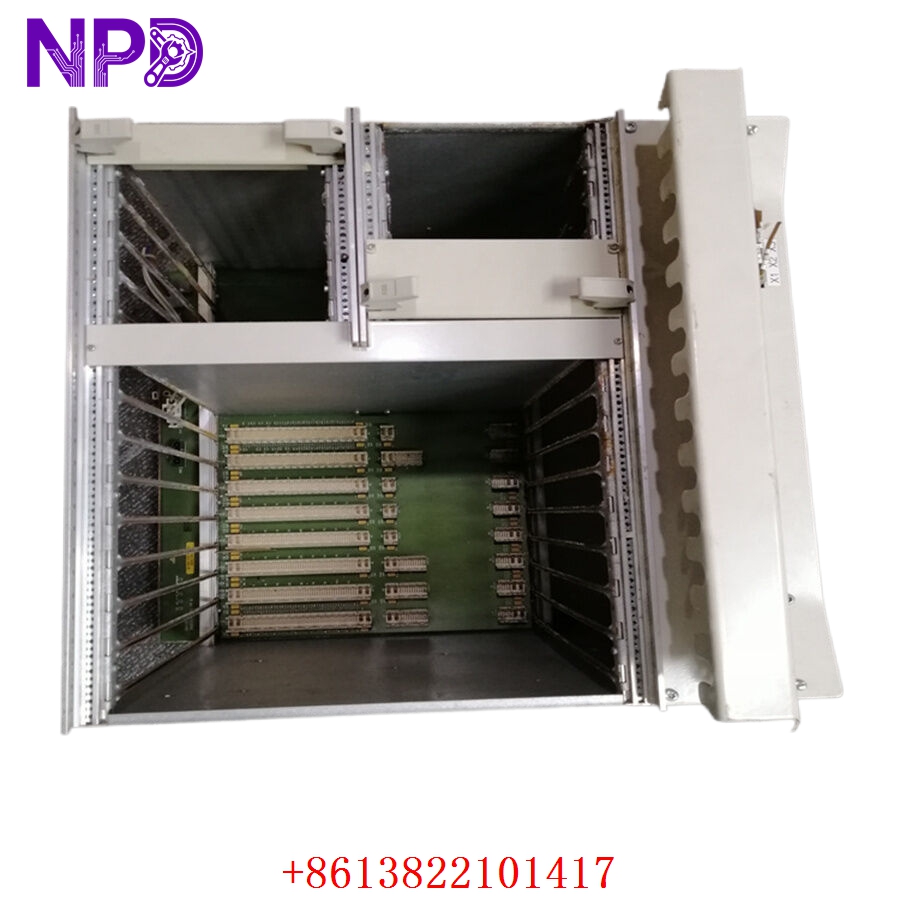
ABB RF533 3BSE014227R1
Application Scenarios & Pain Points
In large-scale continuous-process plants—such as oil refineries, municipal water systems, and thermal power stations running on heritage ABB Symphony or Contronic systems—the ABB RF533 (3BSE014227R1) subrack forms the physical foundation of the control cabinet. Instead of a single piece of equipment failing, backplane or chassis problems compromise the entire rack environment.
Over decades of continuous operation, subracks suffer from localized thermal stress, contact oxidation on old DIN sockets, or damage to backplane traces caused by leaking backup batteries on old controller cards. If a pin socket cracks or a trace short-circuits, it causes random communications timeouts across multiple adjacent I/O modules, which can lead to unpredictable safety trips or plant-wide shutdowns. Because changing to an entirely new DCS line requires massive engineering costs and lengthy programming rewrites, sourcing an exact matching legacy RF533 chassis allows plant engineers to rebuild their running rack infrastructure during an overnight maintenance window.
Typical Application Scenarios
- Power Plant Control Enclosures – Boiler Control Rebuilding
Houses primary processing nodes, network modems, and analog feedback cards that orchestrate automated boiler burner patterns.
- Chemical Processing Facilities – Distributed Control Distribution Racks
Acts as the central communication mounting frame for I/O clusters running hazardous area loops and process loop optimization schemes.
- Pulp and Paper Mills – Multi-Axis Wet End Controller Arrays
Provides a vibration-resistant, shielded housing platform for high-density analog output cards that drive precision hydraulic press actuators.
Real-World Field Case: Eliminating Intermittent Backplane Data Drops
Background: A chemical processing complex in eastern China was experiencing mysterious, intermittent communication timeouts on a rack of analog input modules within an older ABB control cabinet. The errors occurred randomly and would clear up on their own, making them hard to diagnose.
The Problem: Plant maintenance replaced the active processor cards and communication modems twice, but the communication timeouts continued. An on-site electrical inspection found that over twenty years of continuous operation in a humid environment had oxidized the backplane socket pins on the legacy RF533 chassis. The resulting contact resistance caused localized voltage drops whenever the rack drew peak current, crashing the communications bus.
The Solution: The lead systems engineer contacted our support team. We pulled an original, fully tested ABB RF533 3BSE014227R1 chassis from our warehouse, inspected the backplane pin geometry under magnification, verified trace continuity across all slots, and shipped it using an express overnight air freight courier.
The Result:
- Turnover Speed: The unit reached the customer’s maintenance warehouse in 16 hours.
- Implementation: During a planned maintenance shutdown, the electrical team labeled the wiring bundles, pulled out the modules, and swapped the old chassis out for the new RF533 unit.
- System Recovery: When power was restored, the modules booted up without any communication faults. The communication timeouts disappeared completely, ensuring stable operations for the facility’s production runs.
Compatible Replacement Models
When replacing modular subracks, pay close attention to backplane part numbers to avoid pin mismatch or power scaling discrepancies during re-assembly.
- ABB RF533 3BSE014227R1 (Exact Identification Match) → Direct Drop-in Replacement
- Configuration: Standard structural frame with the exact 3BSE014227R1 backplane layout.
- Action: Mount the chassis into the 19-inch cabinet rails, reconnect the primary power feed lines, and slide the existing cards back into their original slots. No software remapping required.
- Alternative ABB Symphony Plus Subracks (e.g., Next-Gen Modular Carriers) → Not Directly Compatible
- Differences: Newer Symphony Plus carrier foundations feature altered dimensions, utilize compact pluggable power blocks, and incorporate updated high-speed Ethernet-based backplane pathways.
- Recommendation: Do not mix legacy Harmony/Contronic modules into next-generation carriers unless you are undertaking a complete system-wide hardware migration project.
Troubleshooting Quick Reference
Use this reference guide when inspecting subrack assemblies for faults during field maintenance routines.
| Field Observation | Probable Root Cause | Subrack Component Relevancy | Field Diagnostic Test Steps | Action / Fix Protocol |
|---|---|---|---|---|
| Multiple adjacent modules lose power simultaneously | Short circuit on a backplane copper rail or failed feed wire | ✅ High | Measure the DC voltage arriving directly at the subrack’s primary power input terminals with a multimeter. | If input voltage is correct but the slots lack power, check the backplane bus bars for physical damage. Replace the chassis if traces are blown. |
| A specific module slot throws continuous communication faults | Bent or oxidized pin inside that slot’s DIN connector socket | ✅ High | Power down the rack, pull the card out, and check the slot’s female pin matrix with a high-intensity flashlight. | Straighten slightly bent pins carefully using an insulated alignment tool. If a pin is broken or burned from an overcurrent event, replace the RF533 subrack. |
| High noise levels or signal drift across all I/O channels | Loose or missing chassis ground connection | ⚠️ Medium | Test the resistance between the subrack’s grounding lug and the main cabinet earth ground bar. It should read under 1 Ω. | Clean away rust or paint from the grounding contact point, tighten the ground wire connection, and ensure clean metal-to-metal contact. |
| Modules run unusually hot or error out during peak ambient days | Blocked ventilation paths or a failed fan tray below the subrack | ❌ Low | Check the airflow paths through the card cage and verify that the external cabinet fan systems are working properly. | Clear out any dust or debris blocking the ventilation spaces. Replace failing external fan trays to ensure adequate cooling airflow. |
❗ ELECTRICAL ISOLATION WARNING: Before removing the backplane power connections or replacing an active RF533 subrack assembly, ensure that all main circuit breakers feeding the cabinet power supplies are opened and tagged out. Working on power connections while lines are live can cause short circuits that damage adjacent processor cards or risk electrical shock to personnel.
If your plant floor technicians need to verify our current inventory’s exact firmware compatibility profiles or require a detailed walkthrough of our automated validation processes before placing a shipment block, connect with our support desk today. We will deliver the data you need within two hours.