Description
⚙️ Product Overview
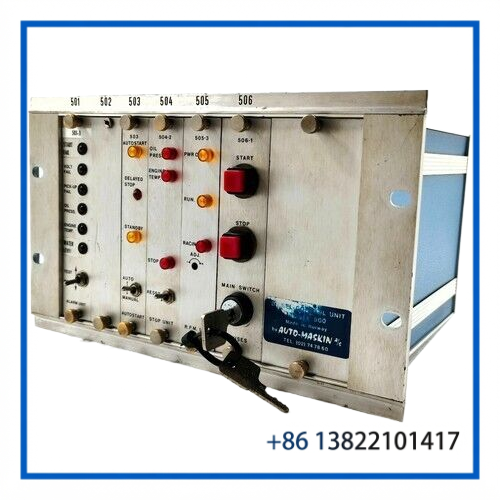
The AUTO MASKIN DCU 500 is an electronic Diesel Control Unit (DCU) designed for control and monitoring of diesel engines used in auxiliary and emergency generator applications.
The Model 500 belongs to the earlier Auto-Maskin engine-control platform and uses a modular card-based architecture, with individual control and interface cards installed in the main unit. This design allows the controller to perform engine monitoring and control functions within marine and industrial generator systems.
The DCU 500 is now a discontinued legacy controller, making original units and compatible spare assemblies valuable for maintaining existing installations where a complete system modernization is not immediately practical.
🔧 Main Features
- Auto-Maskin Model 500 DCU platform
- Electronic diesel engine controller
- Engine control and monitoring functions
- Designed for auxiliary generator applications
- Suitable for emergency generator systems
- Modular card-based construction
- Intended for marine and industrial engine-control systems
- Suitable for legacy-system maintenance and spare-part replacement
- Useful for maintaining existing Auto-Maskin installations
- Replacement planning can be considered with newer DCU platforms
📊 Technical Datasheet
| Parameter | Specification |
|---|---|
| Brand | AUTO MASKIN |
| Model | DCU 500 / Model 500 |
| Series | DCU Engine Controller |
| Product Name | Diesel Control Unit |
| Product Type | Electronic Diesel Engine Controller |
| Architecture | Modular Card-Based Controller |
| Primary Application | Auxiliary & Emergency Generator Sets |
| Control Function | Diesel Engine Control and Monitoring |
| System Type | Marine / Industrial Engine Automation |
| Product Status | Discontinued / Legacy Product |
🚢 Application
The DCU 500 was developed for diesel-engine control applications where continuous monitoring and controlled operation of an auxiliary or emergency generator are required.
Typical applications include:
- Marine auxiliary generator sets
- Emergency generator systems
- Shipboard diesel engines
- Industrial standby generators
- Engine monitoring systems
- Generator automation systems
- Legacy marine automation installations
- Diesel power-generation equipment
The controller forms part of the engine automation system and can work together with associated sensing, control, alarm, and interface components.
🧩 Modular Architecture
One of the important characteristics of the DCU 500 is its card-based construction. Instead of being a single monolithic electronic controller, the system is assembled using individual cards installed into the main unit.
This architecture is useful for legacy maintenance because troubleshooting can be approached at both the system and individual card level.
When replacing or servicing a DCU 500 installation, technicians should identify:
- Main controller assembly
- Installed card configuration
- Engine-specific I/O arrangement
- Existing wiring
- Alarm and shutdown circuits
- Generator interface
- Communication or monitoring connections
- Controller configuration
The installed card configuration should be recorded before removing the original controller.
🔌 Replacement & System Integration
Because the DCU 500 is a discontinued platform, replacement should not be treated as a simple physical swap unless the replacement unit has been confirmed against the existing installation.
Before installation, compare:
- Complete controller identification.
- Installed card configuration.
- Engine make and model.
- Generator application.
- Existing field wiring.
- Sensor and actuator connections.
- Alarm and shutdown functions.
- Remote monitoring requirements.
- Existing configuration parameters.
- Mechanical mounting and cabinet arrangement.
For critical marine or emergency-generator equipment, preserve the original wiring documentation and controller configuration before beginning replacement work.
🛠️ Installation & Commissioning
1. Record Existing Configuration
Document all installed cards, terminal connections, cables, labels, and external interfaces.
2. Inspect the Controller
Check the enclosure, connectors, card edges, terminals, and visible electronic components for corrosion, contamination, or mechanical damage.
3. Verify Power
Confirm that the DC control power supplied to the controller matches the installed system requirements before energizing the unit.
4. Check Field Wiring
Verify connections from engine sensors, shutdown circuits, alarms, actuators, and generator-related interfaces.
5. Verify Engine Signals
Check the available engine monitoring signals before starting the engine.
6. Functional Test
After installation, verify controller startup, alarms, shutdown functions, engine indications, and generator-related control functions.
7. Operational Test
Where permitted by the vessel or plant operating procedure, perform a controlled engine run test and confirm normal monitoring and alarm behavior.
🔍 Troubleshooting Guide
Controller does not power up
Check the DC supply, protection devices, power wiring, terminals, connectors, and controller hardware.
Engine monitoring signal is incorrect
Inspect the associated sensor, field wiring, terminal connection, and corresponding controller card.
Alarm remains active
Determine whether the alarm is caused by an actual engine condition or an incorrect/missing input signal. Check the sensor and wiring before replacing electronic hardware.
Engine control function is unavailable
Check the relevant controller card, field connection, actuator circuit, interlocks, and shutdown logic.
Intermittent controller operation
Inspect supply voltage stability, connectors, card seating, corrosion, vibration effects, and cabinet environmental conditions.
Replacement controller does not operate correctly
Confirm that the replacement has the correct card configuration and is compatible with the specific engine-control installation.
🧰 Maintenance Recommendations
- Keep the control cabinet clean and dry.
- Inspect connectors and terminals during scheduled maintenance.
- Check for loose or oxidized connections.
- Monitor DC supply stability.
- Inspect controller cards for signs of corrosion or overheating.
- Maintain backups of available system documentation.
- Record installed card positions before removing modules.
- Keep critical spare cards or a complete replacement controller when practical.
- Avoid unnecessary modifications to legacy wiring.
- Perform periodic generator control and shutdown-function tests according to the vessel or plant maintenance procedure.
♻️ Legacy Replacement Considerations
The DCU 500 is discontinued, so availability of original spare units can become increasingly important for operators maintaining older equipment.
For installations requiring long-term support, a migration assessment may be appropriate. Auto-Maskin identifies the DCU 305 R3 LT Engine Controller as the replacement direction for the discontinued DCU 500 platform.
However, replacement should be engineered against the actual installation rather than assuming direct interchangeability. Existing wiring, controller cards, engine configuration, and application requirements should be evaluated before conversion.
❓ Frequently Asked Questions
Q1: What is the AUTO MASKIN Model 500?
It is the Auto-Maskin DCU 500 electronic diesel engine controller used for engine control and monitoring.
Q2: What is the DCU 500 used for?
It is intended for diesel engines used in auxiliary and emergency generator applications.
Q3: Is the DCU 500 still a current product?
No. The DCU 500 is a discontinued legacy product.
Q4: Is the DCU 500 modular?
Yes. The system is built around a main unit containing individual cards.
Q5: Can a DCU 500 be replaced by a newer controller?
A migration is possible in suitable applications, but compatibility must be evaluated against the installed engine, wiring, card configuration, and control requirements.
Q6: What is the replacement direction for the DCU 500?
Auto-Maskin identifies the DCU 305 R3 LT Engine Controller as the replacement for the discontinued DCU 500 platform.
Q7: What should be checked when purchasing a replacement DCU 500?
Check the complete model identification, installed card configuration, connectors, physical condition, and compatibility with the existing engine-control system.
Q8: Is the DCU 500 suitable for marine applications?
Yes. Its intended application includes diesel engines used in auxiliary and emergency generator systems, including marine installations.
📦 Recommended AUTO MASKIN Models
- DCU 305 R3 LT – Engine Controller
- DCU 305 R3 – Engine Controller
- DCU 305 A R2 – Engine Controller
- DCU 305 P R2 – Engine Controller
- DCU 410 – Engine Controller
- DCU 408 – Engine Controller
- DCU 210 – Engine Controller
- DCU 208 – Engine Controller
- DCU 110 – Engine Controller
- DCU 105 – Engine Controller
📌 Product Summary
The AUTO MASKIN MODEL 500 DCU Diesel Control Unit is a legacy electronic engine controller designed for diesel-engine control and monitoring in auxiliary and emergency generator applications.
Its modular card-based construction makes it particularly relevant to maintenance teams supporting older marine and industrial generator systems. As the DCU 500 has been discontinued, sourcing a verified original spare can be useful for minimizing downtime while a longer-term controller migration is evaluated.