Description
⚙️ Product Overview
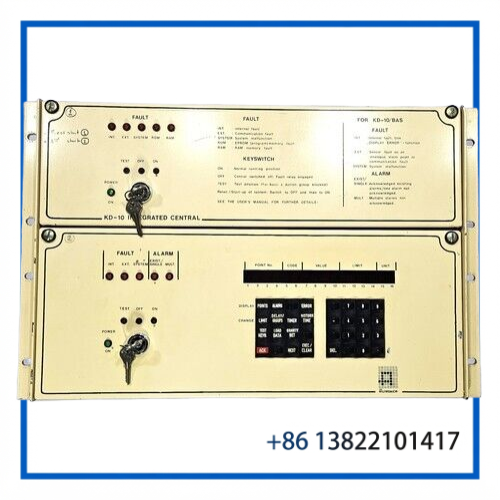
The AUTRONICA KD-10/COM-BAS is a Basic Integrated Central Engine Control Alarm System designed for marine engine-room monitoring and control applications. It belongs to the legacy KD-10 family used on marine vessels for centralized supervision of diesel-engine operating conditions, alarm signals, and associated control functions.
The system is intended to collect and process signals from engine-room equipment and present important operating and fault conditions through a centralized control and alarm architecture. Its modular construction allows different functional cards and interface modules to be combined according to the vessel’s original configuration.
The KD-10/COM-BAS is particularly useful as a replacement or spare assembly for vessels maintaining existing Autronica KD-10 installations. Because individual KD-10 systems can have different module combinations, buyers should verify the installed module types, wiring, cable configuration, and unit identification before replacement.
🔧 Main Features
- ⚓ Designed for marine engine-room automation
- 🚨 Centralized engine monitoring and alarm management
- 🛠️ Modular card-based system architecture
- 🔌 Supports multiple signal interface and conditioning modules
- 📡 Suitable for integration with engine and auxiliary equipment
- 🏭 Intended for legacy Autronica KD-10 installations
- 🔄 Useful for maintenance, repair, and system restoration projects
- 📦 Suitable as an industrial and marine automation spare part
- 🔍 Configuration should be verified against the original vessel installation
📊 Technical Datasheet
| Parameter | Specification |
|---|---|
| Brand | AUTRONICA |
| Model | KD-10/COM-BAS |
| Series | KD-10 Central Engine Control System |
| Product Name | Basic Integrated Central Engine Control Alarm System |
| Product Type | Marine Engine Control & Alarm System |
| Application | Marine Diesel Engine Monitoring and Engine-Room Automation |
| System Architecture | Modular Centralized Control and Alarm System |
| Associated Modules | KDS-6, KDE-1A, KDM-8, KDC-3, KDD-1A, KDA-2, KDB Series |
| Cable / Interface | XCA-176 and configuration-dependent system wiring |
| Product Status | Legacy / Discontinued Platform |
🚢 Marine Automation Applications
The KD-10/COM-BAS can be found in legacy marine automation installations where centralized monitoring of propulsion engines, auxiliary engines, generators, pumps, temperature signals, pressure signals, and other engine-room parameters is required.
Typical applications include:
- Main engine monitoring
- Auxiliary engine monitoring
- Generator monitoring
- Engine-room alarm systems
- Temperature and pressure supervision
- Analog signal monitoring
- Equipment fault indication
- Centralized alarm annunciation
- Marine automation retrofit and maintenance projects
🧩 Modular System Configuration
One important characteristic of the KD-10 platform is its modular architecture. A complete installation may contain several different functional modules rather than relying on the central unit alone.
Associated modules may include:
- KDS-6 power supply unit
- KDE-1A interface module
- KDM-8 input/output module
- KDC-3 control/interface module
- KDD-1A/16 digital interface
- KDU-1A/16 digital interface
- KDA-2/R1 4–20 mA signal interface
- KDA-2/T1 current input interface
- KDA-2/U1 temperature/voltage-related interface
- KDB-1A / KDB-2B signal processing modules
The exact configuration depends on the original vessel and engine-control design. Matching the complete module set is therefore important when replacing a legacy KD-10 installation.
🔌 System Integration Considerations
Before installation, compare the replacement unit with the existing system using:
- Model and type designation
- Module arrangement
- Module identification numbers
- Cable type and connector configuration
- Terminal assignments
- Power-supply configuration
- Input and output signal types
- Alarm channel allocation
- Existing control logic
- Original vessel documentation
A replacement should not be connected solely because the enclosure or model name appears similar. Legacy marine control systems can contain vessel-specific configurations.
🛠️ Installation & Commissioning
For a maintenance replacement, first isolate the relevant control-system power and confirm that the engine and associated machinery are in a safe condition.
Check the original wiring against the replacement unit before reconnecting cables. Pay particular attention to power-supply connections, signal polarity, common terminals, analog inputs, digital inputs, relay outputs, and inter-module connections.
After installation:
- Verify supply voltage.
- Inspect connectors and terminal blocks.
- Confirm module positions.
- Check alarm inputs individually.
- Verify analog signal readings.
- Test alarm indication.
- Check shutdown/interlock functions where applicable.
- Confirm communication with associated control equipment.
- Record the final configuration for future maintenance.
🔍 Troubleshooting Guide
No system power
Check the incoming supply, protective devices, power module, terminal connections, and internal wiring.
Incorrect alarm indication
Check the associated input module, sensor wiring, signal type, terminal assignment, and alarm channel configuration.
Analog value is incorrect
Verify the transmitter range and input-module type. Inspect wiring polarity and signal-loop connections, particularly for current-loop inputs.
Individual channels are unavailable
Check the corresponding I/O module and its connections. A loose connector or incorrect module position can affect multiple channels.
Intermittent operation
Inspect terminals, connectors, power-supply stability, aging wiring, and module contacts. Legacy marine systems should also be checked for corrosion or contamination.
Replacement unit does not match the existing system
Compare the complete module configuration rather than only the KD-10 model designation.
🔧 Maintenance Recommendations
For long-term preservation of a KD-10 installation:
- Keep control cabinets clean and dry.
- Inspect connectors periodically.
- Check power-supply output stability.
- Inspect terminal blocks for looseness.
- Check for corrosion in marine environments.
- Verify alarm channels during scheduled maintenance.
- Keep records of installed module types.
- Maintain spare interface and I/O modules where possible.
- Label replacement modules before installation.
- Keep a complete backup of vessel-specific wiring and configuration information.
Because the KD-10 is a legacy platform, maintaining suitable spare modules can be particularly important for vessels that have not yet completed a full automation retrofit.
⚠️ Replacement & Obsolescence Considerations
The AUTRONICA KD-10 platform is a legacy marine automation system and is no longer a current-generation control platform. Replacement components may therefore be sourced primarily from surplus, recovered, refurbished, or remaining-stock inventories.
For a successful replacement, the most important consideration is configuration compatibility, not simply the model number.
Where a complete modernization is planned, the existing KD-10 installation may also be evaluated as part of a larger marine automation retrofit.
❓ Frequently Asked Questions
Q1: What is the AUTRONICA KD-10/COM-BAS?
It is a basic integrated central engine control and alarm system used for marine engine-room monitoring and control.
Q2: Is KD-10/COM-BAS suitable for new vessel automation projects?
It is primarily a legacy system and is generally more relevant to maintenance, repair, and replacement of existing KD-10 installations.
Q3: Does the KD-10/COM-BAS work independently?
The complete system normally consists of a central unit together with various power, I/O, interface, and signal-processing modules.
Q4: What should I check before ordering a replacement?
Confirm the exact model, module configuration, type numbers, wiring, cable arrangement, and identification labels of the existing installation.
Q5: What cable is associated with this system?
XCA-176 is associated with KD-10/COM-BAS configurations, but the complete vessel installation should be checked before replacement.
Q6: Can the individual modules be replaced separately?
Depending on the original configuration, individual functional modules may be replaced, but compatibility must be verified with the existing system.
Q7: Is KD-10/COM-BAS used in marine applications?
Yes. The KD-10 platform was developed for engine-room monitoring and control applications on marine vessels.
Q8: What signals can the system handle?
The modular system can accommodate different digital and analog signal interfaces depending on the installed modules.
Q9: Is the product condition important for a legacy system?
Yes. For used or surplus equipment, visual inspection, connector condition, module identification, and functional testing are important before installation.
Q10: Can you supply related KD-10 components?
Related modules and accessories can be matched according to the existing KD-10 system configuration and required replacement position.
📦 Recommended Related AUTRONICA KD-10 Parts
- AUTRONICA KDS-6 – Power Supply Unit
- AUTRONICA KDE-1A – Interface Module
- AUTRONICA KDM-8/00-M2 – I/O Module
- AUTRONICA KDC-3A/87-C3 – Control/Interface Module
- AUTRONICA KDD-1A/16 – Digital Interface Module
- AUTRONICA KDU-1A/16 – Digital Interface Module
- AUTRONICA KDA-2/R1 – 4–20 mA Interface Module
- AUTRONICA KDA-2/T1 – Current Input Module
- AUTRONICA KDA-2/U1 – Analog/Temperature Interface Module
- AUTRONICA KDB-2B – Signal Interface Module
🏁 Product Summary
The AUTRONICA KD-10/COM-BAS is a legacy marine central engine control and alarm system designed around modular monitoring and control functions. Its primary value today is in maintenance, spare-parts replacement, vessel repair, and restoration of existing KD-10 engine-room automation systems.
For replacement projects, always compare the complete module configuration, wiring, power supply, signal interfaces, and identification labels with the existing installation before commissioning.