Description
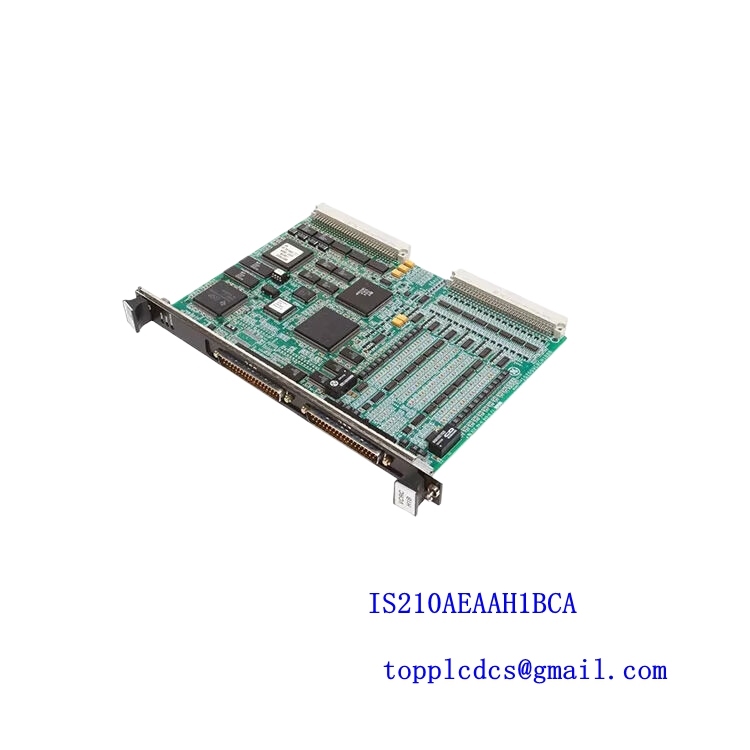
- Model: GE Ansaldo VME-SSI (also referred to as AVMESSI)
- Brand: GE Ansaldo / Nidec ASI (Legacy GE Industrial Systems)
- Series: VMEbus Control / SilcoMatic D / Mark VI
- Core Function: Serial Synchronous Interface (SSI) for absolute encoders
- Product Type: VMEbus Expansion I/O Card
- Key Specs: Multi-channel SSI VME Standard Form Factor Differential RS-422 Signaling

ANSALDO VME-SSI AVMESSI
Key Technical Specifications
- Processor Interface: Standard VMEbus (Slave interface)
- Interface Type: SSI (Synchronous Serial Interface) for Absolute Encoders
- Channels: Typically 2 to 4 independent SSI channels (depending on hardware revision)
- Signal Level: RS-422 / RS-485 Differential
- Clock Frequency: Configurable (typically up to 1 MHz)
- Data Resolution: Supports 12-bit to 24-bit encoder data frames
- Galvanic Isolation: Optical isolation between VMEbus and field side
- Connectors: Front panel DIN or D-Sub connectors (variant dependent)
- Power Requirements: +5 VDC via VME backplane
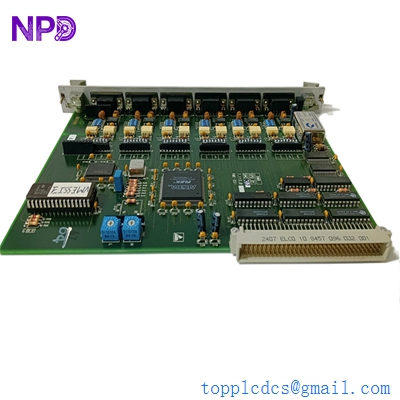
ANSALDO VME-SSI AVMESSI
Application Scenarios & Pain Points
The AVMESSI board is a specialized niche module found in legacy GE Ansaldo drive systems and SilcoMatic D platforms. Its sole purpose is to provide high-precision position feedback from absolute encoders. If this board fails, the drive loses its ability to track the exact position of the motor shaft or mechanical load, leading to immediate system trips and “Feedback Loss” alarms. In my experience, these boards are common in heavy industry where massive torque and precise positioning must go hand-in-hand.
Typical Application Scenarios:
- Metal Rolling Mills Used to monitor the screw-down position of rolls in hot or cold mills. Precise absolute positioning is required to ensure the thickness of the steel or aluminum is consistent.
- Heavy Hoist & Crane Systems Managing the lift height and trolley position for large-scale industrial cranes where “incremental” encoders aren’t safe enough—you need to know exactly where the load is, even after a power cycle.
- SilcoMatic D Drive Controls Serving as the feedback interface for large DC drive systems used in mining or paper production.
- Synchronous Motor Control Providing the rotor position feedback necessary for high-efficiency control of large synchronous machines.
Case Study: The “Zero Point” Ghost
Background: A heavy-duty shipyard crane was using an AVMESSI module for its main hoist. Every time the system was rebooted, the “Zero Position” would shift slightly, requiring a manual recalibration that took two hours.
The Problem: The AVMESSI board wasn’t actually “broken,” but the internal opto-couplers on the clock line were degrading. This caused a slight lag in the SSI data frame, leading the VME controller to misinterpret the first bit of the encoder string during the boot-up initialization.
The Solution: We replaced the aging AVMESSI with a tested unit from our stock. We also advised the customer to check the shielding on the encoder cable, as the degraded opto-couplers had become more sensitive to electromagnetic noise.
Result: The crane now maintains its absolute zero position across reboots, saving the client hours of calibration time per week.
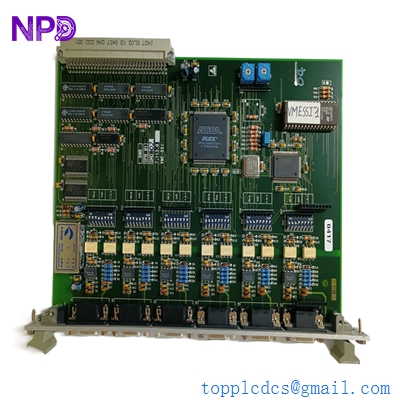
ANSALDO VME-SSI AVMESSI
Compatible Replacement Models
The AVMESSI is a very specific legacy board. Compatibility is usually strictly “like-for-like.”
| Model / Tag | Compatibility | Note |
| GE AVMESSI (Standard) | ✅ Direct | Standard absolute encoder interface. |
| VME-SSI (Ansaldo) | ✅ Direct | Often just a different naming convention for the same PCB. |
| VME-ENCODER (Incremental) | ❌ Incompatible | This handles A/B pulses, not SSI digital frames. |
Troubleshooting Quick Reference
| Symptom | Possible Cause | Relevance | Action |
| No Encoder Data | No Clock Signal | ✅ High | Check if the AVMESSI is sending a clock pulse (RS-422 levels). |
| Data “Jumping” | Shielding/Noise | ⚠️ Medium | Ensure encoder cable shield is grounded only at the AVMESSI end. |
| VME Bus Error (BERR) | Address Conflict | ✅ High | Check the jumper settings (J1/J2) on the board to match the old unit. |
| Module “NOT READY” LED | Internal Logic Failure | ✅ High | Power cycle the rack; if the error persists, the board’s logic is shot. |
Technical SOP & Quality Guarantee
Dealing with Ansaldo legacy parts requires a “detective” mindset. We don’t just ship the board; we verify its history:
- Backplane Verification: We test the board in a dedicated VME rack to ensure the addressing logic (A24/A16) is functioning correctly.
- Signal Integrity Test: Using an oscilloscope, we verify that the SSI clock output is a clean square wave and the data input can be read without bit errors.
- Jumper Audit: We document the jumper positions of the board we send you. Important: You must mirror these jumpers from your old board to the new one, or the CPU won’t find the board at the correct memory address.
- Cleaning & Preservation: These boards often come from “dirty” environments like steel mills. We perform an ultrasonic clean and apply a moisture-resistant coating to prevent future corrosion.
Field Engineer’s Warning: Most AVMESSI failures I’ve seen involve “blown” RS-422 transceiver chips caused by someone plugging or unplugging the encoder while the system is powered up. Always kill the 24V/5V power before messing with the encoder connections.