
Description
Product Introduction
The Basler Electric SR8A-2B15B3A Static Voltage Regulator is an automatic voltage regulator (AVR) designed to control excitation in synchronous generator systems. By regulating generator field current, it helps maintain stable output voltage as electrical load conditions change.
The SR8A series is used in industrial and marine power-generation applications, including generator control panels and excitation systems. Its functions can include voltage sensing and regulation, reactive droop or cross-current compensation for parallel generator operation, and underfrequency protection, depending on the specific model configuration.
This regulator is intended for maintenance and replacement applications where the original generator system specifies the same SR8A model and option configuration. Confirm the complete model number, sensing input, excitation requirements, wiring arrangement, and installed generator specifications before replacement.
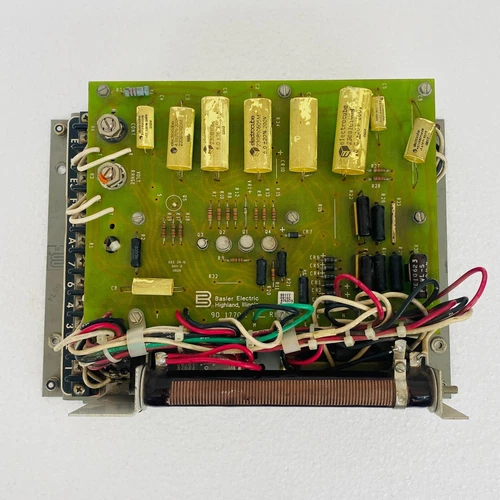
Basler Electric SR8A-2B15B3A
Key Features
- ⚡ Automatic Voltage Regulation: Controls generator excitation to help maintain stable terminal voltage.
- ⚙️ Static Regulator Design: Uses electronic control and power components for excitation regulation.
- 🔌 Generator Excitation Control: Designed for compatible synchronous generator systems.
- 🔄 Parallel Operation Support: Model-dependent provisions for reactive droop or cross-current compensation.
- 📉 Underfrequency Protection: Supports voltage roll-off under reduced generator frequency, according to configuration.
- 🚢 Marine and Industrial Applications: Suitable for compatible shipboard and land-based generator systems.
- 🛠️ Maintenance Replacement: Intended for repair and spare-parts requirements involving the matching SR8A configuration.
- 🔍 Model-Specific Configuration: Verify all option codes and terminal connections before installation.
Product Specifications
| Specification | Details |
|---|---|
| Brand | Basler Electric |
| Model | SR8A-2B15B3A |
| Series | SR8A |
| Product Name | Static Voltage Regulator |
| Product Type | Automatic Voltage Regulator (AVR) |
| Primary Function | Generator voltage and excitation regulation |
| Application | Synchronous generator systems |
| Sensing Input | Confirm exact configuration; supplier references report 480 VAC input for this model |
| Output Rating | 125 VDC, 7 A reported by component supplier |
| Excitation Control | Electronic field-current regulation |
| Operating Frequency | 50/60 Hz, subject to system configuration |
| Parallel Operation | Compensation features depend on installed options |
| Place of Manufacture / Origin | Not independently confirmed for the individual unit |
| Product Status | Legacy model; confirm availability |
| Dimensions | Confirm against the unit and installation manual |
| Weight | Approximately 6.27 kg reported by a supplier; verify actual shipping weight |
| Country of Origin | Seller listings report Germany; verify the individual unit |
| Power Requirements | Must match the regulator nameplate and generator system |
| Discontinued | Current official status for this exact configuration not confirmed |
| Condition | Confirm with seller |
Frequently Asked Questions
Q1: What is the Basler SR8A-2B15B3A used for?
A: It regulates generator excitation to help maintain stable AC output voltage in compatible synchronous generator systems.
Q2: Is this an automatic voltage regulator?
A: Yes. It is a static AVR designed for generator voltage regulation through excitation control.
Q3: Can it be used in marine generator systems?
A: It may be suitable for marine applications where the generator’s original design specifies this exact regulator configuration. Verify the generator and excitation-system documentation before installation.
Q4: What output rating is associated with this model?
A: A component supplier lists an output of 125 VDC at 7 A. Confirm this against the regulator nameplate and original technical manual before using it as a replacement.
Q5: Can this regulator operate generators in parallel?
A: The SR8A family supports parallel-operation compensation options, including reactive droop or cross-current compensation. Confirm that the required features are present in the specific SR8A-2B15B3A configuration.
Q6: Is it interchangeable with the Basler SR6A or SR9A?
A: Do not assume direct interchangeability. Different regulator models and option codes may have different electrical ratings, wiring requirements, and excitation characteristics.
Q7: What should I verify before ordering?
A: Check the complete model number, nameplate ratings, sensing voltage, output-current requirements, terminal layout, compensation options, physical condition, and test status.
Recommended Related Basler Electric Models
The following models belong to related Basler voltage-regulation and generator-control product families. They may be useful for comparison or spare-parts research, but they are not automatically interchangeable with the SR8A-2B15B3A.
- Basler SR4A — Static voltage regulator for generator excitation systems.
- Basler SR6A — Static voltage regulator in the SR family.
- Basler SR8A — SR8A voltage regulator family.
- Basler SR9A — Static voltage regulator in the SR family.
- Basler SSR63-12 — SSR-series retrofit voltage regulator.
- Basler SSR125-12 — SSR-series retrofit voltage regulator.
- Basler AVC125-10 — Automatic voltage regulator used in selected SR retrofit packages.
- Basler AVC63-4 — Automatic voltage regulator model for compatible generator systems; verify specifications.
- Basler DECS-100 — Digital excitation control system.
- Basler DECS-200 — Digital excitation control system for generator applications.
- Basler DECS-250 — Digital excitation control system.
- Basler DECS-400 — Digital excitation control system for generator excitation applications.
- Basler BE1-11g — Generator protection relay.
- Basler BE1-25 — Synchronism-check relay.
- Basler BE1-32R — Reverse-power relay for generator protection applications.
Ordering Note
When requesting a quotation, provide the full part number SR8A-2B15B3A and clear photos of the nameplate and terminal connections. Confirm the sensing input, DC output rating, available compensation functions, condition, and test results. Because generator excitation equipment is application-specific, installation and commissioning should follow the manufacturer’s documentation and be performed by qualified personnel.