Description
- Model: BENTLY NEVADA 330103-00-03-05-02-05
- Brand: Bently Nevada (Baker Hughes / USA)
- Series: 3300 XL 8 mm Proximity Transducer System
- Core Function: Non-contacting eddy-current sensor that measures static gap distance and dynamic vibration between a rotating shaft and the probe tip.
- Condition: Brand New Surplus (Original factory packaging, non-refurbished)
- Product Type: 8 mm Reverse Mount Proximity Probe
- Key Specs: 3/8-24 UNF thread | 0.5-meter (1.6 feet) cable length | Miniature ClickLoc coaxial connector | Unthreaded length 0.3 inches
- 330103: 3300 XL 8 mm Proximity Probe, 3/8-24 UNF thread, Reverse Mount
- -00: Unthreaded Length Option (0.0 inches)
- -03: Overall Case Length Option (0.3 inches)
- -05: Total Length Option (0.5 meters / 1.6 feet)
- -02: Connector Option (Miniature ClickLoc coaxial connector, with connector protector)
- -05: Agency Approval Option (Multiple CSA, ATEX, and IECEx intrinsic safety certifications)
Core Physical & Electrical Specs:
- Target Material: AISI 4140 electric steel (Standard reference material for calibration scale factors)
- Linear Range: 2.0 mm (80 mils), typically starting at approximately -2.0 V DC bias out to -18 V DC bias
- Nominal Scale Factor (ASF): 7.87 V/mm (200 mV/mil) when matched with a 3300 XL Proximitor sensor
- Operating Temperature (Probe Tip & Cable): -51 °C to +177 °C (-60 °F to +350 °F)
- Maximum System Pressure: 7.0 bar (100 psi) differential across the probe tip
- Minimum Target Diameter: 15.2 mm (0.6 inches) to avoid target profile edge effects
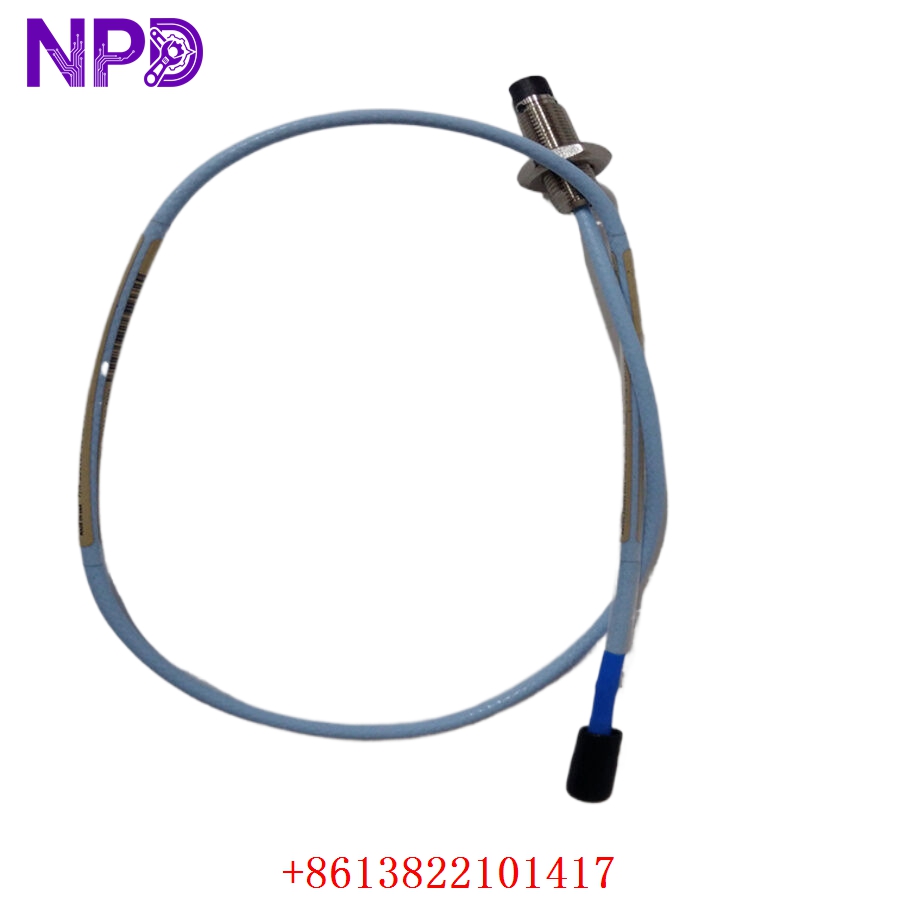
BENTLY 330103-00-03-05-02-05
Application Scenarios & Engineering Pain Points
In high-speed turbo-machinery, internal clearances are measured in microns. The 330103-00-03-05-02-05 reverse-mount probe is designed specifically for tight fluid-film bearing housings where you cannot adjust the probe from outside the casing. Instead, it threads from the inside out or mounts inside a specialized internal sleeve.
The single biggest engineering failure point with proximity probes isn’t the sensor tip—it’s mechanical damage to the thin coaxial extension lead during maintenance shutdowns, or fluid tracking through unsealed conduit boxes. When a rigger accidentally crimps an extension cable or oil contaminates the ClickLoc coaxial connection, the high-frequency impedance of the circuit changes completely. This shifts the calibration scale factor, blinding your Bently Nevada 3500 monitor or causing false vibration trips that can bring down a critical machine group instantly.
Typical Field Deployments:
- Centrifugal Compressor Bearings – Radial Vibration Mapping
Mounted in orthogonal pairs (X-Y configuration, 90^\circ apart) directly inside the bearing cap to track actual shaft centerline orbit profiles.
- Steam Turbine Main Shafts – Axial Thrust Displacement
Measures absolute axial float movement of the rotor relative to the fixed thrust bearing collar to prevent catastrophic rotor-to-stator contact.
- High-Pressure Water Injection Pumps – Phase Reference (Keyphasor)
Targets a machined notch or projection on the pump shaft to provide a once-per-revolution pulse for synchronous speed and vibration phase-angle calculations.
Case Study: The Blind Compressor Casing Interlock
- The Setup: An ethylene plant utilized a high-speed centrifugal process gas compressor equipped with internal fluid bearings. The tight casing geometry required internal 330103 series reverse-mount probes to track rotor orbit vectors.
- The Crisis: During an active machine overhaul, a technician working inside the housing accidentally snagged the probe’s short 0.5-meter lead pigtail against a heavy lifting shackle, tearing through the outer Tefzel protective jacket and severing the inner shield wire. On startup checks, the matching 3500/42M rack immediately locked out the channel on a permanent “Not OK” fault. Without this critical safety loop running, plant safety rules prohibited ramping up the machine, delaying production restarts at a cost of roughly $22,000 per hour.
- The Fix: Because local supply loops lacked this specific combination of unthreaded/threaded length codes with intrinsic safety certification labels, the project manager reached out to us. We verified a matching new surplus unit in our inventory, conducted a high-frequency continuity trace analysis on our bench, and expedited the package on an overnight special courier run.
- The Outcome: The part arrived at the plant floor at 7:30 AM. The millwright slipped the reverse-mount probe into its internal adapter socket, routed the lead safely through the internal cable clamps, and clicked it into the extension lead. The 3500 monitor instantly returned to “OK” status with a perfect -10.2 V DC gap voltage reading, allowing the plant to bring the compressor up to full speed before the midday shift slot.
Standard Operating Procedure (SOP) Quality Transparency
Because an uncalibrated proximity sensor can compromise major mechanical safety loops, our engineering workshop tests every incoming 330103-00-03-05-02-05 probe through a strict five-stage quality cycle before it is authorized to ship:
[Visual Thread & Tip Audit] ➔ [ClickLoc Connector Clean Check] ➔ [Static Linear Calibration Loop] ➔ [Dielectric Shield Audit] ➔ [ESD Safe Packing] 1. Visual Thread and Tip Audit
- Geometric Verification: We inspect the 3/8-24 UNF threads using calibrated thread ring gauges to ensure zero binding or deformities. The green PPS composite probe tip is examined under magnification for micro-fissures or factory casting defects.
2. ClickLoc Connector Clean Check
- Gold Face Review: The miniature ClickLoc coaxial pin is inspected to verify that the gold contact layer is completely smooth and unmarred. We ensure the integrated connector protector sleeve slides cleanly over the connection joint.
3. Static Linear Calibration Loop (Live Bench Test)
- Test Architecture: The probe is connected via a verified 3300 XL 4.5-meter extension cable to an authentic 3300 XL Proximitor sensor unit. The assembly is secured onto a precision micrometer spindle targeting a certified AISI 4140 steel block.
- Data Log Matrix: We advance the micrometer in steps of 0.25 mm (10 mils) across the full 2.0 mm operational gap profile. We log the DC output voltage with a fluke multimeter to ensure the Average Scale Factor (ASF) tracks perfectly within the specified 200 mV/mil\pm10\% limit.
4. Dielectric Shield Audit
- Isolation Verification: We use a high-resistance testing tool to confirm complete electrical isolation between the coaxial outer shield layer and the outer physical stainless-steel thread case, eliminating potential field ground-loop risks.
5. ESD Safe Packing and Dispatch
- Sealing: The verified probe is coiled loosely to prevent internal core strain and heat-sealed inside a clean anti-static bag.
- Boxing: Wrapped securely in impact-resistant bubble casing within high-density double-wall cartons to ensure the delicate sensor arrives in factory-perfect condition.
Technical Pitfall Mitigation Guide
Replacing an internal reverse-mount probe requires precise installation habits to protect the physical component from damage during startup.
1. The 4140 Steel Calibration Trap
- The Risk: Bently Nevada 3300 XL 8 mm proximity probes are factory-calibrated for AISI 4140 electric steel. If your machine features a custom shaft sleeve or uses a different alloy composition (e.g., stainless steel or monel), the scale factor will change completely. The 3500 monitor will read an incorrect vibration amplitude, potentially missing a dangerous mechanical condition.
- The Fix: If your shaft material is not 4140 steel, you must consult your plant’s original engineering records to see if a custom calibration scale factor was programmed into the matching 3500 monitor rack or if a specialized target material Proximitor sensor was used.
2. Proper Coaxial Cable Connection Practices
- The Risk: The ClickLoc connector is a precise miniature link. Over-tightening it with heavy pliers or allowing oil to coat the internal contact pins will alter the loop impedance, causing the channel to throw random “Vibration Spikes” or “Not OK” faults.
- The Fix: Connect the joints finger-tight only. Click them together firmly until they seat. Once connected, always slide the integrated connector protector sleeve over the link or wrap it in specialized self-vulcanizing high-temperature silicone tape to keep out moisture and turbine lubrication oils. Never allow raw wires to sit bare inside an open terminal box.
3. Mechanical Clearance Check (The Blind Insertion Issue)
- The Risk: Because a reverse-mount probe threads in blindly from inside the housing or via an internal sleeve, you cannot visually see if the tip is pressing hard against the shaft surface. If you turn the machine over while the probe tip is mechanically jammed against the rotor, the shaft will instantly shear off the green composite tip.
- ❗ Crucial Warning: Always connect a digital multimeter to the matching Proximitor sensor’s output lines while you are threading the probe into place. Monitor the DC gap voltage. As the probe tip approaches the shaft, the voltage will begin to drop down from its -24 V open circuit rail. Thread the probe carefully until the voltage reads between -9.0 V DC and -11.0 V DC (the ideal middle-of-scale target operating gap). Secure the locknut at that exact position to ensure safe mechanical clearance.
Compatible Replacement Models
If you face inventory constraints or are planning a platform update, note these relative component cross-references:
| Original Model | Potential Alternative | Compatibility Level | Key Differences | Necessary Field Action | Cost Impact |
| 330103-00-03-05-02-05 | 330104 Series | ❌ Hardware Incompatible | Standard forward-mount style probe featuring an external hex nut configuration. | Cannot be used in internal reverse-mount adapters; it will not thread into the casing from the inside out. | Identical baseline cost sheet. |
| 330103-00-03-05-02-05 | 330103-00-03-10-02-05 | ⚠️ Software Compatible | Features a longer total integrated pigtail cable length (1.0 meter instead of 0.5 meter). | Requires swapping out the matching extension cable from a 4.5-meter run to a 4.0-meter run to keep the total loop length at exactly 5.0 meters. | Identical cost profile. |
| 330103-00-03-05-02-05 | NSv 8mm Proximity Series | ❌ Total Retrofit Required | Designed for very small target diameters and restricted clearance areas with distinct calibration parameters. | Requires changing out the Proximitor sensor unit and updating the configuration files inside the 3500 rack system. | High capital and re-engineering layout layout (+150%). |
Troubleshooting Quick Reference
Use this field matrix to isolate probe loop performance issues before removing components from the housing:
| Diagnostic Symptom | Root Cause Probability | Card Relevance | Field Verification Steps | Recommended Remediation |
| Monitor reads “Not OK”, DC Voltage sits at -24 V DC | Open circuit in the cable loop, disconnected ClickLoc link, or broken inner core wire. | ✅ High | Disconnect the extension cable and measure the center-pin to outer-shield resistance of the probe pigtail with a multimeter. | A healthy 0.5-meter 3300 XL probe should read between 4.0 Ω and 6.0 Ω of coil loop resistance. If it reads infinity (\infty), the inner coil or wire is broken. Replace the probe. |
| Monitor reads “Not OK”, DC Voltage sits at 0 V DC | Direct short circuit between the inner signal wire and the outer shield ground. | ✅ High | Measure the resistance from the center pin of the ClickLoc connector directly to the stainless-steel outer probe case thread. | The resistance should be infinite (\infty). If you measure near 0 Ω, the wire insulation has collapsed inside the case. The probe must be replaced immediately. |
| Vibration readings jump erratically when machine speed changes | Oil film ingress inside the coaxial connector or loose connector link. | ⚠️ Medium | Open the local junction box, pull back the connector protector sleeve, and check for liquid oil tracking inside the gold contact pin. | Clean the connection pins thoroughly using an residue-free industrial electronics contact cleaner spray, dry completely, reconnect securely, and seal tightly with self-vulcanizing silicone wrap. |
Need immediate engineering backup? If your plant is down and you cannot pinpoint the failure node, drop our technical support desk an email with photos of your current indicator lights and a copy of your panel’s wiring diagram. We will have an integration engineer respond within 2 hours.