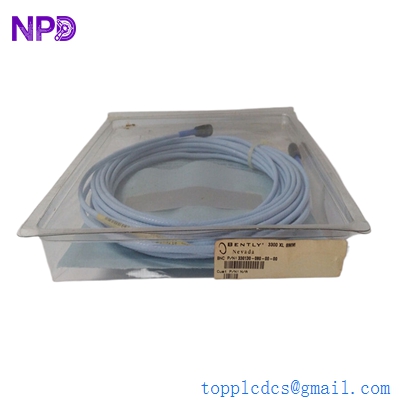

Description
Product Core Brief
- Model: BENTLY NEVADA 330130-080-00-00
- Brand: Bently Nevada (Baker Hughes)
- Series: 3300 XL 8mm Proximity Transducer System
- Core Function: Connects a 3300 XL probe to a Proximitor sensor for non-contact vibration measurement.
- Condition: Brand New Surplus (Original, uninstalled)
- Type: Extension Cable
- Key Specs: 8.0 Meters Length No Armor Standard Coaxial Design
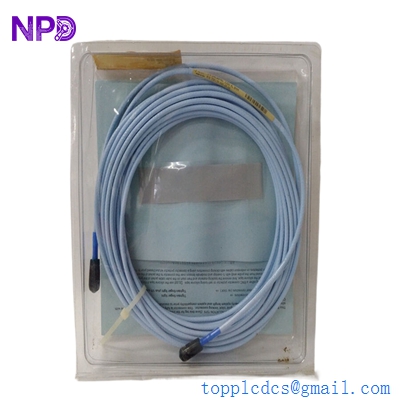
BENTLY 330130-080-00-00
Key Technical Specifications
- Cable Length: 8.0 Meters (approx. 26.2 feet)
- System Compatibility: 3300 XL 8mm Proximity Transducer System
- Total System Length: Designed for 9.0 meter total system length (1m probe + 8m cable)
- Armor Option: -00 (Standard cable, no stainless steel armor)
- Connector Option: -00 (Standard brass ClickLoc connectors)
- Capacitance: 69.9 pF/m (21.3 pF/ft) typical
- Operating Temperature: -51 °C to +177 °C (-60 °F to +351 °F)
- Minimum Bend Radius: 25.4 mm (1.0 inch)
- Material: FEP (Fluorinated Ethylene Propylene) insulated coaxial cable
- Resistance: Center conductor: 0.22 Ω/m; Shield: 0.066 Ω/m
- Weight: 34 grams per meter (approx.)
Installation & Configuration Guide
Phase 1: Pre-Installation (10 Minutes)
⚠️ Critical Length Matching: The 330130-080-00-00 is a 8.0-meter cable. In my experience, the most frequent error is mismatching cable lengths. This cable must be used with a 1.0-meter probe and a 9.0-meter Proximitor. If you mix it with a 5.0-meter system, your calibration will be off by several hundred millivolts, leading to false vibration readings.
Preparation:
- Inspect the ClickLoc connectors for any debris or moisture.
- Verify the Proximitor sensor is labeled for “9.0m System Length.”
- Tools: Connector protector kits (highly recommended), lint-free cloth, and isopropyl alcohol.
Phase 2: Routing (15 Minutes)
- Avoid Sharp Bends: Do not exceed the 25.4 mm minimum bend radius. Kinking the cable will change its impedance and ruin the accuracy of your vibration data.
- Isolation: Route the cable through dedicated conduit or tray. Keep it at least 15 cm (6 inches) away from high-voltage AC lines (440 V+) to prevent EMI (Electromagnetic Interference) noise.
- Cable Ties: Use plastic zip ties but do not over-tighten them. If the tie “bites” into the FEP jacket, you risk internal signal leakage.
Phase 3: Connection & Sealing (5 Minutes)
- Cleanliness: Wipe the male and female connectors with alcohol. Even a fingerprint on the center pin can introduce resistance.
- Locking: Push the ClickLoc connectors together and twist until they click.
- Protection: Apply silicone self-fusing tape or a Connector Protector (Bently Nevada part 40113-02) over the junction.
- Note: In oily or wet environments, if you don’t seal this connection, moisture will wick into the cable and cause the signal to “drift.”
Phase 4: Testing (10 Minutes)
- Static Voltage Check: With the probe at a known gap, measure the DC voltage (Gap Voltage) at the Proximitor.
- Verification:
- If the voltage is -24 V DC, the cable is likely open-circuit.
- If the voltage is 0 V DC, the cable is likely short-circuited.
- Log: Record the total system length and the cable’s serial number in your maintenance database.
Customer Cases & Industry Applications
Case 1: Correcting Calibration Errors in a Paper Mill
Situation: A paper mill in the Pacific Northwest was getting erratic “Gap Out” alarms on a dryer section bearing. Their previous supplier had sent them a 5-meter cable as a “close enough” substitute for the original 8-meter run.
The Problem: Because the system was calibrated for 9.0 meters total, the 5-meter cable caused a massive impedance mismatch. The DCS was reading -18 V DC even when the probe was physically close to the shaft.
Action: We identified the error and shipped three 330130-080-00-00 units from our inventory. I advised the customer to check their Proximitor labels to ensure they matched the 9m requirement.
Result: Once the correct 8.0m cables were installed, the gap voltage returned to the linear range (-8 to -12 V DC). The “Gap Out” alarms vanished, and the mill avoided an unnecessary $20,000 bearing inspection.
Case 2: Emergency Replacement for a Gas Turbine Shutdown
Situation: During a scheduled outage at a peaking plant, a technician accidentally stepped on an unarmored extension cable, crushing the core. The turbine could not be restarted without active vibration monitoring.
Action: The customer needed the “No Armor” version (-00) specifically to fit through existing tight conduits. We dispatched the 330130-080-00-00 via same-day air freight.
Result: The cable arrived before the restart window closed. The plant manager appreciated that we had the exact “New Surplus” part in stock, as the factory lead time was quoted at 4 weeks.
Frequently Asked Questions (FAQ)
Q: Can I use this cable with a 5mm or 11mm probe? A: No. The 330130 series is specifically for the 3300 XL 8mm system. Using it with different probe sizes will result in non-linear output and incorrect vibration data.
Q: What is the difference between the -00 and -01 dash numbers? A: The second-to-last dash number is for armor. The -00 you are looking at is the standard cable. The -01 version comes with flexible stainless steel armor. If your cable is routed inside a machine or in an area with high foot traffic, you might want to consider the armored version next time.
Q: Is it okay to “coil up” the extra length of an 8-meter cable? A: Yes, but keep the coil diameter at least 15 cm (6 inches). Avoid tight “figure-eight” loops which can induce noise. Never cut the cable to shorten it; the length is part of the electrical circuit’s tuned resonance.
Q: Why buy “New Surplus” for a cable? A: Cables don’t “age” like capacitors do, but they are often damaged during installation. Our New Surplus cables give you the exact same electrical performance as a factory-direct unit but at a 20-30% lower price point and, more importantly, without the 4-8 week lead time.
Q: How do I know the cable isn’t a used “pull-off”? A: We inspect the brass connectors for any wrench marks or oxidation. A used cable will almost always have slight discoloration on the FEP jacket or scratches on the ClickLoc housing. Our units are clean, bright, and guaranteed uninstalled.