Description
⚙️ Product Overview
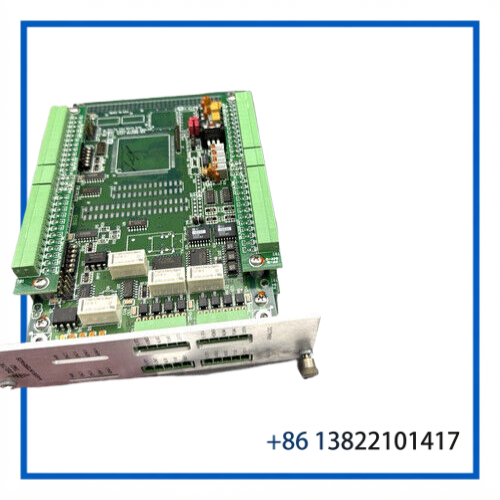
The DELTA TAU OMRON ACC-24E2A is a UMAC Turbo analog axis interface and breakout module designed for multi-axis motion-control systems. The 4-axis configuration consists of two interconnected ACC-24E2A 2-axis boards, providing a total of four analog servo interface channels.
The module provides the interface circuitry between the UMAC motion-control CPU and external servo amplifiers. It supports analog command signals, encoder feedback, amplifier connections, and axis flag connections, making it suitable for machine tools, semiconductor equipment, precision positioning systems, and other PMAC-based automation platforms.
The ACC-24E2A is an interface board, not a complete servo amplifier. External amplifiers receive the command signals generated through the module.
🔧 Key Features
- Delta Tau / OMRON UMAC Turbo motion-control accessory
- ACC-24E2A analog axis interface architecture
- 4-axis configuration
- Two interconnected 2-axis interface boards
- Analog servo command interface
- ±10 VDC analog command capability
- Two DACs per servo channel
- Suitable for velocity, torque, and sinusoidal commutation amplifier control
- Encoder feedback connections for each axis
- Removable amplifier and encoder terminal connections
- Direct connection to the UMAC CPU through the backplane expansion interface
- Suitable for legacy Delta Tau and compatible AMAT motion-control equipment
📋 Technical Datasheet
| Parameter | Specification |
|---|---|
| Brand | DELTA TAU / OMRON |
| Model | ACC-24E2A |
| Product Series | UMAC Turbo |
| Product Name | 4-Axis Analog Interface Module |
| Product Type | Analog Servo Axis Interface / Breakout Board |
| Number of Axes | 4 |
| Command Interface | Analog ±10 VDC |
| DAC Configuration | 2 DACs per servo channel |
| Feedback Interface | Encoder feedback, configuration dependent |
| Power Requirement | 5 VDC, approximately 500 mA; higher with Option 1A |
🎯 Analog Servo Interface Function
The ACC-24E2A provides the electrical interface between the UMAC motion controller and external analog servo amplifiers.
Each analog servo channel provides two ±10 V DAC outputs. These outputs can be used for velocity or torque commands, while the second DAC can also be assigned to another general-purpose function when the amplifier configuration requires only one command signal.
The module can also support sinusoidal commutation-related analog commands and pulse-and-direction functionality under appropriate configuration. This flexibility allows the same UMAC architecture to control different types of machine axes.
A typical control path is:
UMAC CPU → ACC-24E2A → Analog Servo Amplifier → Servo Motor
Feedback returns through:
Servo Motor / Encoder → ACC-24E2A → UMAC Motion Controller
🔌 Encoder & Axis Feedback
The ACC-24E2A includes encoder and axis-related interface connections for the controlled axes. The encoder feedback allows the UMAC controller to compare commanded and actual axis position and perform closed-loop motion control.
Each axis can also have removable flag connections for machine-status signals. This is useful for integrating limit switches, home/reference signals, amplifier status, and other axis-related machine conditions.
Connector configuration depends on the specific ACC-24E2A hardware option. Documented configurations include terminal-block and DB15-based connector arrangements, so the exact board revision and option code should be matched before replacement.
🧩 UMAC System Integration
The ACC-24E2A connects to the UMAC CPU through the system backplane expansion port. It is specifically intended for UMAC rack-mounted systems rather than as a standalone controller.
A typical multi-axis machine architecture can include:
- UMAC Turbo CPU
- ACC-24E2A analog axis interface
- External servo amplifiers
- Servo motors
- Encoder feedback devices
- Digital I/O modules
- Machine PLC or host controller
- Operator interface
- Safety and limit circuits
For a 4-axis application, two 2-axis ACC-24E2A boards can be interconnected to provide four axes of control.
🏭 Typical Applications
The ACC-24E2A is suitable for applications requiring precise coordinated motion, including:
- CNC machine tools
- Semiconductor manufacturing equipment
- Wafer-processing machinery
- Automated assembly equipment
- Precision positioning systems
- Pick-and-place machinery
- Multi-axis inspection equipment
- Industrial robotics
- Packaging machinery
- Legacy AMAT motion-control systems
Its analog ±10 V architecture is particularly useful when the machine uses external servo amplifiers rather than an integrated drive.
🔄 AMAT / Semiconductor Equipment Integration
The ACC-24E2A is also encountered in industrial and semiconductor equipment associated with Applied Materials and other OEM motion-control platforms.
When used in OEM equipment, the Delta Tau board may carry an OEM-specific identification or assembly number in addition to the ACC-24E2A designation. Therefore, replacement should be based on both the Delta Tau model and the original equipment manufacturer’s part number, when available.
For semiconductor equipment maintenance, compare:
- Board part number
- Hardware revision
- Axis count
- Connector type
- Encoder interface
- Amplifier interface
- UMAC CPU compatibility
- OEM assembly number
- Machine software and motion parameters
🛠️ Installation & Commissioning
Before installing an ACC-24E2A:
- Power down the complete UMAC system.
- Disconnect external amplifier power where required.
- Record the original board configuration and option code.
- Photograph encoder and amplifier wiring.
- Verify the 2-axis or 4-axis configuration.
- Check connector type and terminal-board arrangement.
- Inspect the backplane and board-edge contacts.
- Install the module carefully into the correct UMAC position.
- Verify encoder and amplifier wiring before applying power.
- Confirm axis configuration and servo parameters.
- Test each axis at low speed before normal operation.
Never connect or disconnect servo amplifier or encoder wiring while the control system is energized unless the machine manufacturer’s maintenance procedure specifically permits it.
🔍 Troubleshooting
One axis does not respond:
Check the corresponding amplifier command output, enable signal, encoder feedback, axis configuration, and external amplifier.
All axes are unavailable:
Inspect the UMAC backplane connection, 5 VDC supply, CPU communication, and module seating.
Incorrect motor direction:
Check the axis configuration, command polarity, encoder polarity, and motor/amplifier wiring.
Position feedback is unstable:
Inspect encoder cables, shielding, grounding, connector contacts, and encoder configuration.
Servo amplifier receives no command:
Verify the analog command wiring and confirm that the correct ±10 V output channel is assigned to the axis.
Only some channels operate:
Check whether the installed board is a complete 4-axis configuration and whether the additional axis option/board is correctly connected.
🧰 Maintenance
For long-term operation of legacy UMAC systems:
- Keep the module free from dust and conductive contamination.
- Inspect board-edge contacts periodically.
- Check removable terminal blocks for loose connections.
- Inspect encoder cables and shielding.
- Verify analog command wiring.
- Maintain backups of UMAC motion programs and parameters.
- Record the exact hardware and option configuration.
- Store replacement boards in ESD-safe packaging.
- Avoid unnecessary handling of exposed electronic components.
Because the ACC-24E2A is part of a closed-loop motion-control system, a small wiring or feedback problem can produce axis errors that appear to be controller faults. Troubleshooting should therefore include both the interface board and the external amplifier/encoder chain.
♻️ Replacement Considerations
The ACC-24E2A family includes multiple hardware and connector configurations. A replacement should not be selected solely because it carries the same general model name.
Important compatibility checks include:
- ACC-24E2A model
- 2-axis versus 4-axis configuration
- Option 1A analog expansion
- Encoder connector type
- Amplifier connector type
- Terminal-block or DB15 configuration
- UMAC CPU and backplane
- OEM part number
- Existing motion-control software
- Servo amplifier type
Documented ACC-24E2A configurations include part-number variants such as 603398-102 / 603398-552 for one terminal-block configuration and 603398-104 / 603398-554 for a DB15 configuration. These should not be treated as universally interchangeable without checking the actual hardware arrangement.
❓ Frequently Asked Questions
What is the DELTA TAU ACC-24E2A?
It is a UMAC Turbo analog axis interface and breakout board used to connect the motion controller to external analog servo amplifiers and encoder feedback.
How many axes does the 4-axis version support?
The 4-axis configuration provides four analog servo interface channels using two interconnected 2-axis boards.
Is the ACC-24E2A a servo drive?
No. It is an interface board. The external servo amplifier provides the motor power.
What command signal does it use?
The analog configuration provides ±10 VDC command signals.
Does it support encoder feedback?
Yes. Encoder interface connections are provided for the controlled axes.
Can it control torque and velocity amplifiers?
Yes. The analog outputs can be used for velocity or torque control, depending on the external amplifier and system configuration.
Can the ACC-24E2A be used with AMAT equipment?
ACC-24E2A boards are encountered in OEM and semiconductor-equipment applications, including equipment using Delta Tau UMAC motion control. Exact AMAT compatibility should be confirmed using the equipment and board part numbers.
Is every ACC-24E2A physically identical?
No. Connector and option configurations vary. Terminal-block and DB15 versions are documented, among other configurations.
What should be checked before replacing this board?
Verify the complete board number, 2-/4-axis configuration, connector arrangement, option code, UMAC CPU compatibility, encoder interface, amplifier interface, and OEM equipment part number.
🔟 Related DELTA TAU / OMRON Models
- DELTA TAU ACC-24E2A 2-Axis Analog Interface Module
- DELTA TAU ACC-24E2 2-Axis Digital PWM Interface
- DELTA TAU ACC-24E3 Gate3-Style Axis Interface
- DELTA TAU ACC-24M2A MACRO Analog Axis Interface
- DELTA TAU ACC-24M2S MACRO Stepper Axis Interface
- DELTA TAU ACC-51E High-Resolution Encoder Interpolator
- DELTA TAU ACC-58E Resolver-to-Digital Converter
- DELTA TAU ACC-84E Universal Serial Encoder Interface
- DELTA TAU Turbo PMAC2 Motion Controller
- OMRON Power PMAC / UMAC Motion-Control Platform
✅ Product Summary
The DELTA TAU OMRON ACC-24E2A is a specialized UMAC Turbo 4-axis analog servo interface module designed for machine-control systems using external analog amplifiers. Its ±10 V command outputs, encoder feedback interfaces, removable axis connections, and four-axis architecture make it suitable for coordinated industrial motion applications.
For replacement projects, the most important factors are the complete ACC-24E2A configuration, axis count, connector option, OEM part number, UMAC CPU compatibility, encoder arrangement, and external servo amplifier configuration.