Description
⚙️ Product Overview
The DELTA TAU OMRON BC8-C3-AA2-240-4C320 is an 8-axis Power Brick / Brick Controller designed for advanced PMAC-based multi-axis motion-control applications.
The published Omron configuration data identifies this exact model as an 8-axis BrickController with an 80 MHz processor, 1M×24 SRAM, 4 MB Flash, TrDAC functionality, and eight encoder interfaces with 12–24 V flag inputs.
Unlike a simple servo amplifier, the BC8-C3-AA2-240-4C320 combines motion-control processing, feedback interfaces, and machine-control functions in a compact controller architecture. It is suitable for CNC, robotics, semiconductor equipment, precision machinery, and other applications requiring coordinated multi-axis control.
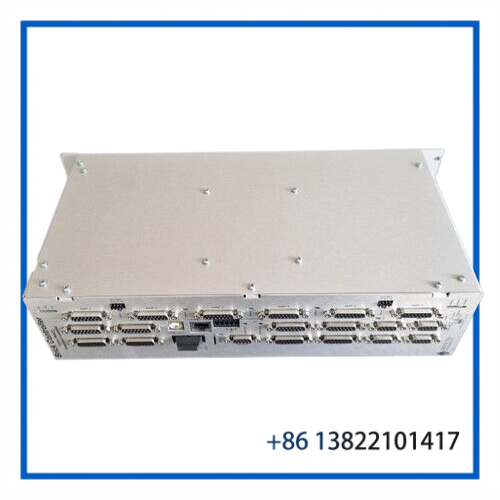
🔧 Key Features
- Delta Tau / Omron Power Brick Controller
- Exact model: BC8-C3-AA2-240-4C320
- 8-axis motion-control architecture
- 80 MHz processor configuration
- 1M×24 SRAM
- 4 MB Flash memory
- TrDAC output capability
- 8 encoder interfaces
- 12–24 V flag input configuration
- PMAC-based motion-control architecture
- Designed for coordinated multi-axis machine control
- Suitable for legacy and replacement applications
📋 Technical Datasheet
| Parameter | Specification |
|---|---|
| Brand | DELTA TAU / OMRON |
| Model | BC8-C3-AA2-240-4C320 |
| Product Series | Power Brick / Brick Controller |
| Product Name | 8-Axis Power Brick Controller |
| Product Type | Multi-Axis Motion Controller |
| Number of Axes | 8 Axes |
| Processor | 80 MHz |
| Memory | 1M × 24 SRAM |
| Flash Memory | 4 MB |
| Feedback / I/O | 8 Encoders; 12–24 V Flag Inputs; TrDAC |
🎯 Motion-Control Function
The BC8-C3-AA2-240-4C320 is intended for coordinated control of up to eight motion axes. Its PMAC-based architecture allows the controller to execute programmed motion profiles while processing encoder feedback and machine-control signals.
The 80 MHz configuration provides the processing platform for real-time motion-control calculations. The eight encoder interfaces allow actual axis position or velocity feedback to be returned to the controller.
Typical motion functions can include:
- Point-to-point positioning
- Multi-axis interpolation
- Electronic gearing
- Coordinated axis motion
- Position and velocity control
- Machine sequencing
- Precision positioning
- CNC motion profiles
- Automated production movements
🔌 Encoder & Machine I/O
A major feature of this configuration is its eight encoder interfaces. Encoder feedback is essential for closed-loop servo systems because it allows the controller to compare commanded motion with actual machine movement.
The specified configuration also includes 12–24 V flag inputs, providing an interface for machine status and axis-related signals. TrDAC functionality is included in the published configuration identification, making the exact unit more than a basic CPU-only motion controller.
Because Power Brick configurations can differ considerably, optional I/O, communication, and electrical functions should be verified from the complete model code and the original machine configuration before replacement.
🏭 Typical Applications
The BC8-C3-AA2-240-4C320 can be used in demanding multi-axis automation systems such as:
- CNC machine tools
- Semiconductor manufacturing equipment
- Precision assembly machines
- Robotics
- Packaging machinery
- Automated inspection systems
- Material-processing machinery
- Electronic manufacturing equipment
- Special-purpose machines
- Multi-axis positioning systems
Its eight-axis architecture is particularly useful when several mechanical axes must operate under coordinated motion programs.
🔗 System Integration
A typical PMAC motion architecture can be represented as:
Host Computer / PLC → Power Brick Controller → Motion Commands → Servo Amplifiers → Motors
with feedback returning through:
Servo Motor → Encoder → BC8 Encoder Interface → PMAC Motion Processor
Machine-level signals can also be connected through the controller’s flag and I/O interfaces.
For a retrofit, the controller should be evaluated together with the servo amplifiers, motors, encoder devices, machine I/O, communication network, and existing PMAC program.
🛠️ Installation & Commissioning
Before installing the BC8-C3-AA2-240-4C320:
- Verify the complete model number.
- Confirm the required eight-axis configuration.
- Record the existing PMAC firmware and software configuration.
- Back up all motion programs and machine parameters.
- Identify every encoder connection.
- Verify encoder voltage and signal compatibility.
- Check 12–24 V flag wiring.
- Inspect connectors and grounding.
- Confirm communication and host-controller settings.
- Test each axis individually at low speed before full machine operation.
Power should be removed before connecting or disconnecting wiring. Encoder and I/O wiring should be checked carefully because incorrect feedback connections can result in uncontrolled or incorrect axis movement.
🔍 Troubleshooting
Controller powers up but an axis does not respond:
Check the axis enable logic, servo amplifier status, PMAC configuration, motor wiring, and encoder feedback.
Encoder position is incorrect:
Verify encoder wiring, supply voltage, signal polarity, scaling, and axis configuration.
Several axes fail simultaneously:
Check common power, controller initialization, system communication, and shared machine-control signals before replacing individual components.
Machine position drifts:
Inspect encoder feedback quality, servo tuning, mechanical coupling, and position-loop parameters.
Flag inputs are not detected:
Verify the 12–24 V signal level, common reference, input wiring, and programmed flag assignment.
Replacement controller will not run the original machine:
Check firmware, PMAC configuration files, motion programs, I/O mapping, encoder settings, and machine-specific parameters.
🧰 Maintenance
For long-term operation and spare-parts management:
- Keep the controller clean and free from conductive contamination.
- Maintain adequate cabinet ventilation.
- Inspect encoder and I/O connectors periodically.
- Check grounding and shielding.
- Back up PMAC programs and configuration files.
- Record firmware and hardware revisions.
- Keep a copy of machine-specific axis parameters.
- Store spare controllers in ESD-protective packaging.
- Avoid unnecessary changes to proven motion parameters.
For legacy Delta Tau installations, maintaining a correctly configured spare can significantly reduce downtime because controller replacement may otherwise require extensive machine reconfiguration.
♻️ Replacement Considerations
The BC8-C3-AA2-240-4C320 should be matched by its complete ordering code rather than simply by selecting another eight-axis Brick Controller.
Important compatibility points include:
- BC8 eight-axis architecture
- C3 processor/configuration designation
- AA2 hardware option
- 240 configuration
- 4C320 final option code
- 80 MHz processor
- 1M×24 SRAM
- 4 MB Flash
- Eight encoder interfaces