Description
⚡ Product Overview
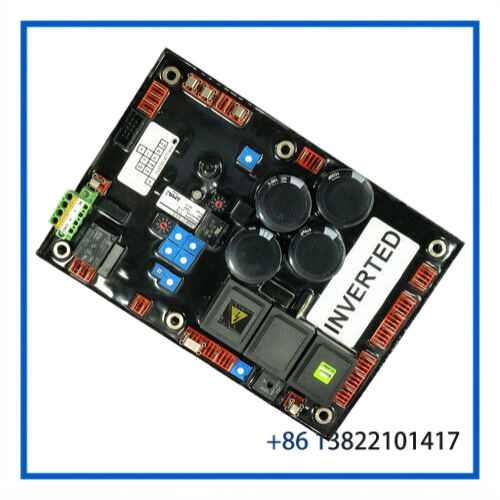
The EMRI EDE LX449 V1.5.0.0 is an Automatic Voltage Regulator (AVR) designed for generator excitation and voltage-control applications. The LX449 platform is intended as a replacement for the R449 and provides configurable control functions for generator voltage, power factor, current limiting, droop, and related excitation-control requirements.
The V1.5.0.0 revision corresponds to a specific LX449 hardware/software generation. The LX449 revision history identifies V1.5.0.0 with hardware version 1.6.0 and software version 1.6.0, with minor hardware changes and the addition of capacitive limiting during cosφ control.
🔧 Product Features
- EMRI EDE LX449 automatic voltage regulator
- Version: V1.5.0.0
- Generator excitation and voltage-control application
- Constant-voltage control
- Volt-per-Hertz control
- Power-factor control
- Generator voltage/current control
- Quadrature voltage droop for parallel operation
- Current limiting capability
- Generator and AVR protection functions
- CAN bus communication
- Adjustable control parameters
- PUR-coated electronics for environmental protection
- Designed for generator and power-generation applications
📋 Technical Specifications
| Parameter | Specification |
|---|---|
| Brand | EMRI EDE |
| Model | LX449 V1.5.0.0 |
| Series | LX449 |
| Product Name | Automatic Voltage Regulator |
| Product Type | Generator AVR / Excitation Controller |
| Application | Generator Excitation & Voltage Regulation |
| Control Modes | Voltage, V/Hz, PFC, Current/Voltage Control, Droop |
| Communication | CAN Bus |
| AVR Field Current | Up to 15 A intermittent / 10 A continuous at 70°C |
| Operating Temperature | -30°C to +70°C |
🎛️ Control Functions
The LX449 provides multiple generator-control modes. Depending on the selected configuration, the AVR can perform constant-voltage control, V/Hz control, generator-voltage control, generator-current control, power-factor control, and droop control for parallel operation.
The controller also supports configurable excitation limits and current limiting. This allows the AVR to be adapted to different generator and excitation-system requirements.
For generator systems operating in parallel, the droop function can be used as part of the voltage-control arrangement. Additional accessories can be used for functions such as voltage matching.
🛡️ Protection Functions
The LX449 incorporates protection functions intended to help protect the generator and excitation system from abnormal operating conditions.
Protection functions include:
- Generator phase loss
- Phase-sequence error
- AVR over-temperature
- Generator over-temperature
- Generator over-voltage
- Generator over-current
- Generator over-excitation
- Loss of excitation during power-factor control
- Loss of current sensing during power-factor control
- Adjustable under-speed knee
- Adjustable excitation-current limits
- Generator current limiting
The AVR also provides status indication through its status LED and status contact.
🔌 Electrical Interface
The LX449 uses dedicated terminals for generator-voltage sensing, AVR supply, excitation field connection, droop/current sensing, accessory inputs, status contacts, and CAN communication.
The documented maximum ratings include generator voltage-sensing inputs up to 450 VAC continuously at 50 Hz, with higher intermittent limits depending on frequency and duration. The excitation field current is rated up to 15 A for short-duration operation, with continuous ratings depending on operating temperature.
The AVR supply input supports a wide range depending on the selected connection, while the CAN interface can be used for external monitoring and associated AVR communication functions.
⚙️ Generator Applications
The EMRI EDE LX449 can be applied to:
- Marine generator sets
- Auxiliary generators
- Industrial generator systems
- Synchronous generator excitation
- Generator retrofit projects
- Power-generation control panels
- Parallel generator installations
- Generator maintenance and replacement projects
- AVR modernization
- Replacement of compatible R449 systems
🛠️ Installation & Commissioning
Because the LX449 operates directly within a generator excitation system, installation should only be performed by qualified electrical personnel familiar with generator AVR systems.
Recommended procedure:
- Confirm the complete LX449 V1.5.0.0 identification.
- Verify generator voltage, frequency, excitation-field characteristics, and wiring requirements.
- Isolate the generator and excitation system before working on the AVR.
- Inspect the generator winding insulation before installation.
- Verify sensing-voltage connections and phase sequence.
- Confirm the excitation-field wiring and field resistance.
- Check the AVR supply arrangement.
- Confirm droop/current-transformer connections where applicable.
- Configure the required control mode and protection settings.
- Start the generator under controlled conditions and verify voltage regulation.
- Check excitation current, protection status, and system response.
- Record final commissioning parameters for future maintenance.
⚠️ The LX449 manual specifically warns that hazardous voltages can be present on the regulator and generator system. The AVR should never be serviced while energized.
🔍 Troubleshooting Guide
Generator voltage is unstable
Check sensing connections, generator wiring, control-mode settings, proportional gain, integral time, and excitation-system condition.
Generator voltage is too high or too low
Verify the selected voltage range, sensing input, voltage coarse/fine settings, and generator operating frequency. Incorrect sensing or configuration can produce abnormal regulation.
AVR reports an over-excitation condition
Check excitation current, excitation-field resistance, excitation ceiling settings, and generator operating conditions.
AVR indicates phase-loss or phase-sequence fault
Inspect the U-V-W generator sensing connections and verify the correct phase sequence.
Power-factor control does not operate correctly
Check current sensing, PFC configuration, accessory connections, and the selected control mode. Loss of current sensing during PFC is one of the documented protection conditions.
AVR overheats
Verify that the heatsink fins are vertically oriented and that sufficient airflow is available around the regulator. The documented operating temperature range is -30°C to +70°C.
🧰 Maintenance
For generator and marine spare-parts management, the LX449 should be stored in a clean, dry, ESD-protected environment.
Recommended maintenance practices include:
- Inspect terminal connections periodically.
- Check generator sensing wiring.
- Inspect excitation wiring for overheating or loose connections.
- Keep the AVR heatsink and surrounding area clean.
- Verify ventilation and airflow.
- Record AVR hardware and software versions.
- Keep commissioning parameters in the maintenance documentation.
- Inspect stored spare units before installation.
- Avoid changing rotary-switch or DIP-switch settings while the generator is operating.
❓ FAQ
Q1: What is the EMRI EDE LX449 V1.5.0.0?
It is an automatic voltage regulator designed for generator excitation and voltage-control applications.
Q2: What is V1.5.0.0?
It identifies a specific LX449 product revision. The documented revision history associates this version with hardware 1.6.0 and software 1.6.0.
Q3: Can the LX449 replace an R449?
The LX449 was designed as a replacement platform for the R449, but the complete generator and excitation configuration must be checked before replacement.
Q4: Does the LX449 support CAN communication?
Yes. CAN bus is provided for AVR communication and external monitoring functions.
Q5: Does it support power-factor control?
Yes. Power-factor control is one of the available LX449 control modes.
Q6: Is the LX449 suitable for marine generators?
Yes. It is suitable for compatible generator excitation applications, including marine power-generation systems, provided the generator and AVR specifications match.
Q7: What should be checked before purchasing a replacement?
Verify the complete model/version, generator voltage and frequency, excitation-field requirements, wiring configuration, and existing AVR settings.
Q8: Can the AVR be adjusted while the generator is running?
Dangerous voltages are present during generator operation. Maintenance and electrical adjustments should follow the applicable safety procedures and manufacturer documentation.
📦 10 Related EMRI EDE / LX449 Spare Parts
- EMRI EDE LX449 V1.5.0.0 – Automatic Voltage Regulator
- EMRI EDE LX449 V1.4.4.0 – Automatic Voltage Regulator
- EMRI EDE LX449 V1.4.3.0 – Automatic Voltage Regulator
- EMRI EDE LX449 V1.4.1.0 – Automatic Voltage Regulator
- EMRI EDE R449 – Automatic Voltage Regulator
- EMRI EDE LX_VMA – Voltage Matching Unit
- EMRI EDE AVR Assistant – AVR Programming / Monitoring Device
- EMRI EDE DROOPCAT – Droop / Current-Limiting Accessory
- EMRI EDE LX449 3F-Filter – Generator Voltage Sensing Filter
- EMRI EDE DFD7.5 – Diode Failure Detector
🏁 Product Summary
The EMRI EDE LX449 V1.5.0.0 Automatic Voltage Regulator is a configurable generator excitation controller designed for voltage regulation, power-factor control, current limiting, droop control, and related generator protection functions.
Its CAN communication capability, configurable control modes, excitation-current management, and generator protection functions make it suitable for compatible industrial and marine generator systems. For replacement applications, matching the LX449 version, generator electrical characteristics, excitation system, and existing configuration is essential.