
Description
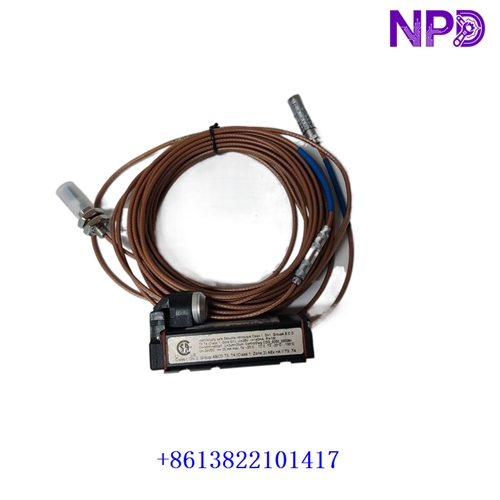
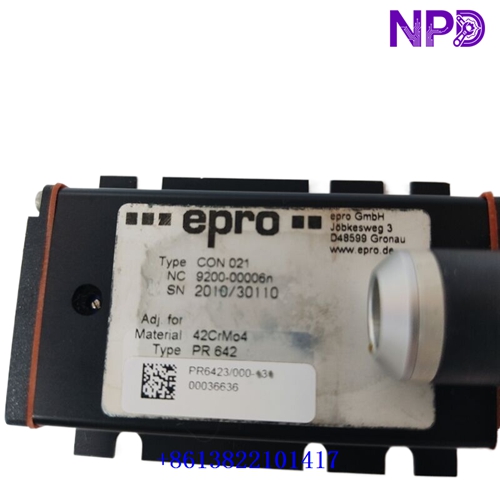
The Emerson / EPRO PR6423/000-031-CN paired with the CON 021 converter forms a complete, high-precision eddy current proximity probe and signal conditioning assembly. Engineered for the MMS 3000 and AMS 6500 machinery health platforms, this system provides non-contact measurement of shaft vibration, axial position, and rotational speed on critical rotating machinery such as steam turbines, compressors, and large generators.
| Parameter | Specification |
| Brand / Manufacturer | Emerson / EPRO (Machinery Health Platform) |
| Component Assembly | PR6423/000-031-CN (Proximity Probe) + CON 021 (Signal Converter / Driver) |
| Product Type | Eddy Current Displacement Sensor & Signal Conditioning Unit |
| Probe Thread / Type | M33 x 1.5 thread, unarmored integral cable configuration (-CN variant) |
| Linear Measurement Range | 0 to 2 mm (standard operating range for relative vibration/position) |
| Power Supply (Converter) | Nominal -26 V DC (supplied via monitoring rack or dedicated driver supply) |
| Output Signal | Proportional voltage/current matching gap distance (e.g., mV/µm) |
| Product Status | Industrial Automation Spare Part / Active System Support |
First-Run Inspection Checklist
- ☑ Physical & Tip Integrity
Inspect the probe tip, threaded body, and high-frequency coaxial cable for any mechanical damage, kinks, or insulation wear prior to installation.
- ☑ Con 021 Converter Check
Verify that the matching CON 021 converter unit is free from housing damage and that its internal components are protected against moisture and conductive dust.
- ☑ Extension Cable & Connector Seating
Ensure that the coaxial connectors between the probe cable and the CON 021 converter are screwed together firmly, clean, and insulated from grounding to prevent erratic signal spikes.
Routine Maintenance & Servicing
- 🛠 Gap Voltage Calibration Check
Periodically verify that the static gap voltage (typically around -10 V DC at midpoint) aligns with machinery protection baseline requirements when the shaft is at rest.
- 🔌 Terminal & Shielding Inspection
Inspect signal cables running from the CON 021 converter to the monitoring rack to ensure proper outer shield grounding and freedom from high-frequency electromagnetic interference (EMI).
Troubleshooting & Common Issues
- ⚠️ Zero/Open Circuit Alarms (-26 V rail or 0 V output)
If the monitoring system registers a sensor fault, check coaxial cable continuity, inspect connector joints for moisture ingress, and verify that supply voltages at the CON 021 are stable.
- ⚠️ Erratic Vibration or Noise Spikes
If signal readings fluctuate abnormally, inspect the probe mounting bracket for mechanical looseness, check for ground loops on the shield, and verify that the shaft surface is free of runout or magnetic marks.
Safety Precautions
- 🔐 Qualified Personnel Only
Installation, gap setting, and wiring must be executed exclusively by certified instrumentation technicians familiar with non-contact vibration measurement and API 670 standards.
- ⚠️ System Interlock Isolation
Always engage appropriate trip bypass logic in the control system before performing maintenance, sensor repositioning, or replacing hardware connected to emergency machinery shutdown loops.
Frequently Asked Questions (Q&A)
- ❓ Q1: What is the purpose of the CON 021 unit paired with the PR6423 probe?
A: The CON 021 acts as the signal converter (driver), supplying high-frequency radio frequency (RF) excitation to the probe tip and converting the resulting eddy current impedance changes into a clean, linear voltage signal for the monitoring rack.
- ❓ Q2: Why is proper static gap setting critical during installation?
A: Setting the correct gap ensures the probe operates precisely in the linear region of its characteristic curve, guaranteeing accurate, distortion-free measurement of shaft vibration and position across the full operating range.