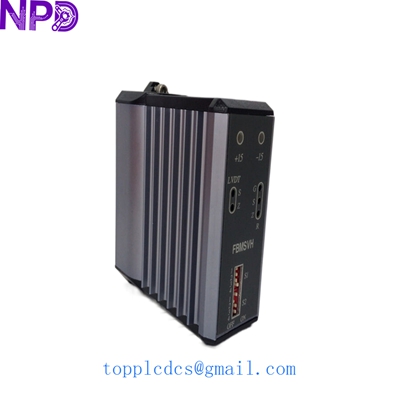
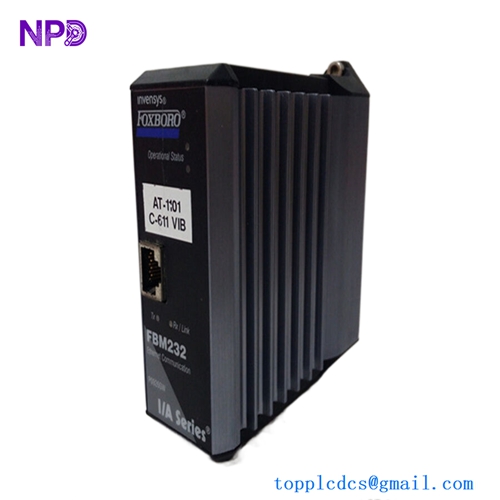
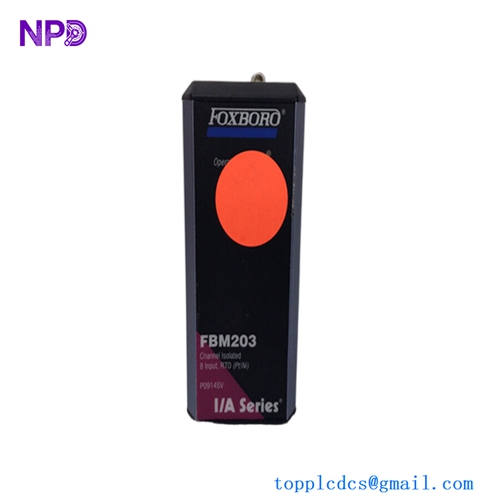
Description
- Model: FBM207 P0914TD
- Brand: FOXBORO (Schneider Electric)
- Series: I/A Series Fieldbus Module (FBM200 Series)
- Core Function: 16-channel isolated analog input acquisition
- Type: Analog Input Module (AI)
- Key Specs: 16 AI channels 4–20 mA input Channel isolation
- Input Channels: 16 isolated analog input channels
- Signal Type: 4–20 mA DC current loop
- Input Impedance: 250 Ω nominal
- A/D Resolution: 16-bit conversion
- Measurement Accuracy: ±0.1% of full scale at 25 °C
- Isolation: Channel-to-channel and channel-to-ground isolation
- Power Supply: 24 V DC from baseplate
- Power Consumption: Approx. 5 W
- Operating Temperature: 0 °C to 60 °C
- Mounting Method: FBM200 baseplate, DIN rail cabinet installation
- Communication: I/A Series fieldbus to Field Control Processor (FCP)
- Diagnostics: Per-channel fault detection and status reporting
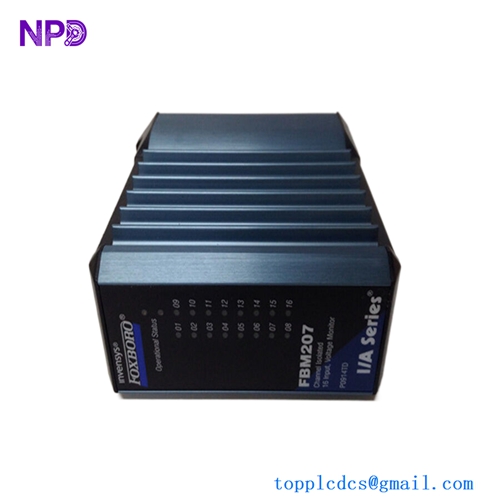
FOXBORO FBM207 P0914TD
Part 4: Installation & Configuration Guide
An experienced DCS technician can complete replacement within 30 minutes if preparation is handled correctly.
Phase 1: Pre-Installation (Estimated 10 minutes)
⚠️ Safety First
- Notify operations and schedule a maintenance window.
- Confirm the process is in a safe state (valves closed, motors stopped).
- Shut down the I/O cabinet power supply, including redundant feeds.
- Wait at least 5 minutes for capacitors to fully discharge.
Tools Required
- Anti-static wrist strap and anti-static mat
- PH1 screwdriver
- Digital multimeter (we use a Fluke 115 for voltage verification)
- Wire labels and marker
- Smartphone for configuration photos
Backup Tasks
- Export the current control configuration from the I/A engineering workstation.
- Take detailed photos of:
- Terminal wiring layout
- Module slot position
- Any loop power connections
Do not skip documentation. It prevents unnecessary troubleshooting later.
Phase 2: Removal of Existing Module (5–8 minutes)
- Remove the front cover (clip-on design).
- Label and disconnect field wiring individually.
- Loosen terminal screws carefully (counterclockwise).
- Release the module locking mechanism at the base.
- Pull the module straight outward to avoid stressing the backplane connector.
⚠️ Inspect baseplate connector pins. Clean dust with compressed air if needed.
Phase 3: Installation of New Module (10 minutes)
- Wear anti-static protection.
- Verify the model number matches FBM207 P0914TD.
- Insert the module vertically into the baseplate until fully seated.
- Reconnect field wiring according to documented labels.
- Tighten terminal screws (approximately 0.5 N·m torque).
Self-check:
- Correct slot location
- All wires secured
- Terminal numbers verified
- Module fully engaged
Phase 4: Power-On & Functional Testing (10–15 minutes)
Before energizing:
- Measure input supply voltage (24 V DC ±10%).
- Check for short circuits (>10 kΩ between +24 V and GND).
Power-up sequence:
- Energize the I/O cabinet.
- Observe LED indicators:
- Green steady: normal operation
- Red flashing: configuration or loop issue
- Connect to I/A Series engineering workstation.
- Confirm module recognition by the Field Control Processor (FCP).
- Verify all 16 channels display valid readings.
Functional verification:
- Inject 4–20 mA signals into selected channels.
- Confirm scaling and linearity in the DCS display.
- Monitor operation for at least 30 minutes without alarm conditions.
If communication fails, inspect fieldbus wiring and baseplate addressing.
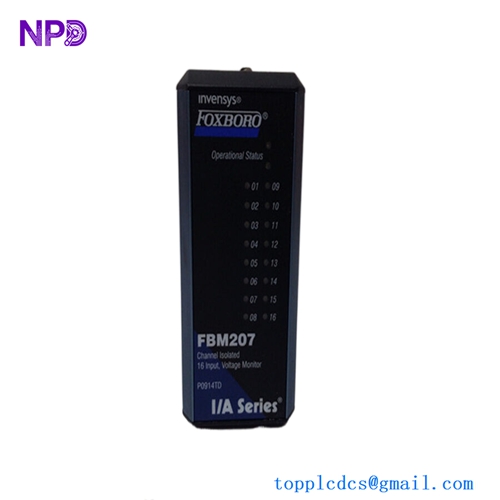
FOXBORO FBM207 P0914TD
Part 5: Customer Cases & Industry Applications
Case 1: Chemical Plant Emergency Replacement
Situation
A mid-sized chemical facility operating an I/A Series system experienced unstable temperature readings on a reactor loop after 9 years of service.
Task
The faulty analog channel caused repeated alarms and forced partial manual operation, reducing throughput by 25%.
Action
The plant identified a failed FBM207 module. The OEM quoted 8 weeks lead time. We supplied a fully tested Brand New Surplus unit within 24 hours.
Result
Replacement completed during a planned shift stop. No reprogramming required. Estimated avoided loss: approximately $120,000. The plant later added two modules as buffer stock.
Case 2: Power Utility Strategic Last-Time-Buy
Situation
A regional power station planned to operate its I/A Series system until 2032 despite module discontinuation.
Task
No spare analog input modules were available on-site. Lead time variability posed risk.
Action
Based on historical failure rate (1 module every 3–4 years), we recommended:
- Min Level: 1 unit
- Max Level: 3 units
- Reorder Point: 1 unit
They secured three units as a controlled last-time-buy.
Result
One module failed due to surge impact in 2024. Replacement completed within 40 minutes. No forced outage occurred. The procurement team later acknowledged the investment was justified.
Case 3: System Integrator Project Delivery
Situation
An engineering contractor expanding a wastewater plant needed matching analog input modules for an existing I/A rack.
Task
Redesigning the control system would have delayed commissioning and increased project cost by $80,000.
Action
We verified firmware compatibility, completed full functional tests, and shipped within 48 hours.
Result
The project was delivered on schedule. The contractor avoided penalties and consolidated future spare sourcing through vendor consolidation.
Part 6: Frequently Asked Questions (FAQ)
Q1: Is FBM207 still manufactured?
A: No. This model has been discontinued. Migration to newer FBM models may require configuration changes. For plants operating beyond five years, keeping 1–2 spare units on-site is advisable.
Q2: Are these modules new or refurbished?
A: They are Brand New Surplus units only. Not used, not repaired. We verify serial numbers, inspect PCB condition, and perform full functional testing. Test reports are available upon request.
Q3: Can this module be hot-swapped?
A: In many I/A Series configurations, FBMs support hot replacement. However, always confirm system redundancy and safety procedures. When unsure, power down the I/O segment to minimize risk.
Q4: What is the expected service life?
A: Under normal cabinet conditions (20–30 °C), a new unit typically operates 10–15 years. Long-term storage does not significantly impact reliability if humidity is controlled.
Q5: Why is your price lower than OEM pricing?
A: We source global surplus inventory, operate with lower overhead, and prioritize inventory turnover. The hardware remains original and traceable. Customers may verify serial numbers independently.
Q6: What stocking strategy do you recommend?
From field experience:
- Critical AI modules: Maintain 1–2 units as insurance.
- Moderate usage: Reorder when stock reaches 1 unit.
- Multi-site organizations: Consider cross-site inventory pooling.