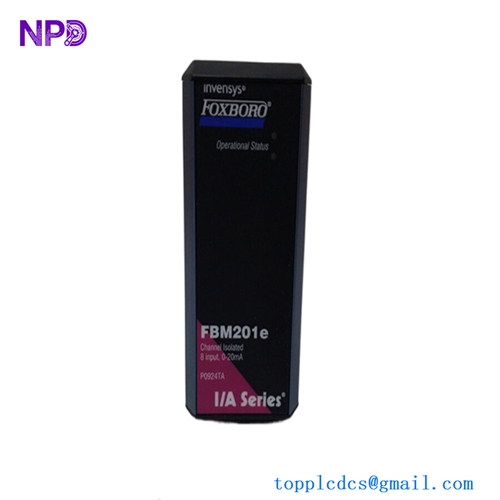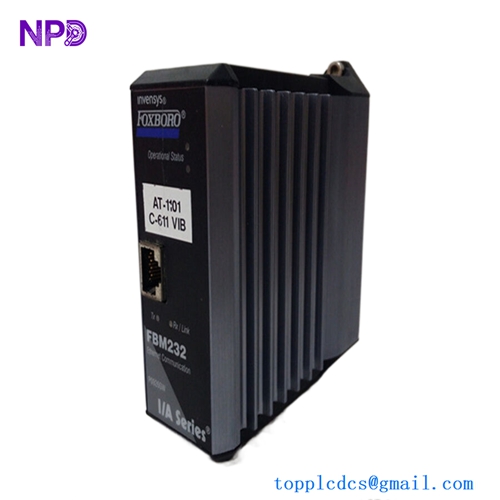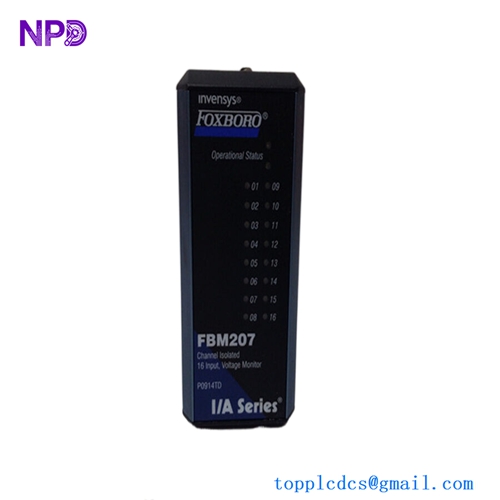

Description
The Foxboro FBM207 (Part Number: P0914TD) is a high-density discrete input interface designed for the EcoStruxure Foxboro DCS (Distributed Control System). It functions as a 16-channel Voltage Monitor or Contact Input module, providing the critical link between field-side discrete signals and the system’s control processors.
Product Introduction
The FBM207 P0914TD is engineered to detect the state of 16 independent discrete inputs. It is a “Universal” discrete module, capable of monitoring dry contacts (using an external or internal power supply) or sensing the presence of specific AC or DC voltage levels.
This module is widely used for monitoring motor starter auxiliary contacts, limit switches, and pushbutton states. Each channel is optically isolated, ensuring that high-voltage transients or ground loops from the field do not damage the sensitive electronics of the DCS backplane. The module is hot-swappable and supports redundant configurations when installed on a redundant modular baseplate.
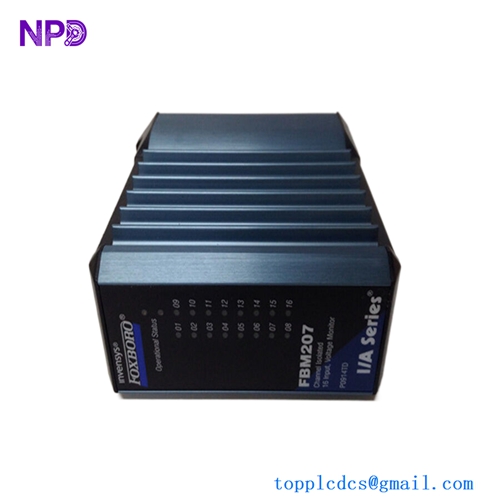
FOXBORO FBM207 P0914TD
Product Parameters (Datasheet)
The following specifications detail the technical capabilities of the P0914TD:
| Parameter | Specification |
| Model Number | FBM207 |
| Part Number | P0914TD |
| Input Channels | 16 Isolated Discrete Inputs |
| Input Type | Contact Sense (Dry) or Voltage Monitor (Wet) |
| Input Voltage (DC) | 24V DC / 48V DC / 125V DC (Configurable via TA) |
| Input Voltage (AC) | 120V AC (with appropriate Termination Assembly) |
| Isolation | 600V AC (Input-to-Ground), 600V AC (Channel-to-Channel) |
| Power Consumption | 3.0 Watts (Maximum) |
| Communication | 2 Mbps HDLC Fieldbus |
| Filter Time | 4 ms to 255 ms (Software Configurable) |
| Operating Temp | -20°C to +70°C |
| Relative Humidity | 5% to 95% (Non-condensing) |
Country of Origin
- Origin: United States (USA)
The P0914TD is manufactured in the United States by Schneider Electric (Foxboro), meeting global industrial standards for electromagnetic compatibility (EMC) and hazardous area operations.
Technical Description & Features
The FBM207 P0914TD provides several advanced features for industrial discrete monitoring:
- Optical Isolation: Each of the 16 channels is galvanically isolated from the system logic and other channels. This prevents a single electrical fault in the field from propagating through the entire I/O rack.
- Configurable Debouncing: To prevent “chatter” from mechanical switches, the module features software-configurable digital filters (debouncing). Users can set the time a signal must remain steady before the state change is registered.
- Sequence of Events (SOE): When properly configured with the control station, the FBM207 can support SOE logging, allowing technicians to see the exact microsecond order in which contacts tripped during a process upset.
- Flexible Powering: Depending on the Termination Assembly (TA) used, the module can provide its own “wetting voltage” to sense dry contacts or monitor externally powered circuits.
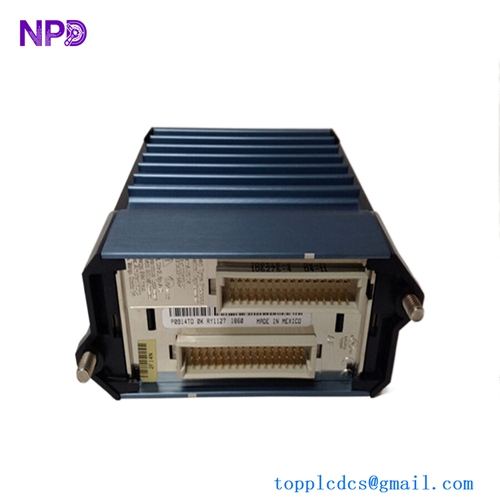
FOXBORO FBM207 P0914TD
Product Usage Instructions
1. Hardware Installation
- The FBM207 must be installed on a Modular Baseplate (2, 4, or 8-slot versions).
- Align the module with the baseplate guide rails.
- Press the module firmly into the baseplate connectors and tighten the two captive screws to secure it.
2. Field Wiring and Termination
The P0914TD requires a separate Termination Assembly (TA) to connect to field wiring.
- Connect the field wires to the TA terminals.
- Ensure the TA type matches the voltage being monitored (e.g., use the 120V AC TA for AC sensing).
- Warning: Ensure field power is disconnected before connecting wires to the TA to prevent accidental shorts.
3. Software Configuration
- Open the Foxboro Configuration Component (ICC or FoxView).
- Define the Letterbug for the module position.
- Assign CIN (Contact Input) blocks to the individual channels.
- Configure the “Invert” attribute if the contact logic is Normally Closed (NC).
Common Problems Q&A
Q: What is the difference between FBM207 and FBM207b/c? A: The standard FBM207 (P0914TD) is the core 16-channel version. Variants like “b” or “c” may have different internal components or factory-set filtering characteristics optimized for specific high-speed applications.
Q: Why is the “Ready” LED red? A: A solid red LED indicates an internal hardware failure. If the LED is flashing red, it typically indicates a mismatch between the configured Letterbug and the physical module, or a failure to download the configuration from the Field Control Processor (FCP).
Q: Can I monitor 24V DC and 120V AC on the same FBM207? A: No. While the module is universal, the Termination Assembly (TA) determines the voltage level. A single TA (and thus a single FBM207) must be used for a uniform voltage type across its channels.
Q: How do I test a channel manually? A: You can use a jumper wire on the Termination Assembly to simulate a closed contact. If the “Active” LED on the module faceplate turns on and the software state changes, the module and TA are functioning correctly.
Recommended Related Models
- Foxboro FBM217 (P0914TR): 32-channel high-density Discrete Input module.
- Foxboro FBM219 (P0917LH): 24-channel Combined Discrete I/O module.
- Foxboro FBM201 (P0914SQ): 8-channel Analog Input module.
- Foxboro FCP270 (P0917CP): The Field Control Processor that coordinates FBM207 data.
- Foxboro Termination Assembly P0916BT: Common TA used for 24V DC contact sensing with FBM207.