Description
✨ Product Overview
The GE Fanuc / Abaco Systems VMIACC-5595-208 (also designated under parts 350-805595-208 and ACC-5595-208) is an industrial-grade, high-performance managed hub assembly engineered to operate seamlessly with the 5565 family of Reflective Memory real-time deterministic networks. This 2 Gb/s fiber-optic network module acts as a smart hosting hub, replicating serial optical signals across multiple nodes with ultra-low latency. It is specifically designed for mission-critical applications that demand synchronized, deterministic data sharing, such as large-scale distributed simulation networks, advanced aerospace testing systems, and high-tier industrial automation loops.
📋 Product Datasheet & Parameters
| Parameter | Specification |
| Target Model | GE 350-805595-208 ACC-5595-208 |
| Brand Manufacturer | GE Fanuc / VMIC (Abaco Systems) |
| Product Type | 2 Gb/s Reflective Memory Managed Hub Module |
| Network Compatibility | 5565 Series Reflective Memory real-time networks |
| Port Configuration | Up to 8 Small Form-Factor Pluggable (SFP) transceivers |
| Transceiver Loadout | Equipped with 8 Multimode pluggable transceivers |
| Network Scaling | Cascading support up to 256 nodes total |
| Communication Ports | 1x RS232 Serial (Local), 1x 10BaseT Ethernet (Remote) |
| Enclosure Type | 19-inch 1U Rack-Mountable or Desktop chassis |
| Dimensions | Standard 1U Rack enclosure format |
| Weight | Approx. 5.70 kg |
| Country of Origin | United States |
| Power Supply Type | Internal universal power supply supporting international standards |
🏭 Application Fields
- Distributed Control Systems (DCS): Real-time high-speed data mirroring and synchronization between high-tier controller nodes.
- Aerospace & Defense: High-fidelity flight simulation networks requiring absolutely deterministic and jitter-free data routing.
- Industrial Automation Hubs: Fiber-optic backbones connecting heavy production machinery zones over long geographic spans.
- Power Grid Simulation: Real-time data logging and network testing structures where communication latency must remain near zero.
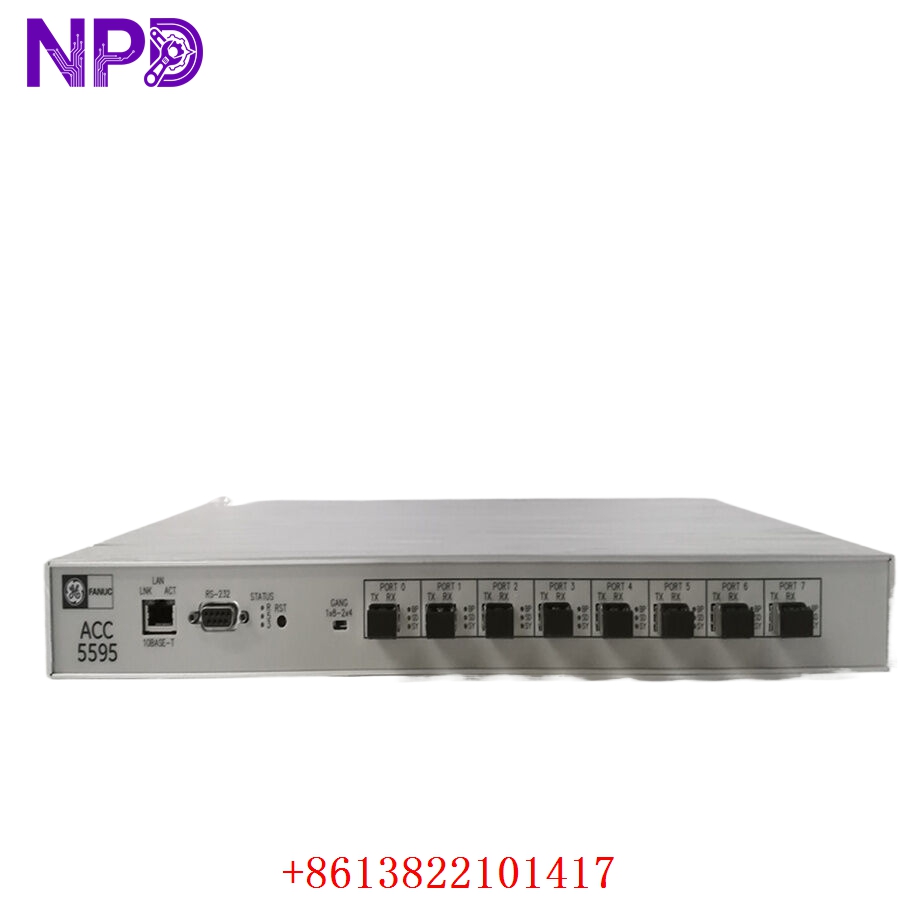
GE 350-805595-208 ACC-5595-208
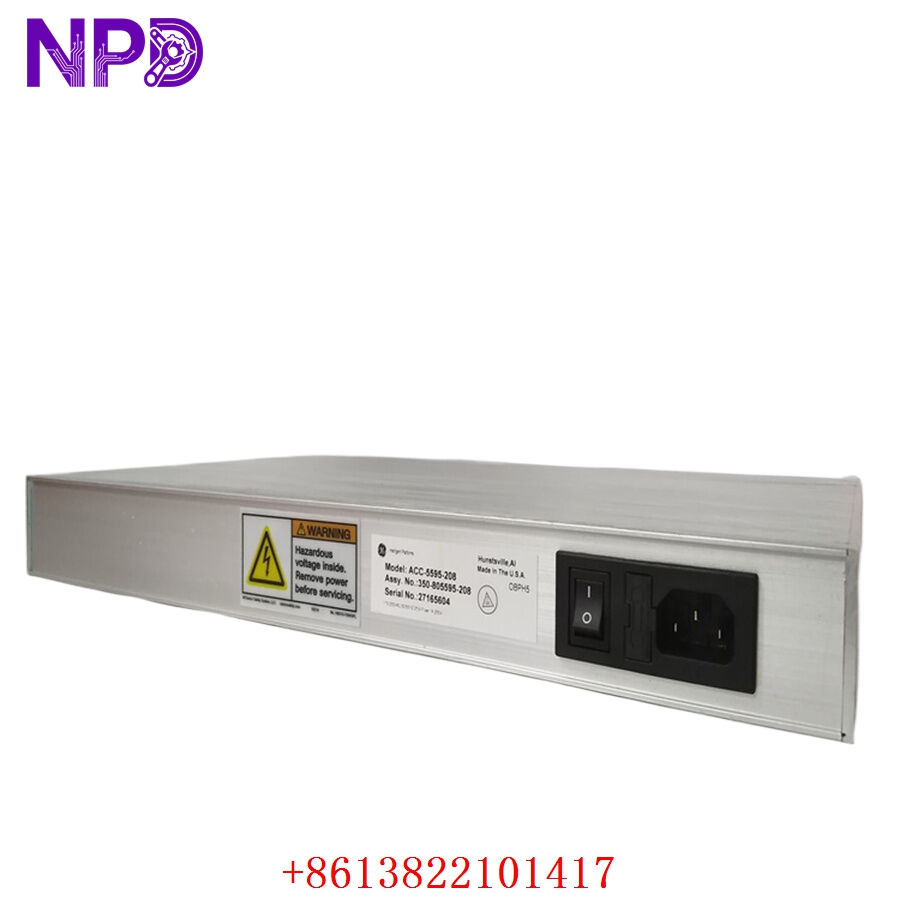
GE 350-805595-208 ACC-5595-208
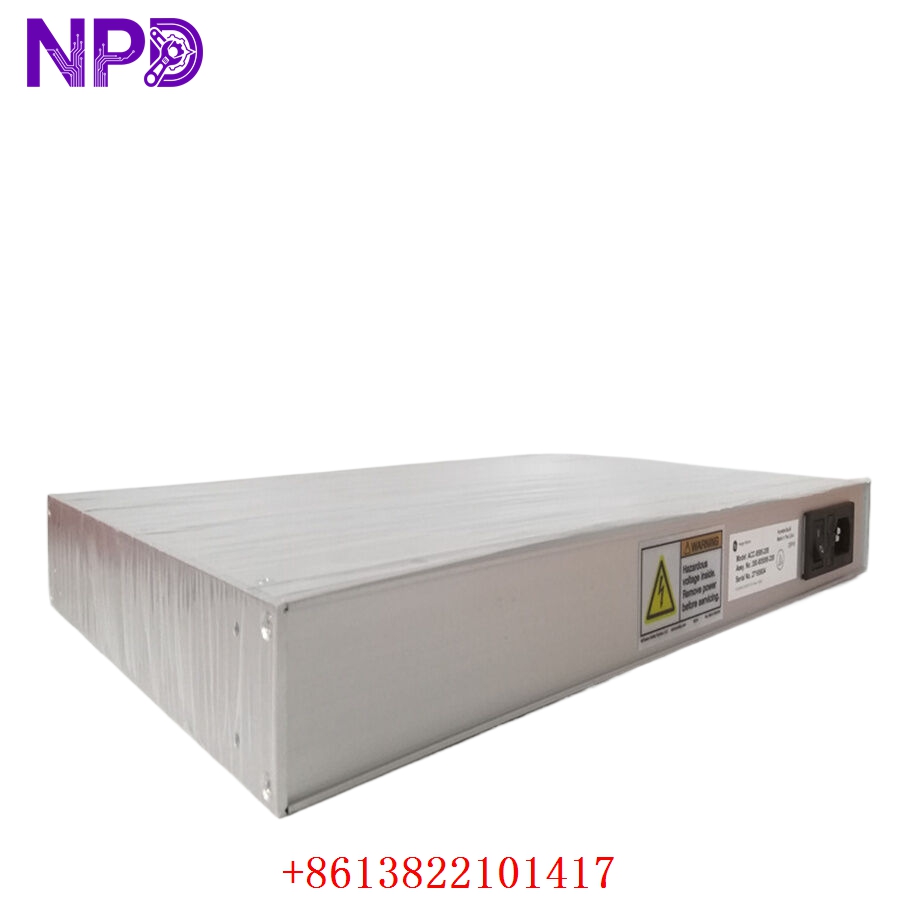
GE 350-805595-208 ACC-5595-208
⚙️ Product Usage Instructions
- Chassis Mounting: Secure the hub assembly firmly inside a standard 19-inch industrial rack using the included 1U mounting ears, or place it on a stable desktop using the provided rubber feet pads.
- Fiber-Optic Interconnection: Insert matching SFP transceivers into the front ports. Route the multimode fiber-optic cables safely, respecting the minimum bend radius to avoid localized signal degradation or physical core damage.
- Local and Remote Interface Setup: Connect a local PC terminal to the RS232 serial port for initial register changes, or link the 10BaseT Ethernet port to your local area network (LAN) to access the integrated, HTML-based web browser utility.
- Loop Management Configuration: Use the hardware Gang Select switch to set your routing layout either as a single continuous loop of 8 ports or split it cleanly into two separate isolated loops of 4 ports each.
❓ Q&A: Frequently Asked Questions
Q1: What happens if one of the connected network nodes fails or loses power?
💡 A: The VMIACC-5595-208 features intelligent automatic bypass logic. When it detects a Loss of Signal (LOS) or a loss of valid synchronization patterns on a port, it immediately shunts that node out of the loop. This mechanism keeps the remaining nodes fully active without fracturing the entire network ring.
Q2: How does the hub mitigate signal loss over extended cable layouts?
💡 A: Each active port on the hub fully regenerates the serial optical signal. By completely recreating the light wave pulse, it eliminates insertion loss and cable attenuation while drastically reducing jitter to maximize overall data purity.
Q3: Can single-mode and multimode transceivers be mixed inside this same hub?
💡 A: Yes. Since the optical channels utilize flexible SFP transceiver slots, you can combine short-range multimode ports (up to 300 meters) and long-range single-mode ports (up to 10 kilometers or more) within the same unit to match your system blueprint and optimize structural costs.