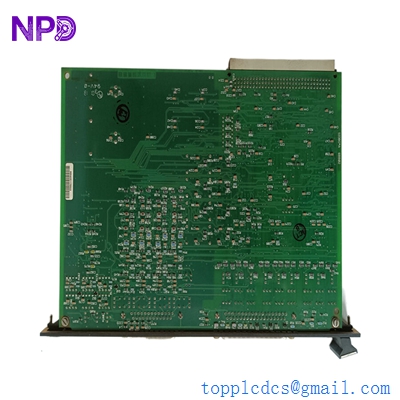

Description
- Model: GE DS200SIOBH1ABA
- Brand: General Electric (GE)
- Series: Mark V Speedtronic Control System
- Core Function: Serial Input/Output Bridge (SIOB) interface board
- Product Type: I/O Bridge Board
- Key Specs: Supports RS-232/RS-422 communication, handles I/O bus bridging, 24 V DC logic levels
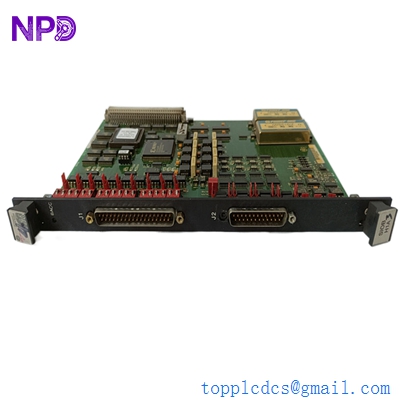
GE DS200SIOBH1ABA
Key Technical Specifications
- Product Rev: H1ABA (High-level revision with specific hardware fixes)
- Communication Interface: Dual serial ports supporting asynchronous protocols
- Bus Integration: Connects the STCA/TCQA boards to external serial devices
- Mounting Type: Stand-off mounting on the <I> or <C> cores
- Power Requirements: +5 V, +15 V, and -15 V DC from the power distribution module
- On-board Indicators: Diagnostic LEDs for Tx/Rx activity
- Logic Density: High-density FPGA for signal processing
- Operating Temp: 0 °C to +60 °C (32 °F to 140 °F)
- Connector Type: 34-pin ribbon cable headers (J1/J2)
Application Scenarios & Pain Points
If you are running a GE Mark V system today, you are likely feeling the pressure. These systems have been the backbone of power plants and refineries for decades, but finding reliable parts is becoming a nightmare. When an SIOB board fails, your turbine control system loses its ability to communicate with the operator interface or external PLCs. You aren’t just losing data; you are losing visibility. In a high-stakes environment like a peaking power plant, that loss of visibility means you can’t start your turbine when the grid needs it most.
1. Gas/Steam Turbine Control (Mark V)
The DS200SIOBH1ABA serves as the critical “translator” between the core control logic and the serial communication peripherals. Without it, your HMI (Human Machine Interface) is essentially blind.
2. Legacy DCS Integration
Used in older refinery setups where the Mark V system needs to report status to a third-party Distributed Control System via serial links. It bridges the proprietary bus to standard protocols.
3. High-Reliability Power Generation
Found in TMR (Triple Modular Redundant) systems where communication reliability is non-negotiable for safety-critical operations.
Case Study: The Midnight Communications Blackout
Background: A mid-sized cogeneration plant in the Midwest was running a GE Frame 7 Gas Turbine managed by a Mark V system. Everything was steady until the <I> core stopped communicating with the HMI.
The Problem: The operators couldn’t see exhaust temperatures or vibration levels. The turbine was running, but they were flying blind. Diagnostics pointed to the SIOB board in the <I> core. The OEM lead time was “indefinite” because the board is technically legacy.
The Solution: We received the call at 10:00 PM. We had a DS200SIOBH1ABA with the exact H1ABA revision in our inventory. Our engineers performed a 2-hour loop-back communication test on our Mark V simulation rack (using a 500 V megohmmeter to verify insulation) and shipped it via Next Day Air.
The Result: The board arrived by 9:00 AM the next morning. The plant engineers swapped the board, verified the DIP switches, and restored communication by noon.
- Avoided Loss: Estimated $120,000 in lost power sales and potential grid penalties.
- Takeaway: Keeping a “hot” spare SIOB board is significantly cheaper than a 24-hour communication outage.
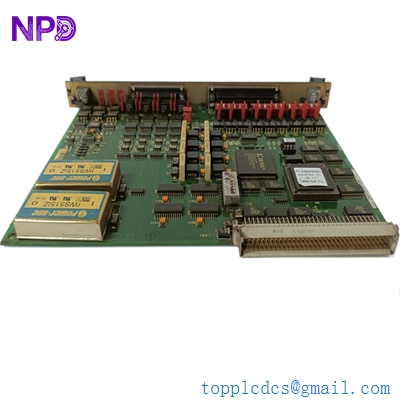
GE DS200SIOBH1ABA
Compatible Replacement Models
| Original Model | Replacement Model | Compatibility | Key Differences | Workload |
| DS200SIOBH1A | DS200SIOBH1ABA | ✅ Direct | H1ABA is the improved version | None (Plug & Play) |
| DS200SIOAG1A | DS200SIOBH1ABA | ⚠️ Software | Different logic chip; check firmware | Firmware Re-flash |
| IS200 series | DS200SIOBH1ABA | ❌ Incompatible | Mark VI vs Mark V; totally different | Complete upgrade |
Engineer’s Advice: Honestly, if you have an older “H1A” or “G1A” version, upgrading to the “H1ABA” revision is a smart move. It fixed several timing issues found in earlier boards. Just make sure your ribbon cables are still in good shape—those 34-pin connectors get brittle over time.
Troubleshooting Quick Reference
| Symptom | Potential Cause | SIOB Relevance | Quick Check | Action |
| HMI “Comm Failure” | Bad Serial Cable | ⚠️ Medium | Swap cable with a known good one | If cable is OK, test SIOB port |
| No Activity LEDs | No Power to Board | ✅ High | Check +5V DC at the J1 connector | Verify Power Dist. Module |
| Intermittent Data | EMI / Poor Ground | ⚠️ Medium | Check shield grounding on DB9/DB25 | Ensure 120 Ω termination |
| “EPROM Error” | Firmware Corrupt | ✅ High | Check if chips are seated correctly | Re-seat or replace EPROMs |
Quick Diagnosis Tips:
- The “Sniff Test”: These old boards often have capacitors that leak or bulge. If you see any brown residue or smell a “fishy” scent near the board, it’s done. Replace it immediately.
- DIP Switch Ghosting: ❗ Warning! I’ve seen this a dozen times. Someone replaces a board but forgets to copy the DIP switch positions. Take a photo of the old board’s switches before you pull it out. If those switches are wrong, your baud rate or station ID will be mismatched, and the system won’t talk.
- Loop-back Test: If you suspect the board is dead, try a simple loop-back on the RS-232 port. If the Rx/Tx LEDs don’t flicker during the test, the UART chip on the SIOB is likely fried.