
Description
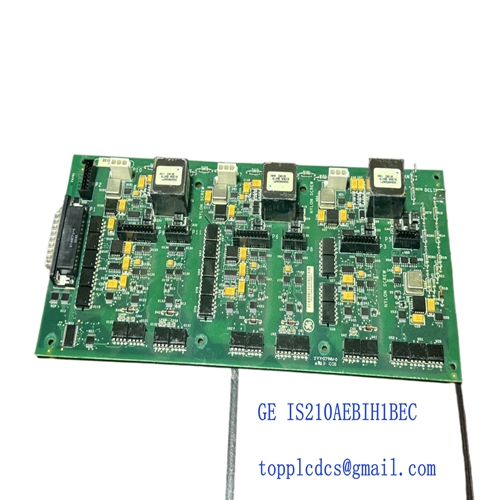
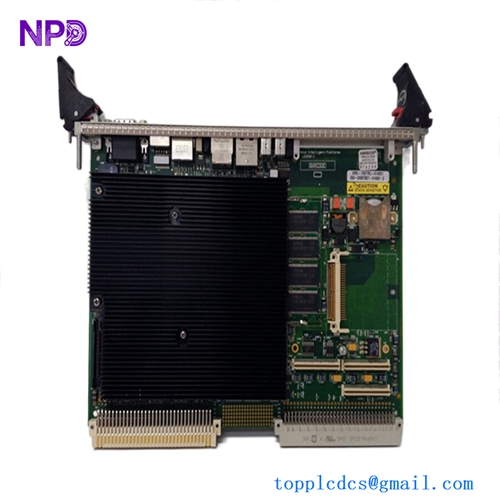
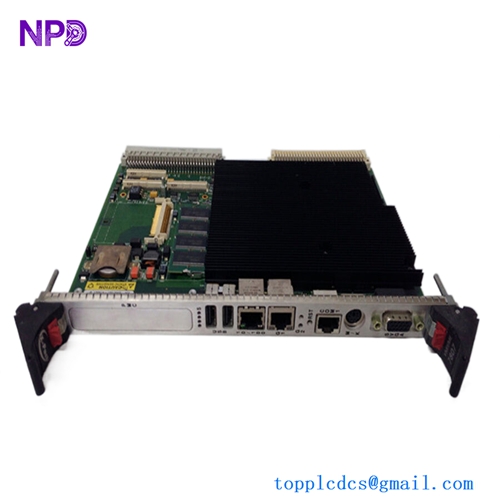
The GE VME-7807RC-414001 (associated with part numbers 350-93007807-414001 and variants like VMIVME-017807-414001) is a high-performance Single Board Computer (SBC) designed for the VMEbus architecture. It is part of the GE Fanuc (formerly VMIC) family of embedded controllers, engineered specifically for high-reliability military, aerospace, and industrial automation applications.
GE VME-7807RC-414001 350-93007807-414001 VMIVME-017807-411001 VMIVME-017807-414001
Product Introduction
The VME-7807RC is based on the Intel Pentium M processor, providing a balanced combination of high-speed computational power and low thermal dissipation. As a “Ruggedized” (RC) module, this board is built to operate in harsh environments where shock, vibration, and extreme temperature ranges are common.
The module functions as a comprehensive system controller, featuring integrated high-speed networking, extensive memory support, and a wide array of I/O interfaces. Its VME64 compatibility ensures it can act as a system master or slave within a standard VME chassis, making it a frequent choice for upgrading legacy systems without requiring a complete overhaul of the backplane infrastructure.
Product Parameters (Datasheet)
The following specifications represent the technical profile for the 414001 configuration:
| Parameter | Specification |
| Model Number | VME-7807RC-414001 |
| Processor | Intel Pentium M (Typically 1.8 GHz) |
| Memory (RAM) | Up to 2 GB DDR SDRAM (with ECC support) |
| L2 Cache | 2 MB Integrated |
| VME Interface | Tundra Universe II (VME64 compatible) |
| Ethernet | Dual 10/100/1000Base-T (Gigabit Ethernet) |
| Storage Interface | Ultra ATA/100 and CompactFlash (Type II socket) |
| Serial Ports | 2 x RS-232/422/485 ports |
| USB Support | 2 x USB 2.0 Channels |
| PMC Expansion | Two 64-bit IEEE 1386.1 PMC slots |
| Operating Temp | -40°C to +85°C (Ruggedization Level 4) |
| Power Consumption | Approx. 20-30 Watts (Load dependent) |
Country of Origin
- Origin: United States (USA)
The VME-7807 series was developed and manufactured by GE Intelligent Platforms (now Abaco Systems, a part of AMETEK) at their aerospace and defense facility in Huntsville, Alabama, USA.
Technical Description & Key Features
The VME-7807RC-414001 incorporates several hardware-level features designed for longevity and performance:
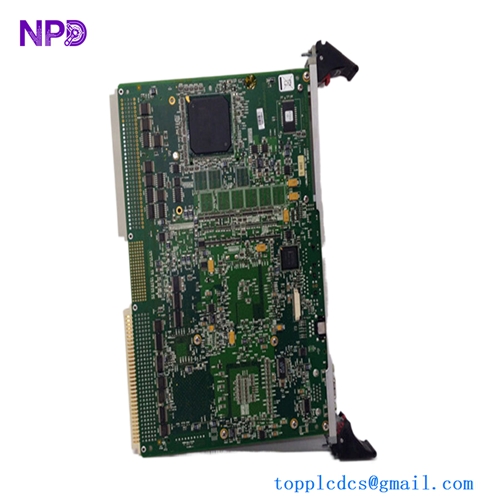
- Ruggedized Construction: The “RC” designation indicates a conformal coating and enhanced mechanical bracing, protecting the surface-mount components from moisture, corrosion, and high-G force environments.
- PMC Scalability: The board includes two PCI Mezzanine Card (PMC) slots. This allows users to add specialized I/O—such as MIL-STD-1553, ARINC 429, or additional graphics processing—directly onto the SBC without using extra VME slots.
- Advanced Thermal Management: The board uses a passive heat sink designed for conductive cooling or high-airflow environments, ensuring the Pentium M processor stays within safe operational limits even at peak computational loads.
- Legacy Compatibility: By utilizing the Universe II bridge, the board maintains seamless communication with older 16-bit and 32-bit VME modules while taking advantage of the increased bandwidth of VME64.
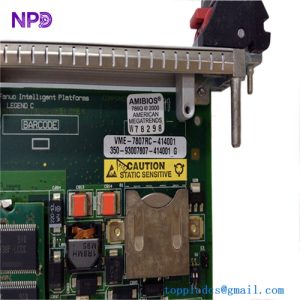
GE VME-7807RC-414001 350-93007807-414001 VMIVME-017807-411001 VMIVME-017807-414001
Product Usage Instructions
1. Configuration and Jumpers
Before insertion, review the jumper settings on the board. These jumpers determine the VME system controller status (enabled/disabled), the boot sequence (CompactFlash vs. Ethernet), and the serial port mode (RS-232 vs. RS-422).
2. Hardware Mounting
- Ensure the VME chassis is powered down.
- Slide the VME-7807RC into the designated slot (usually Slot 1 if it is the system controller).
- Secure the top and bottom injector/ejector handles.
- Tighten the mounting screws to ensure the board is electrically grounded to the chassis frame.
3. Software and OS Support
The board supports various Real-Time Operating Systems (RTOS) including:
- VxWorks (Driver support for GE/VMIC devices)
- Windows Embedded
- Linux (Industrial distributions)
- QNX
Drivers for the Gigabit Ethernet controllers and the VME bridge are typically included in the Board Support Package (BSP) provided by GE.
Common Problems Q&A
Q: What is the difference between VME-7807 and VME-7807RC? A: The “RC” version is ruggedized. While the standard 7807 is meant for office or lab-grade environments (0°C to 55°C), the RC version uses industrial-grade components and conformal coating to survive extended temperature ranges and high vibrations.
Q: Can I boot the OS from the CompactFlash card? A: Yes. The VME-7807RC views the CompactFlash socket as a primary IDE drive. You can install an OS on a Type II CompactFlash card and configure the BIOS to boot from it for diskless operation.
Q: The VME bus communication is failing. Why? A: Check if the board is set as the “System Controller.” In a VME system, exactly one board must be the system controller to provide the bus clock and arbiter functions. If two boards are set as controllers, or if none are, the bus will lock up.
Q: Does the board support ECC memory? A: Yes, the memory controller on the 7807RC supports Error Correcting Code (ECC) to detect and correct single-bit memory errors, which is critical for high-reliability mission applications.
Recommended Related GE Models
- GE VME-7750: An earlier Pentium-based SBC, often replaced by the 7807 during system upgrades.
- GE VME-7805: A variant of the 7807 series with different I/O and processor speed configurations.
- Abaco/GE VME-7807RC-410001: A configuration with lower RAM or different Ruggedization levels.
- GE VMIVME-5565: A high-speed Reflective Memory module often used in conjunction with 7807 SBCs for real-time data sharing.
- GE VMIVME-017807-114000: The standard (non-ruggedized) version for development environments.