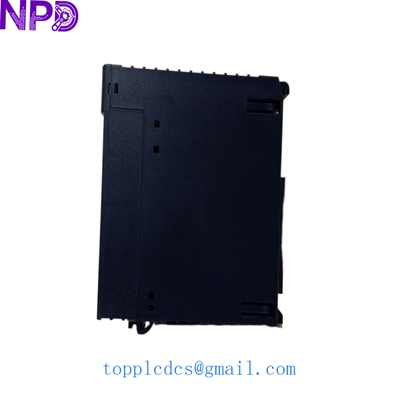

Description
- Model: IC695RMX128
- Brand: GE Fanuc / Emerson (PACSystems RX3i)
- Series: RX3i High Availability / Redundancy
- Core Function: Reflective Memory (RMX) Module for deterministic data synchronization
- Product Type: High-speed Fiber Optic Communication Module
- Key Specs: 128 MB Memory | 2.12 GBaud Link Speed | Single-mode/Multi-mode Fiber Support
- Memory Size: 128 MB of onboard SDRAM for mirrored data.
- Data Transfer Rate: 2.12 Gbaud (Fiber Optic).
- Latency: Extremely low, deterministic data transfer between controllers (typically < 1 microsecond per node).
- Fiber Port: Dual LC-type connectors (Transmit and Receive).
- Distance Support:
- Up to 300 meters with Multi-mode fiber.
- Up to 10 kilometers with Single-mode fiber.
- Network Topology: Supports Ring or Point-to-Point configurations.
- Bus Interface: RX3i PCI Bus (occupies one slot in the Universal Backplane).
- Node Capacity: Up to 256 nodes in a single reflective memory network.
- Diagnostics: Onboard LEDs for Link Status, Activity, and Module Health.
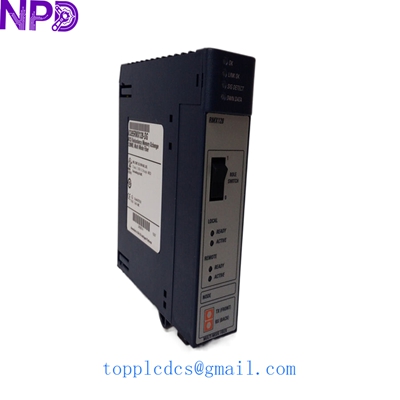
GE IC695RMX128
Installation & Configuration Guide
Stage 1: Pre-Installation
⚠️ Safety Checklist:
- Redundancy Pair: If you are setting up a Hot Standby Redundancy system, you generally need two identical IC695RMX128 modules (one for each rack).
- Fiber Integrity: Fiber optic cables are fragile. Ensure the bend radius is not less than 30mm to prevent signal attenuation.
- Backplane Compatibility: This module must be installed in a PCI-compatible slot of an IC695 Universal Backplane.
Required Tools:
- PAC Machine Edition (PME) Software (v5.80 or higher).
- LC-to-LC Fiber Optic Patch Cables.
- Fiber Optic Cleaning Kit.
Stage 2: Hardware Setup
Steps:
- Slot Selection: Insert the IC695RMX128 into the RX3i backplane. Ensure the module is firmly seated and the top/bottom clips click.
- Fiber Connections:
- Connect the TX (Transmit) port of Module A to the RX (Receive) port of Module B.
- For a redundant pair, connect the TX of Module B back to the RX of Module A to complete the loop.
- Power Up: Turn on the rack power. The “OK” LED should be solid green after the internal self-test.
Stage 3: Software Configuration (PME)
Steps:
- Hardware Configuration: In PME, right-click the slot and select “Add Module.” Choose the IC695RMX128.
- Memory Map: Define the memory offsets. This is critical—the data you want to mirror must be mapped to the RMX memory area.
- Redundancy Settings: If using the RX3i Redundancy CPU (e.g., IC695CRU320), select the RMX module as the “Redundancy Link” in the CPU settings.
Stage 4: Testing & Commissioning
Validation:
- Link LED: The “Link” LED on the front of the module must be solid green. If it is off or blinking, check your fiber connections and ensure the “TX” and “RX” are not swapped.
- Data Sync: Force a variable in the Primary Rack and verify that the value changes in the Secondary Rack within the same scan cycle.
- Failover Test: Perform a controlled switchover. The backup controller should take control seamlessly without any loss of I/O state.
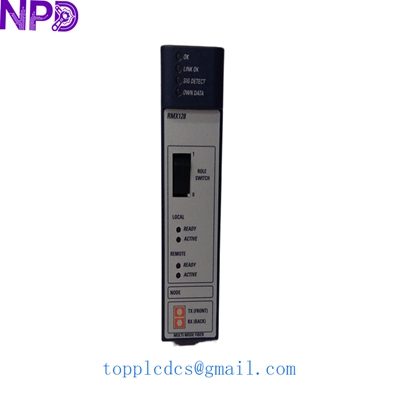
GE IC695RMX128
Customer Cases & Industry Applications
Case 1: High-Speed Turbine Control Redundancy
Situation: A power plant was upgrading its gas turbine control system. Because of the high speeds involved, they required a sub-millisecond data sync between the primary and secondary controllers.
Task: Implement a deterministic redundancy link that does not rely on standard Ethernet, which can have unpredictable “jitter.”
Action: We supplied a pair of IC695RMX128 modules. These were used to link two RX3i racks via single-mode fiber.
Result: The reflective memory architecture allowed for the synchronization of over 10MB of data per scan with virtually zero CPU overhead. The plant successfully passed its “Black Start” testing with a seamless failover.
Case 2: Water Treatment Facility Long-Distance Link
Situation: A water treatment plant had two control rooms separated by 2 kilometers. They needed to share critical process data in real-time for coordinated pumping.
Task: Find a solution that could handle the distance without the latency of a standard radio or cellular link.
Action: Using the IC695RMX128 with single-mode fiber, we provided a 10km-capable link.
Result: The reflective memory treated the two distant racks as if they were sitting next to each other. The operator in Control Room B could see “instant” updates from Control Room A, allowing for precise valve timing.
Frequently Asked Questions (FAQ)
Q: Can I use standard Ethernet cables with this module? A: No. The IC695RMX128 uses dedicated high-speed fiber optic ports (LC-type). It does not support RJ45 or standard Ethernet protocols. It is a specialized reflective memory bus.
Q: What is the difference between RMX128 and RMX228? A: The main difference is the memory size and sometimes the fiber type support. The RMX128 provides 128 MB of mirrored memory, which is usually more than enough for even the most complex RX3i redundancy projects.
Q: Do I need to write code to “send” the data? A: No. That is the beauty of Reflective Memory. Once configured in the hardware settings, any data written to the specified memory offset is automatically mirrored to all other nodes on the link by the hardware itself.
Q: Is “New Surplus” reliable for redundancy applications? A: Yes. Our New Surplus modules are original GE/Emerson parts that have never been used. In critical redundancy systems, you want components that haven’t been subjected to heat and electrical stress. These units provide the highest level of reliability for high-availability systems.
Featured Inventory List (Current Stock)
- GE IC695CPU320 RX3i CPU
- GE IC695CRU320 Redundancy CPU
- ABB PM866 Controller
- Bently Nevada 3500/22M
- TRICONEX 3503E
- Honeywell CC-PAIH01
- Siemens 6ES7 417-4XT07-0AB0
- Allen-Bradley 1756-L75
For more details on these parts, visit our catalog at newplcdcs.