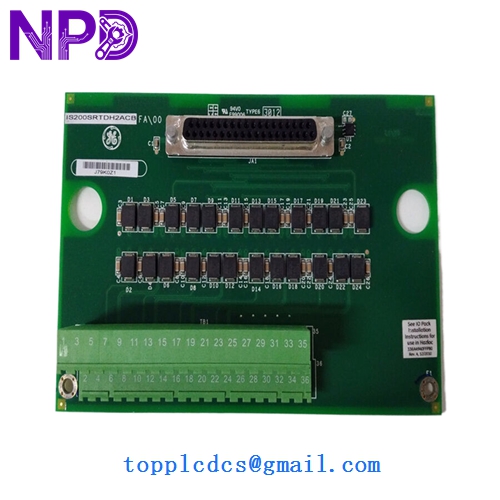

Description
- Model: GE IS200SRTDH2ACB
- Brand: General Electric (GE)
- Series: Mark VI Speedtronic Control System
- Core Function: RTD (Resistance Temperature Detector) termination and signal conditioning
- Product Type: Simplex RTD Terminal Board (SRTD)
- Key Specs: 12 RTD Inputs Supports 10Ω Copper/100Ω Platinum Barrier Terminal Blocks
- Input Capacity: 12 individual RTD channels
- RTD Types Supported: 100 Ω Platinum (DIN), 100 Ω Platinum (American), 10 Ω Copper, 120 Ω Nickel
- Wiring Configuration: Supports 3-wire RTD connections (to compensate for lead-wire resistance)
- Excitation: Provided by the VTCC/VRTD processor cards (typically 2.5 mA or 10 mA)
- Connectors: Two 37-pin D-type cable connectors (JR1 and JS1)
- Protective Features: High-frequency noise filtering and surge suppression on every channel
- Ambient Temperature: Rated for -30 to +65 °C (-22 to +149 °F)
- Board Code: H2A (Indicates specific hardware revision and grouping)
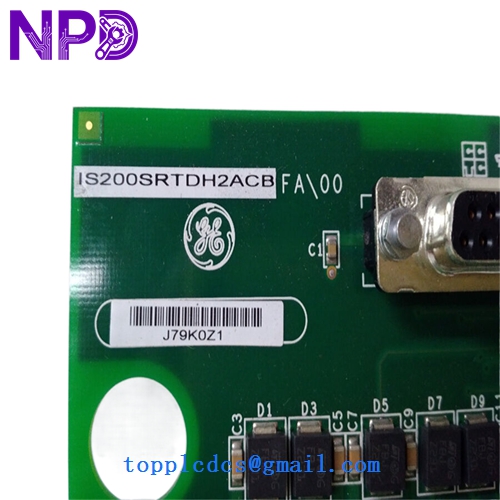
GE IS200SRTDH2ACB
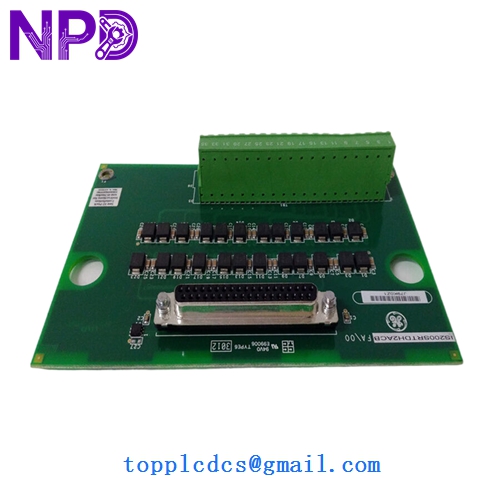
GE IS200SRTDH2ACB
GE IS200SRTDH2ACB
Application Scenarios & Pain Points
In the GE Mark VI ecosystem, the IS200SRTDH2ACB is the physical landing point for temperature sensors across the turbine skid. It gathers data from bearings, exhaust gas paths, and lubrication systems. Unlike the TMR (Triple Modular Redundant) versions, the “Simplex” SRTD is used in applications where high-density, cost-effective temperature monitoring is needed without the footprint of a triple-redundant core. The biggest pain point I see with these boards is grounding errors—if a sensor shield is landed incorrectly, it can introduce noise that makes the turbine “think” a bearing is melting when it’s actually running cool.
Typical Application Scenarios:
- Bearing Temperature Monitoring Monitoring the critical “metal temps” of turbine and generator bearings to prevent catastrophic mechanical failure.
- Lube Oil System Control Ensuring the oil temperature is within the safe viscosity range before a high-speed start.
- Transformer Winding Protection Monitoring the internal heat of step-up transformers in the plant yard.
- Generator Stator Cooling Tracking the temperature of stator windings to manage load limits and prevent insulation breakdown.
Case Study: The “Jittery” Bearing Alarm
Background: A gas turbine site in Southeast Asia was getting intermittent “High Vibration/High Temp” alarms on the #2 Bearing. The temperature would jump from 80°C to 110°C in a split second, which is physically impossible.
Problem: We inspected the IS200SRTDH2ACB board and found that the 37-pin JR1 connector was slightly loose. The vibration from the nearby turbine was causing micro-breaks in the connection, resulting in huge resistance spikes that the Mark VI interpreted as extreme heat.
Solution: We replaced the board with a fresh IS200SRTDH2ACB from stock and used threaded standoffs to ensure the cables were mechanically locked in place.
Result: – Stability: The temperature readings returned to a flat-line 82°C.
- Reliability: The site avoided a forced outage that would have been triggered by the “High-High” trip logic.
- Engineer’s Insight: “With RTDs, resistance is everything. A single loose screw or a dirty pin on the SRTD board can look like a 30-degree temperature swing to the DCS.”
Compatible Replacement Models
The SRTD board has several “H” (Hardware) versions. The H2 revision is specific to certain input scales and connector layouts.
| Original Model | Replacement Model | Compatibility | Note |
|---|---|---|---|
| IS200SRTDH2ACB | IS200SRTDH2ACB | ✅ Exact Match | The standard “H2” revision. |
| IS200SRTDH1A | IS200SRTDH2ACB | ⚠️ Software | H1 is the older version; check I/O Configuration in Toolbox. |
| IS200SRTDH2ACB | IS200TRTDH1D | ❌ Incompatible | TRTD is a TMR (Triple) board; different footprint/wiring. |
Troubleshooting Quick Reference
| Symptom | Possible Cause | Relation | Quick Check | Action |
|---|---|---|---|---|
| Channel reads -50°C | Open Circuit | ✅ High | Check for a loose wire or broken RTD lead. | Tighten terminal screws; check RTD continuity. |
| Channel reads +250°C | Short Circuit | ✅ High | Check for a bridge between the “A” and “B” leads. | Clear the short; check terminal block for debris. |
| All channels drifting | Excitation Fault | ⚠️ Med | Measure the DC voltage across the RTD terminals. | Check the ribbon cable to the VRTD card. |
| Erratic “Noise” on signal | Grounding/Shielding | ✅ High | Ensure the shield is only landed at the SRTD board. | Lift one end of the shield if double-grounded. |
❗ Pro Tip: 3-Wire Compensation
The IS200SRTDH2ACB uses a 3-wire system to cancel out the resistance of the long field cables. If you only have a 2-wire RTD, you must jumper the “B” and “C” (or “Return” and “Sense”) terminals on the board. If you don’t, the board will report a massive temperature offset because it thinks the lead wire has infinite resistance.
Wiring & Maintenance:
These boards are exposed to the environment more than the CPU cards.
- No “Hot-Wiring”: Always disable the I/O point in the Mark VI software before disconnecting an RTD.
- Torque Matters: Over-tightening the screw terminals can crush the fine copper strands of the RTD wire, leading to high-resistance “hot spots.”
- Dust is a Conductor: In desert or coastal environments, keep the cabinet doors closed. Fine dust on the SRTD board can create high-resistance leakage paths between channels.