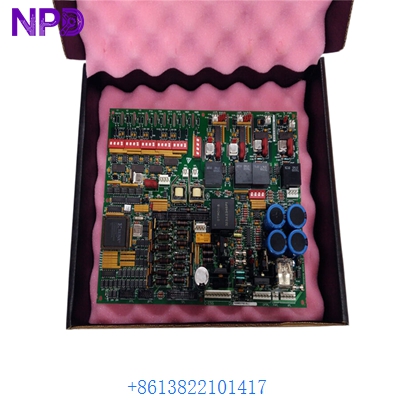

Description
GE IS200TTURH1CFD (often cataloged or bundled with the paired IS230TNTRH1C I/O pack assembly) is a specialized Terminal Turbine Board (TTUR) engineered specifically for the General Electric Mark VI and Mark VIe gas and steam turbine control systems. Designed to serve as a primary protection and turbine input junction, this board manages critical overspeed trip logic, speed sensing, potential transformer voltage monitoring, and main breaker control (such as the 52G breaker).
Product Specifications (Datasheet)
- Brand: GE (General Electric / GE Fanuc)
- Model / Part Number: IS200TTURH1CFD (Terminal Board) / IS230TNTRH1C (Associated I/O Pack Assembly)
- Series: Mark VI / Mark VIe Speedtronic Turbine Control
- Product Name: Primary Turbine Protection Input Terminal Board (TTUR)
- Place of Origin: United States
- Lifecycle Status: Active / Specialized Industrial Supply
- Dimensions: Approx. 12 in \times 9 in (305 mm \times 229 mm)
- Weight: Approx. 4.0 lbs (1.8 kg)
- Country of Origin: USA
- Key Inputs: Supports up to 12 passive pulse rate devices for turbine speed sensing (toothed wheel pickup), alongside generator and bus potential transformer (PT) voltage inputs.
- Key Relays: Equipped with critical control relays including K25, K25P, and K25A for synchronization and breaker management.
Operating Guidelines and Usage Methods
Proper integration and handling of turbine protection terminal boards require strict adherence to instrumentation wiring and electrical safety protocols.
- ESD Precautions: Always utilize a certified grounded electrostatic discharge (ESD) wrist strap when handling associated electronic I/O packs (such as the TNTR pack) to protect sensitive internal logic circuits from static damage.
- Terminal Wiring: Ensure all incoming field speed pickup cables, PT voltage feeds, and trip command lines are securely terminated to the proper screw blocks, observing strict shielding and grounding practices.
- Environmental Control: Operate the host turbine control cabinet within a clean, climate-controlled environment protected from excessive humidity, conductive dust accumulation, and severe temperature fluctuations (-30°C to +65°C operating range).
Power-On and Power-Off Sequence
Adhering to correct energization protocols prevents signal transients and protects high-reliability protection loops within the Mark VI/VIe architecture.
- Power-On Sequence:
- Confirm that all field sensor wiring, power feeds, and backplane interface cables are correctly and securely terminated to the IS200TTURH1CFD board.
- Plug the compatible IS230TNTRH1C I/O pack firmly into the board connectors and engage all mechanical locking latches.
- Switch on the primary cabinet power distribution feeds and check operator workstation software to confirm normal module communication, trip circuit health, and speed input status.
- Power-Off Sequence:
- Safely take the turbine protection loops offline or ensure the unit is in a non-running state via the operator workstation software.
- Power down the system rack distribution feeds if complete electrical isolation is required prior to maintenance.
- Allow internal circuits to fully de-energize before unseating the plug-in I/O pack from the terminal board.
Product Instructions
The TTUR board functions as the permanent mechanical termination point for primary turbine protection and speed-matching signals, feeding data directly to the paired I/O pack. It supports both Simplex and Triple Modular Redundant (TMR) architectures. Periodically inspect terminal screw torques, shield grounding bars, and relay states during scheduled maintenance outages to prevent false trips or synchronization errors.
Frequently Asked Questions (Q&A)
- Q: What system utilizes the IS200TTURH1CFD / IS230TNTRH1C assembly?
- A: It is deployed within the GE Mark VI and Mark VIe Speedtronic turbine control architecture for primary protection and speed sensing.
- Q: What is the purpose of the associated IS230TNTRH1C module?
- A: It acts as the intelligent electronic I/O pack that plugs directly onto the IS200TTURH1CFD terminal board to process the collected analog and pulse signals.
- Q: What should I check first if a speed input or trip channel fails?
- A: Verify field wiring and terminal tightness on the terminal board, inspect speed probe gaps against toothed wheels, and ensure the plugged I/O pack is securely seated.
Recommended Alternative Series and Models
- GE Mark VIe IS220PTCCH1A
- GE Mark VIe IS420UCSBH4A
- GE Mark VI IS200VAICH1A
- GE Mark VI IS200TVIBH2B
- GE Mark VI IS200TBCIH1B
- GE Mark V DS200TCQAG1AFC
- GE EX2100 IS200EPSMG1A
- GE Fanuc IC695CPU310
- GE Multilin 469
- GE Multilin 850